

Earned Wage Access State Rules 2026: The Borrower's Map
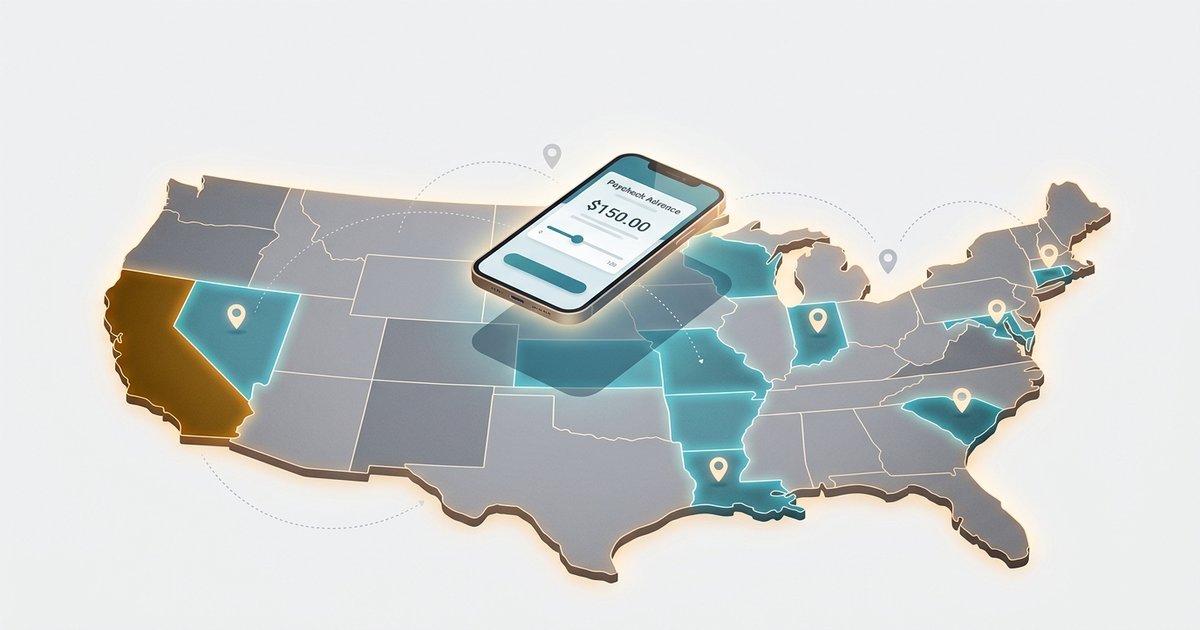
Earned wage access is regulated state by state, and the map looks nothing like it did a year ago. At least 12 states had enacted EWA-specific laws by late 2025. California treats the product as a loan under the California Financing Law. Nevada, Missouri, Wisconsin, Kansas, South Carolina, Arkansas, Indiana, Maryland, Connecticut, and Louisiana run on a registration framework. Your fee disclosures, the tip prompts you see in the app, and the legal protections you actually have depend on which state you live in and whether your provider is registered there. State law usually controls, regardless of whichever federal advisory opinion is currently on the books.
A warehouse worker in Sacramento opens EarnIn on payday week and notices the app behaves differently than it did when he lived in Phoenix. The tip prompt is gone. The "express" fee disclosure is more prominent. The maximum advance is calculated differently. He did not change his hours. He did not change his employer. He moved across a state line.
That is not a bug. As of February 2025, the California Department of Financial Protection and Innovation treats earned wage access as a loan under finalized regulations and requires providers to register with the state. The same product, in the same app, on the same paycheck, has a different legal status in California than it does in Texas. And depending on which state you wake up in, your protections, your fee disclosures, and even whether the company can keep doing business with you can shift overnight.
Here is how the 2026 EWA map actually works, what registration means for you as a borrower, and when an EWA advance is the right tool versus when a small installment loan in the $500 to $5,000 range is the better call.
The 30-Second Answer
Earned wage access is regulated state by state. Twelve states had enacted EWA-specific laws by late 2025, with more on the way. Your protections (and the cost structure you see in the app) depend on which state you live in and whether your provider is registered there. The federal position changed three times in the last 12 months. State law usually controls regardless.
How EWA Actually Works
Two basic models, both built around the idea that wages you have already earned should be available before the scheduled pay date.
Employer-integrated EWA. Your employer signs a contract with a provider (DailyPay, Payactiv, ZayZoon, others). The provider sees your hours through payroll integration, calculates your earned but unpaid balance, and lets you draw against it. Recoupment happens through payroll deduction on payday. The model the CFPB calls "covered EWA" sits here. See our piece on help your employer might already offer.
Direct-to-consumer EWA. You sign up directly with an app (EarnIn, Brigit, MoneyLion Instacash, Dave). The app estimates your earnings based on bank account data, GPS-based timesheets, or employer logins, and advances you a portion. Recoupment usually happens via debit from your linked checking account on payday. The legal classification gets messier here, and California's loan treatment specifically targets this model.
Most providers offer a free option (slower delivery) and a paid option (instant or same-day). The paid option typically charges an "express fee" of a few dollars per advance. Tips are technically voluntary in most state frameworks, although several states are actively examining whether app-prompted tips function as disguised finance charges. Our cash advance vs. overdraft math walks through how those fees compare to bank charges.
The Nevada Model vs. the California Model
Two regulatory templates have emerged, and they go in very different directions.
The Nevada Model: EWA Is Not a Loan, But Providers Must Register
Nevada AB 254, passed in 2023, was the first state EWA-specific law. It treats EWA as a distinct product, not a consumer loan, but requires providers to register with the state's Financial Institutions Division and follow specific consumer protection rules: at least one no-cost option, cap on overdraft-related fees, no debt collection of unpaid advances using traditional collection methods, and disclosure of fees.
Missouri, Wisconsin, Kansas, South Carolina, and Arkansas have followed the Nevada template with variations. Kansas signed its law in April 2024, effective July 1, 2024, with annual registration through the Office of the State Bank Commissioner. Indiana, Maryland, Connecticut, and Louisiana joined the registration-based approach in 2025 (citing McGuireWoods and Faegre Drinker legal alerts).
What this means for you as a borrower in a Nevada-model state: the company should not be charging you a mandatory fee with no free alternative, should be telling you up front what the express fee costs, and cannot legally pursue you through a debt collector if a payday repayment fails. If your provider does not appear in the state's registered-provider list, that is a problem.
The California Model: EWA Is a Loan
The California DFPI took the opposite road. In October 2024, the DFPI finalized regulations treating earned wage access products as loans subject to the California Financing Law. Providers had to register and become licensed under that framework by early 2025. The DFPI's position is that "tips" and "express fees" can constitute finance charges and that the product as commonly offered functions as credit.
For a California borrower, the practical effects include APR-style disclosures, state-law remedies if the provider violates the rules, and the application of California's broader consumer lending protections (Rosenthal Fair Debt Collection Practices Act on collection, for example).
This is not a hypothetical fight. Major direct-to-consumer EWA providers reshaped their California products in response. EarnIn's California experience is now structurally different from its Texas experience, by design.
Quick State Reference
This is a high-level snapshot. Verify the current statute and the provider's registration status with the state regulator before relying on any of this.
- Nevada: Registration-based EWA law. Financial Institutions Division.
- Missouri, Wisconsin, Kansas, South Carolina, Arkansas: Nevada-style registration laws.
- Indiana, Maryland, Connecticut, Louisiana: Enacted EWA-specific frameworks in 2025.
- California: Loan treatment under DFPI regulations. Providers must hold a California Financing Law license.
- New York, New Jersey, Massachusetts: No EWA-specific statute. Existing lender licensing laws may still apply. Do not assume a state without an EWA-specific law is "unregulated." See our payday-ban state guide for how these states police small-dollar credit.
- Texas, Florida, and other no-specific-law states: Federal advisory opinion treatment may apply, but state UDAP and consumer protection laws still cover deceptive disclosures and collection practices.
Twelve states with EWA-specific laws sounds like a lot. It is, by financial regulation standards, fast movement. It is still less than a quarter of the country.
The CFPB's 2024-2026 Whiplash
Three positions in a little over a year. Here is the order of events, because some news coverage has run them together.
In 2020, the CFPB issued an advisory opinion taking the view that certain employer-integrated EWA programs were not credit under the Truth in Lending Act.
In January 2025, the CFPB rescinded that 2020 opinion under the prior administration's interpretation, signaling that EWA products might be subject to TILA and Regulation Z.
In May 2025, the CFPB withdrew that rescission.
On December 23, 2025, the CFPB issued a new advisory opinion (published in the Federal Register, 90 FR) stating that "covered EWA" services are not credit under TILA. The opinion defines "covered EWA" narrowly: the advance amount cannot exceed already-earned wages, recoupment must happen through payroll deduction, the provider must disclaim any legal or contractual claim against the consumer if payroll deduction is insufficient, and the provider does not assess individual credit risk.
What this means in plain terms: if your provider does not match every element of "covered EWA" (and most direct-to-consumer apps do not, because they collect via debit not payroll deduction), the federal advisory opinion may not even apply to your situation. State law fills the gap.
And federal advisory opinions are not statutes. A different CFPB leadership can issue a different opinion next year. Plan around the state framework you live in, not around a federal posture that has now shifted three times.
How to Verify Your Provider Is Registered
Every state with an EWA law publishes a registered-provider or licensee list. A few places to start:
- California: DFPI license search at dfpi.ca.gov.
- Nevada: Financial Institutions Division licensee list at fid.nv.gov.
- Kansas: Office of the State Bank Commissioner at osbckansas.org.
- Missouri: Division of Finance licensee search at finance.mo.gov.
- Maryland: Office of the Commissioner of Financial Regulation.
If your provider is not on the list and your state requires registration, that is information. Either the provider is operating in a gray area, or it is not legally authorized in your state. Either way, you would want to know before relying on the service for next month's rent.
Tips and Express Fees: Are They the Same as Interest?
Federally, the December 2025 CFPB opinion says no. State-by-state, the answer is more nuanced. California's DFPI has explicitly treated tips and express fees as components of the cost of credit. Several state attorneys general are examining tip-prompting UI as a potentially deceptive practice.
The practical math matters more than the legal label. A $3.50 express fee on a $100 advance, repaid in 7 days, works out to an effective APR north of 180 percent if you treat the fee as a finance charge. Two of those per pay period is more expensive than a state-capped installment loan on an annualized basis. The fee feels small in isolation because it is small in absolute dollars. It is not small as a rate. See how to translate APR into actual dollars.
When EWA Is the Right Tool
EWA is well suited to a specific situation: you need a small amount of cash ($50 to $300), you can wait the no-cost delivery window (one to three business days), you are confident the advance will be repaid on the next paycheck without throwing off the rest of your budget, and your provider is registered in your state.
EWA is the wrong tool when:
- You are using it every pay period (you have a recurring shortfall, not a one-time gap).
- The amount you need is closer to $500 than $200.
- You are stacking advances from multiple apps in the same cycle.
- You are paying the express fee every time, which means you are accepting an annualized cost rivaling a state-regulated installment loan.
If any of those apply, a fixed-term installment loan in the $500 to $5,000 range from a state-licensed lender, with a known APR and a real amortization schedule, is usually the more honest tool. Quick5k connects borrowers with state-licensed lending partners in that range. We are not an EWA provider and we do not offer paycheck advances. We are a lending-partner network.
What to Do Right Now
If you are already using an EWA app, check whether your provider is registered in your state. Read the most recent fee disclosure (it has probably changed in the last year). Look at how many advances you took in the last three months and what you paid in tips and express fees. If the annualized cost is higher than a state-capped installment loan would be, your tool and your situation are mismatched.
If you are considering EWA for the first time, ask the same questions before you sign up. The product is genuinely useful for the right situation. It is also more regulated, more expensive, and more variable across state lines than the marketing implies.
Frequently Asked Questions
It depends on which state you live in and which federal opinion is currently in effect. California's DFPI treats EWA as a loan under state regulations finalized in October 2024. The CFPB's December 2025 advisory opinion says "covered EWA" is not credit under TILA, but the definition is narrow and many direct-to-consumer apps do not meet it. State law usually controls.
As of late 2025, at least 12 states had enacted EWA-specific laws, including Nevada, Missouri, Wisconsin, Kansas, South Carolina, Arkansas, Indiana, Maryland, Connecticut, and Louisiana with registration-based frameworks, and California with a loan-licensing framework. Confirm the current statute with your state regulator before assuming a state is or is not regulated.
California's DFPI finalized regulations in October 2024 treating EWA as a loan subject to the California Financing Law. Providers operating in California had to register and modified their products to comply. Tip prompts, express fee structures, and disclosure formats often differ in California for that reason.
The federal answer (under the December 2025 CFPB advisory opinion) is no for "covered EWA." California's DFPI has treated them as part of the cost of credit. Functionally, repeated express fees on small advances can produce an annualized cost in triple-digit APR territory, which is the math that matters even when the legal label says otherwise.
If your state requires registration and your provider is not on the registered-provider list, the provider may be operating in violation of state law. Contact your state regulator to confirm. You can also file a complaint with the CFPB and your state attorney general.
When the amount you need is closer to $500 or $1,000 than $200, when you are using EWA every pay period, when you are paying express fees on every advance, or when you need a fixed repayment schedule longer than a single pay cycle. A state-licensed installment loan in the $500 to $5,000 range has a disclosed APR, a known amortization, and the protections of your state's consumer lending statute.