


A $1,000 Loan, No Credit Check: Your Real Approval Odds
You need a $1,000 loan, no credit check if you can swing it, and you need it before Friday. Your score sits at 550 or worse. A bank already turned you down, and now every ad in your feed promises "guaranteed approval" like it's nothing. Here's what actually happens when you apply, and the order to try things in so you don't pay the highest price first.
Forget the shopping-comparison approach most sites push, where every lender gets ranked side by side like they're equally good options for you. They're not. Some products on this list cost you almost nothing beyond a small fee. Others cost triple digits in APR. The order below runs from cheapest and easiest to approve, given your situation, down to the last resort you reach for only when nothing else worked. Try them in this order and you'll spend less to get the same $500 to $2,000 in your account.
The Approval-Odds Ladder, and Why Order Matters
Every rung on this ladder gets you closer to cash. What changes is the cost and the underwriting. Rung 1 barely looks at your FICO score at all. Rung 4 exists because you have limited options, and someone is willing to price that risk into a payment you'll feel every single month. Skipping straight to rung 4 because an ad said "instant approval" is how a manageable emergency turns into a year or more of expensive payments you didn't have to take on. Work the ladder from the top down.
- Rung 1: Federal credit union small-dollar loans (PALs I and PALs II)
- Rung 2: Income-based approval through cash-flow underwriting
- Rung 3: Secured and credit-builder loans
- Rung 4: Higher-cost online installment lenders and storefront options
Layered through all four is a fifth idea, one I watched trip people up constantly: what "no credit check" and "guaranteed approval" actually mean when a lender prints them on a landing page.
Rung 1: Credit Union PALs I and PALs II
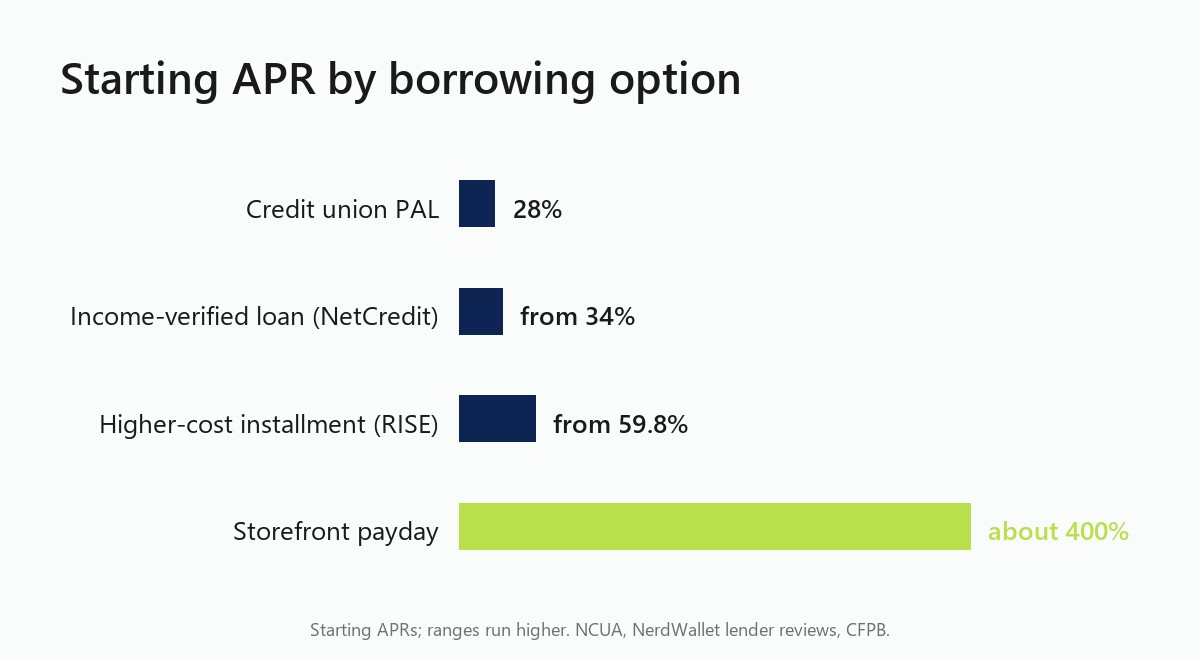
Federal credit unions can offer two standardized small-dollar loans under a specific NCUA rule, 12 CFR 701.21. PALs I run $200 to $1,000 over one to six months, capped at 28% APR with a $20 application fee ceiling, and require you to have been a member for at least a month. PALs II go up to $2,000 over as long as twelve months, same rate cap, and skip the waiting period entirely: a credit union can make you one the same day you join. Quick5k has a full walkthrough on how to find and apply for a credit union Payday Alternative Loans program, so I won't re-report the mechanics here. What matters for your odds is this.
There's no minimum credit score written into the rule. Each credit union sets its own bar, and most weigh proof of employment, like recent pay stubs, over a score cutoff. Credit union membership decides this more than your credit score does: you need to belong to that credit union's field of membership through your employer, where you live, or a family connection, and you'll likely open a small share account to join. If a bank already turned you down and you're looking at credit unions for a bad-credit personal loan, this is the rung built for exactly that.
Rung 2: Cash-Flow Underwriting Proves Your Income
Once you're outside PAL territory, either because you're not eligible for credit union membership or you need funding faster than joining allows, the next best odds come from lenders who underwrite on cash flow, not FICO. This is where a lot of "get $500 loan instant" offers actually live. The lender links to your bank account through a data aggregator, pulls months of real transaction history, and looks at balance patterns, deposit regularity, and how often you overdraft. That's why some of these approvals feel faster than a traditional loan application: the underwriting engine reads your actual cash flow directly, without waiting on a bureau pull.
The NCUA calls this "alternative data," meaning information not typically found on a traditional credit report, and the idea is to expand access for people currently locked out of the mainstream credit system. That population is bigger than most people assume: the CFPB estimates millions of Americans carry no credit file at all with the nationwide bureaus, and millions more have files too thin or stale to produce a usable score. If that's you, income and cash flow are doing the work your score can't.
You have real control here before you apply. Stick with one active checking account for two to three months. Don't scatter deposits across several thin ones. Skip overdrafts in the weeks leading up to your application; an underwriting model reads that as instability. If you're self-employed or working gig income, pull together two to three months of bank statements or 1099s to document what you actually earn. NetCredit, one of the lenders profiled below, requires $18,000 in minimum annual income, according to NerdWallet's review of the lender.
Rung 3: Secured Loans and a Word on Cosigners
If your credit union offers a share-secured loan, sometimes called a savings-secured loan, your approval odds jump close to automatic. You're borrowing against your own savings balance, so the credit union already holds the collateral before you sign anything. That doesn't mean the cash lands in your account all at once, though: like a credit-builder loan, a share-secured loan typically releases funds as you repay principal, not as a single lump sum up front. Rates run well below unsecured bad-credit pricing because there's almost no risk on their end.
Credit-builder loans work the same way structurally. The lender holds the loan proceeds in a locked account and releases them only as you make payments, so you build a payment history and a savings cushion at the same time. A 2020 CFPB study of roughly 1,500 credit union members found real credit-score gains for members with no prior loan history, along with modest increases in savings balances. That's worth knowing, but neither a share-secured loan nor a credit-builder loan hands you $1,000 in cash today the way a straight PAL or personal loan does. Think of both as a plan for next time, not a fix for this Friday.
One more lever belongs here, briefly: adding a cosigner with stronger credit can push you over the approval line on rungs 1 and 2 and shave real points off your rate. Just know your cosigner is legally on the hook for the full balance if you miss a payment, and a late payment can hurt their credit report right along with yours.
Rung 4: Higher-Cost Last Resorts
If you've worked through rungs 1 through 3 and you're still short, or the timeline genuinely doesn't allow for credit union membership or bank-statement gathering, online bad-credit installment lenders are the next real option. Two lenders publish their actual rate spreads. They skip the marketing-minimum trick and show the real range you're looking at.
RISE Credit runs APRs of 59.80% to 299.00% on loans from $500 to $5,000, with a soft credit check for eligibility that doesn't touch your score and no stated minimum score requirement. NetCredit runs 34.00% to 99.99% APR on $1,000 to $10,000, also with no minimum credit score, but it requires that $18,000 minimum annual income, and it runs a soft check to pre-qualify followed by a hard credit check at formal application, according to NerdWallet's reviews of both lenders.
That hard pull on formal application is worth sitting with for a second. A lot of "1000 loan bad credit, no credit check" marketing quietly assumes you won't notice the check that shows up later in the process.
Use the CFPB's own 36% APR line as your mental yardstick. Their 2017 rule on payday, vehicle-title, and high-cost installment loans draws that number as the point where a longer-term loan becomes a "covered" high-cost product subject to extra protections around automatic payment withdrawals. It is not a national rate cap, and it does not make loans above 36% illegal everywhere, but it tells you when you've crossed from "expensive" into "the category regulators built extra rules around." Both lenders above sit above that line across most of their range.
For comparison, a classic two-week storefront payday loan runs roughly 400% APR under the standard $15-per-$100 fee structure, according to the CFPB's own APR explainer. A 299% APR installment loan, while genuinely expensive, usually beats payday-style borrowing on raw cost. That still makes it the lesser evil, nothing more. Quick5k has a full breakdown of what those APR numbers translate to in actual dollars owed, which lands harder than the percentage alone, worth reading before you sign anything at this rung.
Title loans belong on the avoid list here too. Quick5k has a dedicated piece on why we steer readers away from a title loan and what to try instead, so I'll leave the argument there rather than repeat it.
State usury and small-loan licensing laws vary widely across the country, so what's legal and typical in one state may be capped or banned in another. Check your own state's rules before you sign at rung 4.
What "No Credit Check" and "Guaranteed Approval" Actually Mean
Here's the plain truth behind the marketing. "No credit check" almost never means zero underwriting. It usually means no hard pull against the three nationwide bureaus, Equifax, Experian, and TransUnion, the kind that shows up on your credit report and can ding your score. It does not mean the lender approves you blind.
Something else gets checked instead. Bank-account and cash-flow data, often pulled through a linked account at the moment you apply, shows your balance history and overdraft frequency.
The CFPB's own consumer guidance describes specialty consumer reporting companies that collect banking history, rental and eviction records, insurance claims, and employment data, separate from your FICO-based credit report. It's a real check with real consequences if something negative shows up in it, even though your credit score never moves. Quick5k has a deeper piece on this second, alternative credit file most no-credit-check lenders can see, so read that if you want the full rundown; here, just know it exists and it matters.
Income and employment verification round it out. The $18,000 minimum annual income NetCredit requires, according to NerdWallet's review of the lender, is a clean, real example: a lender that markets to a bad-credit audience but still sets an income floor and, further into the application, runs a hard credit pull anyway.
So when you see "1000 loan no credit check" in an ad, read it as "no FICO-score credit check," not "no check at all." Somebody is still deciding whether you can pay this back. They're just looking at different paperwork to figure it out.
One more honest note: alternative data isn't risk-free for you either. Credit unions and lenders that rely on it carry a compliance obligation of their own, and the NCUA expects them to test these models for fair-lending issues.
Separately, the CFPB has flagged that alternative data can act as a proxy for race, ethnicity, or neighborhood, even when it never asks about any of those things directly. It's a real tool, and it's expanded access for millions of people who couldn't get approved any other way. Fair and available aren't automatically the same thing.
How to Pick the Right Rung for Your Situation
If you have even a few days before you need the money, start at rung 1. Call or check online whether a credit union in your area covers your employer, your county, or an association you already belong to, and ask directly about PALs I or PALs II. If credit union membership isn't realistic on your timeline, move to rung 2 and spend those few days getting your bank statements clean: no overdrafts, steady deposits, and one account carrying activity for a couple of months.
Already have a savings cushion sitting at a credit union? Rung 3's secured option is close to a guaranteed yes, though both a share-secured loan and a credit-builder loan release funds as you repay, not as a lump sum on day one. Reach rung 4 only when the first three genuinely don't fit your timeline or your eligibility, and when you get there, read the actual APR range before you sign, not just the marketing headline. And whichever rung gets you through this month, put something toward not needing this ladder next time. Quick5k's guide to saving your first $1,000 while living paycheck to paycheck is the piece to read once this immediate need is handled, so the next surprise bill doesn't send you right back to square one.
Frequently Asked Questions
You can get a loan without a hard pull against your FICO-based credit report, but almost no legitimate lender skips underwriting entirely. Expect a bank-account or cash-flow review, a specialty-bureau check, or income verification in place of a traditional score check.
There's no official minimum score written into the NCUA rule. Each credit union sets its own criteria, and PALs I underwriting commonly asks for recent pay stubs or other proof of employment ahead of any specific score cutoff. Membership matters as much as anything on your credit report, so don't rule yourself out before asking.
Funding speed isn't standardized by federal rule, and it varies by credit union, so there's no single timeframe to promise here. What is fixed: membership has to be in place first. PALs I requires one month of membership before approval; PALs II has no minimum, so a new member can qualify the same day they join.
Not quite. Both a share-secured loan and a credit-builder loan typically release funds as you repay principal, not as a lump sum on day one, even though a share-secured loan is close to automatic approval since your own savings back it. For cash in hand today, a straight PAL or personal loan fits better.
PALs I cap at $1,000 over one to six months and require one month of membership first. PALs II go up to $2,000 over as long as twelve months with no minimum membership period, so a new member can qualify the same day they join.
They're legal and licensed, but legal doesn't mean cheap. Real published rates run from roughly 34% to nearly 300% APR depending on the lender, and most of that range sits above the CFPB's 36% high-cost yardstick, so treat them as a last resort you reach for only after the cheaper rungs are off the table.