


Military Personal Loans: Where to Actually Go Before You Borrow
A guard soldier's rent is due Friday. Drill pay hasn't cleared, a car repair ate the difference, and a loan office sitting just outside the base gate is advertising "guaranteed approval" in letters big enough to read from the road. That combination, a guaranteed paycheck and a lender parked right where that paycheck walks by, is not an accident, and it's exactly why searches for military personal loans lead so many servicemembers to the wrong door first.
Investigative reporting from ProPublica documented storefront lenders clustering outside base gates specifically because servicemembers have steady, predictable income. Before you sign anything from one of those storefronts, you should know that military personal loans come in a much better version, and in some cases you may not need a loan at all. That's true whether you're active duty, a guard or reserve member on qualifying orders, or a veteran with older debt already covered by a federal protection you might not know you have.
Start With the Relief Societies
The four service relief societies exist for one-time financial emergencies: rent shortfalls, utility shutoffs, a car repair, emergency travel for a death in the family, and some medical or dental costs. These aren't lenders in the conventional sense. According to the Defense Department's own Military OneSource program, all four relief societies provide interest-free loans, grants, or a combination of both to eligible members and their families.
Interest-free is the whole pitch, and it's worth sitting with for a second. A $1,000 loan from a relief society costs you $1,000 back, on a repayment schedule, with no fee stacked on top. Compare that to any storefront product charging double- or triple-digit APR and the math isn't close.
Army Emergency Relief
Army Emergency Relief (AER) offers interest-free loans and grants, and its fastest path is the Commander's Referral Program: a company commander or first sergeant can approve a no-interest loan of up to $2,000 directly, no trip to an AER office required. Soldiers can also apply online for an immediate eligibility decision. Eligibility covers active-duty soldiers and their dependents, Army National Guard and Reserve soldiers on Title 10 orders over 30 days, retirees, and surviving spouses or children of soldiers who died on active duty or after reaching retirement eligibility, according to the official Army benefits portal.
Navy-Marine Corps Relief Society
The Navy-Marine Corps Relief Society (NMCRS) has been making interest-free loans and grants to Sailors, Marines, and their families since 1904, and says on its own site that help often arrives "many times on the same day." Active-duty and retired members and their families both qualify. The process starts with scheduling an appointment at the nearest NMCRS office, where a caseworker walks through the request, per the society's own site.
Coast Guard Mutual Assistance
Coast Guard Mutual Assistance (CGMA) covers interest-free loans and grants for emergencies and everyday financial strain, plus education assistance. Eligibility reaches active duty, reserve, auxiliary members, retirees, civilian employees, Public Health Service officers and chaplains attached to the Coast Guard, and surviving spouses. You start with a local CGMA representative, and the organization says on its own site it has more than 600 of them nationwide, or by calling the national line.
Air Force Aid Society
The Air Force Aid Society (AFAS) operates on the same model as the other three: interest-free loans and grants for one-time financial emergencies, per the same Military OneSource summary. If you're in the Air Force, AFAS is the first call to make before you look anywhere else.
The SCRA's 6 Percent Cap: A Different Protection for a Different Kind of Debt
Here's where a lot of servicemembers get confused, and it's an honest mistake because two separate federal laws cap interest rates for military borrowers at two different numbers, for two different kinds of debt. Confuse the two, and you either leave money on the table by not invoking a cap that already applies to you, or assume a protection was never actually there.
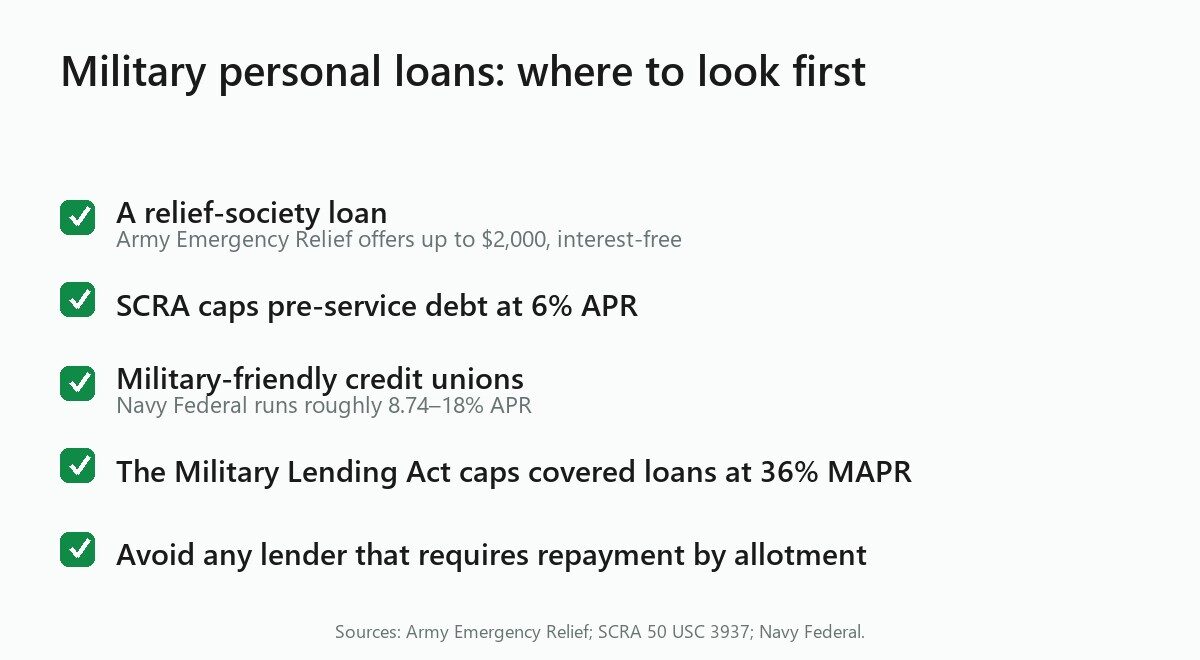
The Servicemembers Civil Relief Act (SCRA), codified at 50 U.S.C. § 3937, caps interest at 6% per year, but only on debt you took on before you entered military service, per the statute itself. Think credit cards, a car loan, or a personal loan you signed before you shipped out.
It does not apply to a loan you take out during active duty. That's a separate rule entirely, the Military Lending Act's 36% MAPR cap, and Quick5k has already covered it in a dedicated explainer on what counts and what doesn't.
Keep the two straight. SCRA covers what you owed before you joined. MLA covers what you borrow while you're in.
How to invoke the SCRA cap
The 6% cap doesn't apply automatically the moment you put on a uniform. You have to invoke it: give the creditor written notice, along with a copy of your military orders, or another acceptable indicator of service such as a certified letter from your commanding officer, as the statute requires. The smart move is notifying every pre-service creditor as soon as you go on active duty, rather than waiting.
There's also a retroactive window. If you didn't invoke the cap right away, you can still give notice up to 180 days after you leave military service and have it apply back to that period.
And the relief is better than a lot of people assume: the statute forgives interest above 6% outright, rather than deferring it or tacking it back onto the loan later, and your payment amount gets reduced by whatever interest was forgiven for that period.
One more thing worth knowing: SCRA covers more than interest. The same law includes eviction and foreclosure protections, lease termination rights, and protections around default judgments. This article's focus is the rate cap, since that's the piece that gets confused with MLA most often, but if you're dealing with a lease you need to break on new orders, or a landlord moving toward eviction while you're deployed, those situations fall under SCRA's other provisions, not the interest-rate mechanic covered here.
Military-Friendly Credit Unions: When You Need New Money, Not Debt Relief
Relief societies and the SCRA cap handle emergencies and old debt. Neither one gets you a personal loan for a planned expense, a debt consolidation, or a purchase that doesn't qualify as a one-time crisis. For that, a handful of credit unions built around military membership consistently beat what you'd find at a storefront or a general-market online lender.
The reason is structural. When a credit union's membership is limited to armed forces personnel, veterans, DoD employees, and their families, it narrows the risk pool to people with steady, verifiable income and often direct deposit already in place. That lets the credit union price loans lower than a lender working with the general public. It's the legitimate version of "military lending," and it looks nothing like the storefronts outside the gate, or a general-market lender marketing itself as "military friendly" without any membership requirement behind the claim.
Navy Federal Credit Union
Navy Federal Credit Union is open to the armed forces, Department of Defense personnel, veterans, and their families. Its Personal Expense Loan runs 8.74% to 18.00% APR for terms up to 36 months, and 10.69% to 18.00% APR for 37 to 60 months, with loan amounts from $250 to $150,000. There's no application fee, no origination fee, and no prepayment penalty, and same-day or next-day funding is available. Loans over $50,000 require a qualified co-applicant, per Navy Federal's own published rates and terms.
PenFed Credit Union
PenFed started as a military and government-focused credit union and has since opened membership to the general public. It offers personal loans to members, and like any lender, its rates, terms, and fees change over time, so check current numbers directly at penfed.org before applying.
USAA
USAA membership is generally limited to active-duty and former military members, certain federal agency employees, and eligible spouses and children; exact eligibility categories are set by USAA. It offers personal loans to members, and rates, terms, and fees vary, so confirm current numbers directly on usaa.com before you apply.
If you don't qualify for any of these three, or you've got a thin or damaged credit history that makes a traditional personal loan a hard sell, a federal credit union Payday Alternative Loan is worth checking before you consider a payday storefront. And if your credit file is thin because of deployment gaps, frequent moves, or time spent without a credit card in your name, there's a second file lenders look at that's worth understanding before you apply anywhere.
Red Flags: What a Predatory Lender Near a Base Looks Like
The Consumer Financial Protection Bureau has repeatedly documented lenders structuring repayment through the military allotment system specifically because it guarantees repayment straight out of a steady paycheck. In one CFPB consent order, 99% of a company's active-duty borrowers were repaying through allotment, a practice the CFPB treated as a Military Lending Act violation, since servicemembers cannot legally be required to repay a covered loan by allotment. Some lenders have even tried routing around the rule by creating allotment-funded "savings accounts" instead, according to the Consumer Financial Protection Bureau.
That same ProPublica investigation, "On Victory Drive, Soldiers Defeated By Debt," documented storefront lenders setting up shop immediately outside base gates, targeting the same thing every lender in this pattern wants: a guaranteed paycheck and a captive customer base. If a loan office sets up shop right outside the gate, ask why it needs to be there instead of anywhere else in town.
A few concrete signals to watch for:
- A lender requiring repayment by military allotment as a condition of the loan. For covered loans, that's illegal under DoD and MLA rules, full stop.
- A storefront located immediately outside a base gate rather than in the surrounding town or online.
- "No credit check, guaranteed approval" marketing aimed specifically at servicemembers.
- Any APR at or above the 36% MAPR cap that the Military Lending Act sets for active-duty borrowers and their dependents.
Title loans deserve a specific mention here too, because they show up in the same predatory pattern: high rates, short terms, and your vehicle as collateral if you can't pay. Quick5k has laid out why it won't send readers to one, along with better options.
Putting It Together
If you're active duty or a veteran facing a real financial gap, work through this in order. Call your branch's relief society first and see if the situation qualifies as a one-time emergency; it's the only option on this list that costs nothing in interest. Check whether any of your existing debt predates your service, because the SCRA's 6% cap might already be sitting there unused simply because you never sent the written notice.
From there, compare a military-affiliated credit union against anything a storefront or online lender is offering, and remember that the MLA's 36% cap is a ceiling, not a benchmark, for anything you borrow during active duty. And if a lender wants your allotment number before it wants your credit history, that's the moment to walk away.
Frequently Asked Questions
The SCRA cap applies to debt incurred before you entered military service, and separated veterans can still invoke it retroactively within 180 days of leaving service for the period they served, per 50 U.S.C. § 3937. It does not apply to new debt taken on after you've left the military.
No. The SCRA's 6% cap only covers debt incurred before you entered service. A car loan signed while on active duty falls instead under the Military Lending Act's 36% MAPR cap, a separate protection Quick5k covers in detail in its MLA explainer.
Yes. Army Emergency Relief, the Navy-Marine Corps Relief Society, Air Force Aid Society, and Coast Guard Mutual Assistance all offer interest-free loans, grants, or both for one-time financial emergencies such as rent shortfalls, utility shutoffs, and emergency travel, according to the Defense Department's Military OneSource program.
Guard and Reserve members qualify too, as long as they're on qualifying orders. Army Emergency Relief, for example, covers Army National Guard and Reserve soldiers serving on Title 10 orders longer than 30 days, along with active-duty soldiers, retirees, and surviving family members. The other service relief societies set their own eligibility rules, so confirm before you apply.
No. Both extend membership to veterans in addition to active-duty members, plus eligible family members, and Navy Federal also covers Department of Defense personnel. USAA's veteran eligibility is narrower, limited to those who retired or were honorably discharged rather than all veterans broadly. Eligibility rules differ by institution, so check each one directly before applying.
Treat it as a warning sign. Lenders cannot legally require allotment repayment as a condition of a covered consumer loan, and the CFPB has pursued enforcement action against companies that structured loans this way specifically to guarantee repayment; in one case, 99% of a lender's active-duty borrowers were repaying through allotment.