


Bad Credit Loan in Texas: What's Legal and What It Actually Costs
A CAB-arranged payday loan in Texas can run 365% to 496% APR, according to the Office of Consumer Credit Commissioner's own 2025 study of consumer loan products. Apply that band to a typical $1,000 loan over a 30-day term and the fee alone lands between $300 and $408, on top of paying back the $1,000 you borrowed. That's the real math behind a bad credit loan in Texas, and it's why the search deserves more than a click on the first storefront that shows up.
Texas does not cap what a Credit Access Business can charge for arranging a payday or title loan, even though the state's own usury law caps interest at 10% a year. The gap comes from a licensing structure written into the Finance Code itself, and once you understand how it works, you can shop around it.
Most people typing "bad credit loan in Texas" into a search bar aren't shopping in the abstract. They need $500 to $2,500 within a few days, their credit score has already closed off a bank's standard personal loan, and the CAB storefront or app in front of them is offering same-day funding with almost no underwriting. That combination is exactly what makes the CAB structure so easy to fall into and exactly why it pays to compare your options before you sign anything.
Why Texas Has No Payday Rate Cap
Section 302.001 of the Texas Finance Code sets the state's general usury baseline: "The maximum rate or amount of interest is 10 percent a year except as otherwise provided by law," and anything above that is usurious "unless otherwise provided by law." Read on its own, that sounds like real protection for anyone borrowing in Texas. It isn't, once a Credit Access Business enters the picture, and that's the part most quick reads on Texas lending skip past.

The OCCC explains the workaround on its own site: a Credit Access Business "obtains credit for a consumer from an independent third-party lender in the form of a deferred presentment transaction or a motor vehicle title loan," then "charges a fee to the consumer for obtaining the third-party loan," usually calculated as a percentage of the amount borrowed. The CAB is licensed as a broker under Texas Finance Code Chapter 393, not as a lender. Its fee is legally a service charge for arranging your loan, not interest on the loan itself, so Section 302.001's 10% ceiling never touches it, no matter how high the fee runs.
Other states have closed similar CAB-style loopholes with outright bans or all-in rate caps, and seeing how other states have closed this same loophole shows what Texas hasn't. Until Texas lawmakers change the underlying statute, the choice sits with you: pay the CAB fee, or steer toward a lender that isn't charging one.
How to Verify a Texas Lender Is Actually OCCC Licensed
Any CAB, and any traditional installment lender operating under Finance Code Chapter 342, has to hold an OCCC license. Banks and credit unions, including the credit union PAL loans covered below, are chartered and supervised elsewhere, not by the OCCC. You can confirm a CAB or Chapter 342 lender's license before you sign anything by starting at the OCCC's own consumer page, which links to its licensee search tool and its complaint process. If you'd rather talk to a person first, the OCCC runs a consumer helpline at 800-538-1579, and a call before you sign costs you nothing to ask.
Texas Finance Code Section 393.201 spells out exactly what a licensed CAB has to hand you in writing before you owe it a dollar. Treat this as a checklist. A legitimate CAB contract discloses:
- The specific fees you'll pay the CAB for arranging the loan, stated in dollars rather than a percentage you'd have to calculate yourself.
- A statement that there's no penalty for paying the loan off early.
- The name and address of the Office of Consumer Credit Commissioner.
- The OCCC's consumer helpline telephone number.
If a storefront or app can't produce all four, or waves you off when you ask, you're not dealing with a licensed operator. The fee bands in this article describe licensed products only. Texas's usury cap and other consumer protections still apply to an unlicensed lender, and operating without a license is itself a violation that's grounds for a complaint to the OCCC (occc.texas.gov/consumers). Walk away, file that complaint, and check the OCCC's licensee search before you consider any other paperwork it hands you.
What a $1,000 Loan Actually Costs in Texas
A percentage is hard to feel in your gut; a dollar total is easier to weigh against your paycheck. The figures below translate each licensed loan type's verified APR range into what a $1,000 loan actually costs over 30 days, using a simple calculation: principal times APR times 30 divided by 365. No regulator publishes a single official dollar total for a $1,000 loan, so these figures are calculated from the OCCC and NCUA APR bands cited throughout this article; a Money Hacks explainer on translating a scary APR into real dollars covers the same math in more depth.
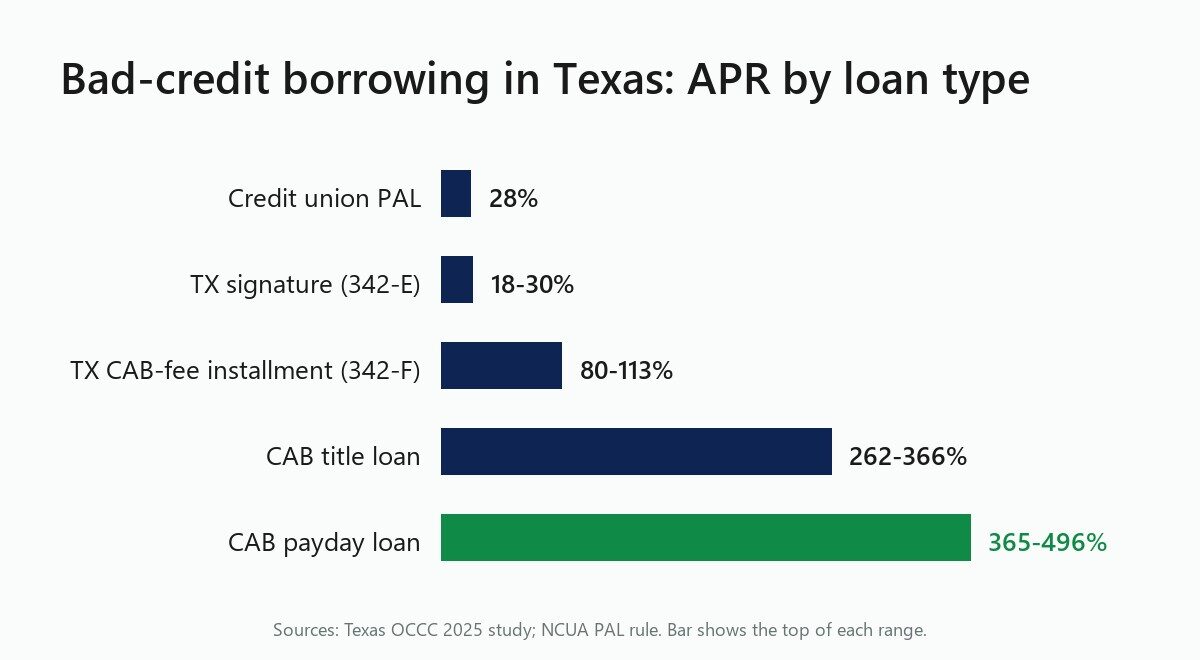
- Credit union PAL (28% APR cap): about $23 in interest for the month, plus a one-time application fee of up to $20.
- OCCC-licensed installment, Chapter 342 Subchapter E (18% to 30% APR): roughly $15 to $25 for the month.
- OCCC-licensed installment, Chapter 342 Subchapter F (80% to 113% APR): roughly $66 to $93 for the month.
- CAB-arranged auto title loan (262% to 366% APR): roughly $215 to $301 for the month.
- CAB-arranged payday loan (365% to 496% APR): roughly $300 to $408 for the month.
Lay those five side by side and the scale is the real story: both CAB-arranged products cost roughly 3x to 20x more than the two OCCC-licensed installment options or the credit union PAL. That gap doesn't hold as cleanly between the PAL and the cheapest licensed installment option, though. Subchapter E's 18% floor sits below the PAL's 28% cap, and on a one-month $1,000 loan, the PAL's application fee of up to $20 can push its total cost above a Subchapter E loan's. Both are close enough that either is a reasonable first call; the difference that matters more is how certain each cap is, since a federal PAL rate never depends on a particular lender's day-to-day Subchapter E pricing.
None of this is hypothetical for Texas borrowers. NBC 5 in Dallas-Fort Worth documented a case where a borrower took out a $2,000 CAB loan and, based on the receipts the borrower shared with the station, paid back nearly $7,000 over 16 months without the balance clearing. The station built its reporting on interviews with Samantha Kehl of Legal Aid of NorthWest Texas and Ann Baddour of Texas Appleseed, both consumer advocates who work on small-dollar lending in Texas. That's the scenario the dollar figures above are meant to help you see coming, ideally before you ever sign.
Safer Options, in Order
These three options are ranked by how reliable and certain the cost cap is: a credit union PAL capped at 28% APR first, then an OCCC-licensed installment loan, then earned wage access. For a $500 to $2,500 need, that certainty is what actually matters once the money is in your account. Start at the top and work down only if the option above it doesn't fit your situation this week.
Credit union Payday Alternative Loans (PAL)
Federal credit unions can offer PAL I loans of $200 to $1,000 with terms of one to six months, and PAL II loans up to $2,000, both capped at 28% APR with an application fee no higher than $20, according to the National Credit Union Administration. You don't have to already bank at a Texas-chartered credit union to qualify. Any federal credit union membership works, though most require you to belong for about a month before you're eligible to borrow, so it's worth setting up before a cash crunch actually hits. If you don't already belong to one, look for a federal credit union with open community membership near you and ask specifically whether it offers PAL I or PAL II before you apply for anything else.
OCCC-licensed installment loans (no broker fee)
Traditional consumer lenders licensed directly under Finance Code Chapter 342, rather than as Credit Access Businesses, aren't brokering a third-party loan and don't tack on a CAB fee. The OCCC's own study puts Subchapter E loans at 18% to 30% APR and Subchapter F loans at 80% to 113%. Subchapter F still isn't cheap, but it's a fraction of what a CAB-arranged loan costs for the same $1,000, and the rate is disclosed as interest under the same 342 licensing structure, with no separate broker fee layered on top.
Check any lender you're considering against the OCCC's licensee search before you apply. If bad credit or a thin credit file is what's steering you toward small-dollar lenders in the first place, it's worth knowing there's a second alternative credit file many bad-credit borrowers don't know exists, one some Chapter 342 lenders check when your traditional score comes up short and a standard bank would simply decline you.
Earned wage access apps
Earned wage access lets you draw against wages you've already worked but haven't been paid yet, usually through an app tied to your employer or bank account. As the law firm Davis Wright Tremaine summarizes it, under a CFPB advisory opinion effective December 23, 2025, EWA products that meet a defined set of conditions, including employer-partnered programs and certain direct-to-consumer products, aren't treated as "credit" under the Truth in Lending Act's Regulation Z, and optional expedite fees or tips on those products aren't treated as finance charges. That regulatory treatment varies by product and by state; a separate breakdown of how earned wage access is regulated state by state covers where the rules differ.
EWA isn't available to everyone. It generally requires a qualifying income type, and often an employer or payroll setup the app can verify before it will advance you anything against a future paycheck. If your income is irregular, gig-based, or paid in cash, check the specific app's requirements before you count on it as your backup plan, since not every worker type clears that bar.
If You're Already in a CAB Loan
Start with the paperwork. Pull your CAB contract and check it against the Section 393.201 disclosure list above. If something's missing, or if you were never shown it, you can file a complaint with the OCCC directly through occc.texas.gov/consumers or by calling the helpline at 800-538-1579. That complaint channel exists specifically because the OCCC licenses and examines CABs, and it takes consumer complaints as part of that oversight, whether or not you plan to keep paying the loan while it's reviewed.
Filing a complaint doesn't erase what you owe, but it puts a documented record in front of the regulator that licenses the business, and that record matters if the same lender turns up in another borrower's complaint later.
If the loan itself is legitimate but you're juggling it alongside other small-dollar debt, don't just pay whichever bill is loudest or calls the most. Money Hacks has a separate rundown on which loan to pay off first, built around which balances grow fastest and which carry the most severe consequences for falling behind. Rolling a CAB loan over instead of paying it off is usually the most expensive decision available to you: it's how a $2,000 loan turned into nearly $7,000 in payments over 16 months without the balance clearing, in the NBC 5 case above.
Frequently Asked Questions
No. Texas allows payday and title lending through the Credit Access Business structure, licensed under Finance Code Chapter 393. What's unusual is that the CAB's fee falls outside the state's 10% usury ceiling under Section 302.001, since regulators classify it as a broker fee rather than interest.
A Credit Access Business, or CAB, is a Texas-licensed broker that arranges a payday or title loan for you from an independent third-party lender and charges a separate fee for that service, on top of what you repay the actual lender for the loan itself.
Start at occc.texas.gov/consumers, which links to the OCCC's licensee search tool, or call the OCCC's consumer helpline at 800-538-1579. A licensed CAB must also disclose its fees, a no-prepayment-penalty statement, and the OCCC's contact information in writing under Section 393.201 before you sign.
It depends on your timeline. A CAB-arranged payday or title loan can fund the same day but costs the most by a wide margin. An OCCC-licensed installment loan or a credit union PAL usually takes a bit longer to set up but costs a fraction as much for the same $1,000 borrowed.