

0% Balance Transfer vs Payday Loan: When the Card Actually Wins
Picture two texts landing on your phone the same week. One is from a payday lender confirming your $1,000 advance, due back in fourteen days plus a fee. The other is a credit card offer promising 0% interest on transfers for over a year. Most people delete that second one without reading it, because the payday loan feels like the only door that opens fast.
If your credit has climbed into fair or good territory, the card might actually be the cheaper door. This is a straight comparison of balance transfer vs payday loan costs, using the same $1,000 borrowed amount on both sides, no sales pitch for either product. Just the math, who actually gets approved, and the specific situations where the payday loan still wins even though it looks worse on paper.
How a 0% Balance Transfer Card Actually Works
A balance transfer moves debt you already owe (or, on some cards, a new purchase) onto a credit card that charges 0% interest for a set introductory window. You are not borrowing new cash from the card issuer the way a payday lender hands you cash. You are shifting an existing balance, or charging an expense directly to the card, and getting a stretch of months where none of it accrues interest.
That 0% offer is not free, though. Card issuers are allowed to charge a balance transfer fee even on a 0% interest promotion, and most do. That fee typically runs 3% to 5% of the amount you move, usually with a small minimum charge of around $5 to $10, and it gets added to your balance the moment the transfer posts. You pay it once, up front, no matter how long you take to pay the balance off within the window.
The intro window itself varies by card. Bankrate's market snapshot from August 2026 shows several well-known cards offering 21 months at 0%, close to the top end of what's available right now, while others sit closer to 12 to 18 months.
Federal rules set a floor here too: once you accept an intro rate, the issuer has to keep it in place for at least six months, and can only pull it early if you fall more than 60 days behind on a payment. That six-month floor is the legal minimum. Actual offers usually run longer, so read your specific terms before you count on more.
The Worked Math: Borrowing $1,000 Two Ways
Here is where the comparison actually earns its keep. Say you need $1,000 and you have two realistic paths: a payday loan, or a 0% balance transfer card you already qualify for.
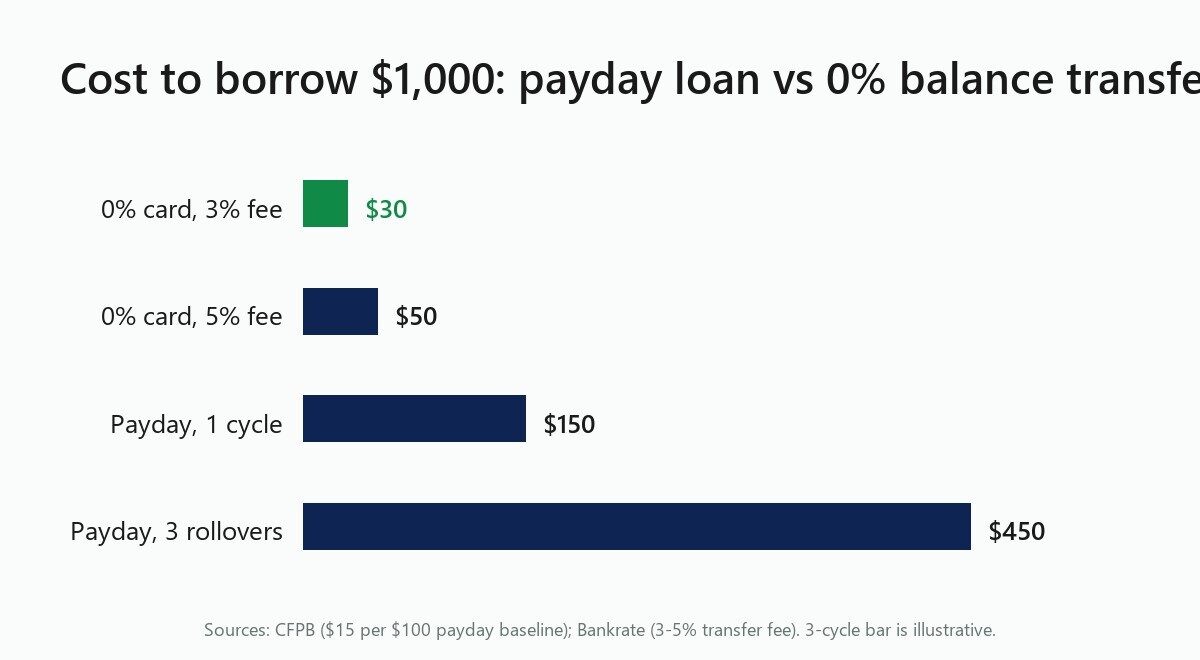
On the payday side, the CFPB's baseline figure is a fee of $15 per $100 borrowed, on a loan averaging around $375 with a roughly two-week repayment term. Scale that to $1,000 and the fee comes out to $150 for a single two-week cycle, so you'd owe $1,150 on your due date. Run that fee through the standard APR conversion, fee divided by principal, times 365 divided by loan term in days, and you land at roughly 391% APR for that one cycle.
Now stretch the timeline out, because most payday borrowers don't pay it all off in one shot. CFPB research shows that more than 80% of these loans get rolled over or followed by a new loan within about two weeks of the last one. If it takes you three two-week cycles, six weeks total, to come up with the full $1,000, the fee alone adds up to $450, and you still haven't touched the principal.
This is an illustrative scenario, since your state's laws and your specific lender determine how many rollovers are even legal. If you want to see how payday APR actually translates into dollars on a smaller loan, we've broken that math down in more detail elsewhere on the site.
On the card side, the entire cost is the transfer fee. At 3%, moving $1,000 costs $30 flat, and at 5% it costs $50 flat. That number doesn't change whether you pay the balance off in two weeks or in month eighteen, as long as you clear it before the intro window closes and you never fall 60 days late.
Compare $150 for two weeks of payday borrowing against $30 to $50 for the entire life of the card offer, and the card comes out roughly three to five times cheaper over that same first two weeks. Stretch the comparison to the six-week payday scenario above and the gap grows further: $450 in payday fees against a card cost still sitting flat at $30 to $50, somewhere around nine to fifteen times cheaper.
The card's cost doesn't scale with time the way the payday loan's does.
The Post-Intro APR Trap
The math above only holds if you actually pay the balance off before the intro period ends. Miss that window and the remaining balance starts accruing interest at the card's standard variable APR, which that same Bankrate snapshot puts roughly in the 17% to 28% range depending on the card. Treat that as a typical range on today's offers, not a guaranteed number, since issuers set and change these rates on their own.

There is a sharper trap hiding inside that same six-month legal floor. Under that CFPB rule, if you go more than 60 days late on a payment, the issuer can revoke your 0% rate early and reprice your entire remaining balance at a penalty APR that applies to everything you owe, not only the payments you missed. Readers who have lived through this often describe it less as owing a little more and more as watching the whole deal blow up at once. One late payment costs more than a fee, and it can undo the entire reason you moved the balance in the first place.
Even at a 17% to 28% go-to rate, carrying a balance past the intro window is still usually far cheaper than a payday loan's effective APR. Still, it's no longer free, and the appeal fades the longer a balance lingers past the promo period. Set a personal deadline a month or two earlier than the card's actual expiration date and give yourself a buffer.
Who Realistically Qualifies for a 0% Card
The best 0% balance transfer offers, meaning the longest windows, the lowest fees, and the highest limits, tend to cluster around applicants with good credit and get materially better once you clear about 700. That doesn't mean fair credit locks you out entirely. Some issuers do extend 0% balance transfer or purchase offers to applicants in the fair range, though usually with a shorter intro window, a smaller limit, or no promotional rate at all. Approval is never guaranteed at any score, and it depends heavily on the specific card and issuer as well as where your number lands.
A fair score and a thin credit file are two different problems. If a recent check turned up barely any history to score at all, more like the situation borrowers with a thin credit file run into, that's worth sorting out on its own before you apply for a 0% card. A rejection or a hard inquiry on a shaky file can push your score down further right when you need it steady.
When the Card Does Not Win
This is the part most balance transfer articles skip, and it is the reason a payday loan sometimes remains the more honest choice.
A 0% balance transfer or purchase offer only helps if the expense is payable by card, or if it's an existing balance you're consolidating. A landlord who only accepts cash, a friend you owe in person, or any bill that won't run through a card network can't be solved with a balance transfer, full stop. You'd need actual cash in hand, which is exactly what a payday loan hands you.
Don't reach for a cash advance on that same 0% card thinking it works the same way, because it doesn't. Cash advances are excluded from the 0% intro rate entirely under the card's own terms and Regulation Z, the federal rule that governs how card issuers structure and disclose these charges. They carry a separate cash advance fee, usually a percentage of the amount pulled, no grace period before interest starts, and an interest rate that begins accruing the moment you take the cash, often at a rate higher than the card's regular purchase APR. Pulling cash on a 0% card can end up costing you more than the payday loan you were trying to avoid.
A thin or damaged credit file rules out the best 0% offers before you even apply. If that describes you, a credit union Payday Alternative Loan, a small-dollar loan the National Credit Union Administration (NCUA) caps at 28% APR, is worth comparing against both the card and the payday lender. Its cost works differently from the card's flat 3% to 5% fee, since it charges interest over the repayment term rather than a single one-time charge, though it still beats a payday loan's compounding cost by a wide margin.
Then there's the temptation problem, and it deserves to be named plainly. Transferring a balance frees up room on your old card, and it can be genuinely hard to leave that room empty. NerdWallet's own coverage of common balance-transfer mistakes flags this same pattern: a cardholder transfers a balance, then starts using the newly emptied card for everyday spending, and ends up carrying two balances instead of paying down one. If that's a realistic risk for you, freeze the old card or take it out of your wallet the same day you complete the transfer.
Be honest, too, about your own timeline. If there's no real chance you clear the balance before the intro window ends, run the post-intro APR math against the payday loan's cost before you commit. In many cases the card still wins even at the higher rate, but not always, and it's worth five minutes of arithmetic to check rather than assume.
Your Quick Eligibility Checklist
Before you apply for a balance transfer card as a payday loan alternative, run through this list honestly.
- The expense is payable by card, or you are consolidating an existing balance, not chasing cash you cannot get any other way.
- You have a realistic plan to pay off the transferred amount before the intro window closes, with a personal deadline set a month or two early.
- Your credit sits in a range where you have a genuine shot at approval, and you have checked your actual score rather than guessing.
- You have a plan for the old, now-empty card, whether that means freezing it, cutting it up, or simply not carrying it.
- You can commit to on-time payments every month, since a single payment more than 60 days late can revoke the entire 0% deal.
If most of those check out, a 0% balance transfer card is very likely the cheaper path. If two or three don't, it's worth pricing out a credit union alternative, or being honest that a payday loan, used carefully and paid off in one cycle, may still be the more realistic option for your situation. A checking account with lower overdraft risk also helps while you pay a transferred balance down, since one overdraft fee at the wrong moment can derail an otherwise solid repayment plan.
Frequently Asked Questions
For a $1,000 balance, a 0% transfer card typically costs $30 to $50 total, a one-time fee of 3% to 5%. A payday loan at the CFPB's $15-per-$100 baseline costs $150 for just one two-week cycle. The card is usually far cheaper, but only if you qualify and pay it off before the intro window ends.
Not under the 0% rate. Pulling cash through a cash advance is excluded from the intro offer, carries its own fee, and starts accruing interest immediately at a separate, often higher rate. If you need actual spendable cash, a balance transfer card isn't built to provide it.
Any remaining balance starts accruing interest at the card's standard variable APR, roughly 17% to 28% on current offers per Bankrate's current sample. That's usually still cheaper than a payday loan's effective rate, but it's no longer free, so the cost advantage shrinks the longer the balance carries past the window.
The strongest 0% deals, the longest terms and the lowest fees, tend to cluster around applicants with good credit and get materially better once you clear about 700. Some issuers extend smaller or shorter offers to fair-credit applicants, but approval is never guaranteed at any score and depends on the specific card and issuer.
Pull your actual score first, since a hard inquiry on a shaky file can push it down further. Compare the card's disclosed terms, since some fair-credit cards skip the 0% promo entirely. If you have a thin file rather than a fair score, a credit union Payday Alternative Loan capped at 28% APR under NCUA rules may fit better.