


You've got three small-dollar loan offers open in three different tabs, and your cursor is hovering over the "Check Your Rate" button on each one. Every warning you've ever absorbed about credit applications is running through your head: too many inquiries wreck your score, lenders can see every place you've shopped, one careless click costs you points you can't get back. So what is a soft credit check, and does clicking that button put any of that at risk? Short answer: a soft credit check is a look at your credit file that does not affect your credit score, and it's the tool most small-dollar lenders use for that first "see your offer" step.
Knowing where that protection starts and where it stops is what lets you shop with your eyes open. This matters most if you're comparing offers on a tight timeline, maybe between shifts or during a week where money is already stretched thin, because that's when a mistaken swipe at your credit score would hurt the most. The good news is that comparing rates and actually applying are two different moves in the eyes of a lender, and only one of them carries any risk to your score at all.
Soft Pull vs Hard Pull, Side by Side
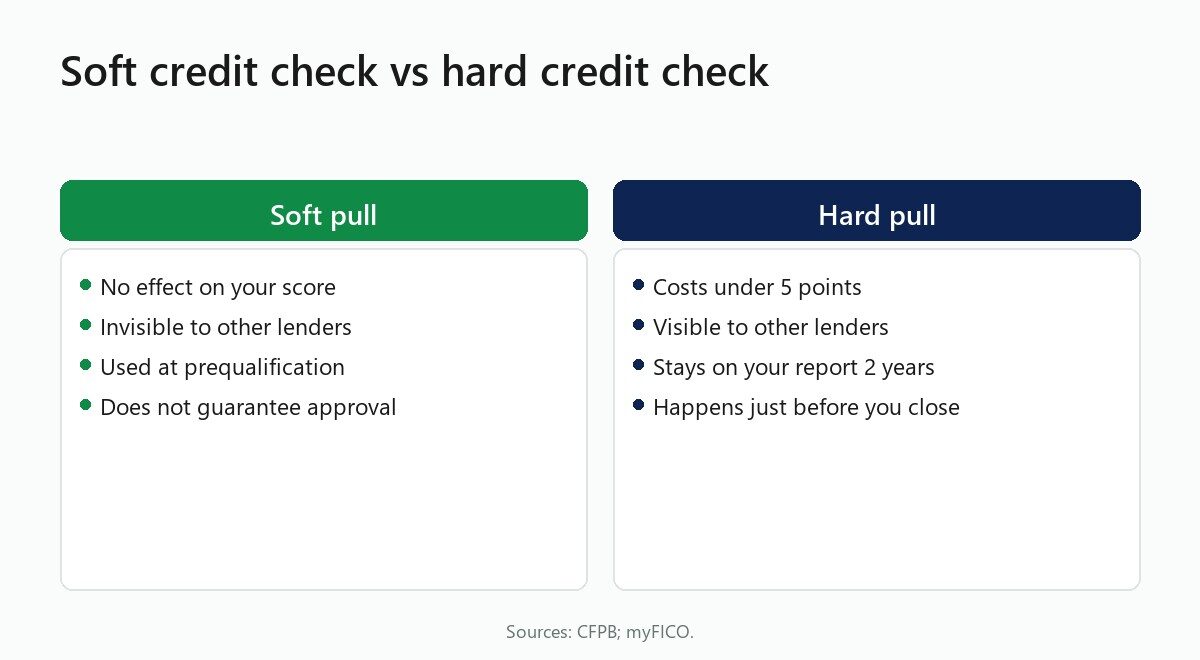
The Consumer Financial Protection Bureau draws a clean line between the two types of credit inquiry. A hard inquiry happens when you actually apply for a new loan, and CFPB guidance on credit inquiries explains that scoring models weigh how recently and how frequently you've applied for credit. A soft inquiry covers a different set of situations: reviews of your existing accounts by a lender you already work with, prescreening by lenders considering an offer, employment screening, and the checks you run on your own report. None of those touch your score, per that same CFPB guidance.
There's a second difference that matters just as much: visibility. A soft inquiry only shows up on the copy of your report that you can see, and other lenders never see it, per CFPB's explanation of which inquiries affect your score. A hard inquiry, on the other hand, is visible to every lender who pulls your file afterward, sitting on your report as a small signal that you've been actively seeking credit.
- Soft inquiry: no score impact, visible only to you, used for prequalification, account reviews, and self-checks.
- Hard inquiry: FICO's own guidance puts the typical cost at under 5 points on a FICO score, visible to other lenders, and triggered when you formally apply for a loan.
Why Small-Dollar Lenders Lead With a Soft Pull
Small-dollar lenders want you to see a real offer before you commit to anything, and a soft pull lets them show you that offer without putting your score on the line. That's the whole appeal from your side: you get a rate, a loan amount, and a term to look at, and nothing about looking costs you anything.
From the lender's side, the soft pull is doing basic screening work. It confirms who you are, pulls a general read on your credit history, and gives the lender enough information to generate a preliminary, conditional offer. Lenders lean on this stage because it lets them extend an offer to far more people at once than a full application would allow, without your score taking a hit every time you compare a rate.
Think of it like browsing a store window before you walk in. Standing outside and looking at the price tag doesn't cost you anything, and a lender showing you a rate through a soft pull works the same way. Nobody expects you to buy the moment you glance at a display, and no lender expects a soft-pull rate check to mean you've committed to the loan either.
What a Soft Pull Actually Shows a Lender
A soft pull gives a lender a real, if partial, picture. It typically includes enough identifying information to confirm you are who you say you are, a look at some of your existing trade lines and payment history, and in some cases alternative data beyond the traditional credit file. What it does not include is a full underwriting review; picture a lender squinting at your file from across the room.
That partial view is limited on purpose. It's enough to generate a conditional offer and rule out applicants who clearly won't qualify, but it stops well short of the deeper look a lender needs before actually handing over money. That gap between seeing a rate and holding a funded loan is where the next stage comes in.
Say you fill out a soft-pull rate check with three lenders on the same afternoon. Each one sees a snapshot: your identity, a general read on your payment history, maybe a look at alternative data if they use it. None of the three can see that the other two just looked too, because a soft inquiry never gets reported to other lenders. What each lender does with that snapshot differs, which is why the offers you get back can look different from each other even though your underlying credit file didn't change between clicks.
The Part Nobody Explains: When the Hard Pull Actually Happens
Here's the detail that catches people off guard. The CFPB is direct about it: lenders usually run a credit check when you apply for a new loan, and that check often lands just before you close on the loan, not at the moment you first request a rate, according to CFPB guidance on when a lender runs a credit check. A check from a lender you already have an account with counts as a soft inquiry and won't touch your score, but that's a different situation from a new lender moving you toward funding.
Walk through the sequence in order. You request a rate: soft pull, no score impact, you see a conditional offer. You decide to move forward, and the lender now needs to verify what you told them, which can mean confirming your income, checking your bank account activity, and running a formal, hard pull as part of final underwriting. That hard pull typically lands at the very end of the process, right before your loan closes and funds.
If nobody tells you that ahead of time, a score dip that lands weeks after you thought you were just checking your rate can feel like it came out of nowhere. That confusion is common, and it usually isn't about anything you did wrong. It's about a lender's process moving from soft to hard without a clear heads-up at the moment it happened.
A hard inquiry itself is a small, temporary cost. It typically costs under 5 points on a FICO score, stays on your credit report for 2 years, but only affects your score for about 12 months, according to myFICO's data on how long hard inquiries last. Small doesn't mean invisible, though, and the timing matters more than the size. Ask upfront, before you request a rate anywhere, when in the process a lender's soft pull turns into a hard one.
Income verification isn't the only extra layer added at this stage. Many lenders serving small-dollar and subprime borrowers also check specialty consumer reporting companies that sit outside the three nationwide credit bureaus. The CFPB's directory of consumer reporting companies lists firms that supply data specifically to companies marketing to lower-income consumers and applicants with limited or damaged credit records, a second credit file some lenders check instead of relying on your traditional score alone. Clarity Services and Teletrack are two widely used names in short-term lending, and checks like these usually happen at underwriting, once you've moved past the soft pull that generated your prequalified offer.
Why a Soft Pull Doesn't Guarantee Approval
A prequalified offer is conditional, and conditional is doing a lot of work in that sentence. The number you see after a soft pull is the lender's best estimate based on a partial picture, not a final decision. Once you move into a full application, the lender fills in the rest of that picture: your actual income, your bank account activity, and often that specialty-bureau data mentioned above. Any one of those can change the outcome.
That means a prequalified offer can come back smaller, priced higher, or declined outright once a lender checks the details a soft pull never asked for. Treat "prequalified" the way it's meant: encouraging, but conditional. The safest posture is to keep comparing offers at the soft-pull stage and treat any number you see there as a starting point, not a guarantee.
How to Shop Multiple Small-Dollar Offers Without Hurting Your Score
If you've ever shopped for a mortgage or a car loan, you might have heard that applying to several lenders within a short window only counts as one inquiry for scoring purposes. That's real, but it comes with a boundary you need to know before you apply it to a small-dollar loan.

FICO's own rate-shopping guidance names the window and the loan types it covers directly: mortgage, auto, and student loans, deduplicated into a single inquiry when they land close together, using a 14-day window on older FICO score versions and a 45-day window on newer ones. FICO names those three loan types specifically, and the CFPB's general description of inquiry dedup speaks only in broad terms, covering multiple inquiries "for the same type of loan." Neither source says that window covers a payday loan, an installment loan, or any other small-dollar product. Assume it doesn't apply here unless a lender tells you otherwise in writing.
That gap is why the soft-pull stage matters so much for small-dollar shopping. It also explains a pattern you may have run into already: wanting to compare offers side by side the way you would mortgage rates, then not being sure if doing that with small-dollar lenders is safe. It is safe, as long as you stay at the soft-pull stage while you compare and save the formal application for the one lender you're ready to commit to. Work through these steps in order:
- Start every comparison at the prequalification stage. Look for lenders who explicitly advertise a rate check with no impact to your credit score, and confirm that step is a soft pull before you enter any information.
- Ask each lender directly when a hard pull happens. A simple question, "at what point in this process do you run a hard inquiry," tells you exactly where the free-shopping window ends for that lender.
- Collect multiple soft-pull offers before you commit to any of them. Since soft pulls never touch your score, you can gather offers from several small-dollar lenders side by side with zero score risk, the way you'd compare quotes for anything else you're buying.
- Look past the headline rate to the real terms. Compare the APR (Annual Percentage Rate), the total repayment amount, and the fees on each offer, since a high APR on a small-dollar loan can still add up to a smaller real cost than it looks at first glance, depending on the term.
- Move to a full application with only the one offer you intend to accept. That's the point where a hard inquiry becomes worth it, because you're applying to actually fund the loan rather than just to see a number.
Follow that order and the only hard inquiry that ever touches your file is the one attached to the loan you actually take out. Everything before it stays soft, invisible to other lenders, and costs your score nothing at all. If a credit union Payday Alternative Loan (PAL) is available to you, it's worth adding to the comparison stack too: credit union PAL rules cap the rate at 28% APR, giving you a regulated ceiling most small-dollar products don't have.
Frequently Asked Questions
No, not if the lender uses a soft credit check for that step. A soft pull never affects your credit score and only appears on the copy of your report that you can see. Confirm with the lender that the rate-check step is soft before you enter any information, since the protection depends on which type of pull they run.
Prequalified means a lender gave you a conditional offer based on a soft pull and limited information. Approved means the lender verified your income, checked additional data, and committed to fund the loan. A prequalified offer can still change or get declined once that fuller review happens, so treat it as encouraging, not final.
Not always, and that's exactly why you should ask directly. Lenders typically run a hard, score-affecting check right before a loan closes and funds, according to the CFPB's guidance on when a lender pulls your report. Ask each lender when in their process a hard pull happens before you submit any application.
A specialty consumer reporting agency collects data outside the three nationwide credit bureaus, often used by lenders serving lower-income and subprime borrowers, per the CFPB's directory of consumer reporting companies. Small-dollar lenders may check one during underwriting, even after a soft pull showed you a prequalified offer, which is one more reason a prequalified offer isn't the final word.