


"I'm 18 and I've never had credit, where do I even start." If that thought has been running through your head since your birthday, you're right on time. Most people don't get a clean starting line for their financial life. You just did.
The best way to start building credit at 18 is a sequence: open one account, confirm it's reporting, then layer on a second source of history. Turning 18 doesn't hand you a credit score. It hands you the legal right to apply for the products that eventually build one. That's a bigger deal than it sounds, and it's also where a lot of new adults get stuck, because the door opens and then a second, quieter rule swings partway shut behind it.
Why Nothing Worked at 17
Can you take out a loan at 17? Practically speaking, no, and the reason comes down to contract law, not any judgment about teenagers and money.
In nearly all US states, 18 is the age of majority, the point at which a person gains the legal capacity to sign a binding contract on their own. A credit card, a loan, a lease: these are all contracts. When a minor signs one, that contract is generally voidable at the minor's election, meaning the minor (or their guardian) can walk away from it later. Lenders build their systems around that risk.
This is general contract law, established state by state instead of through one federal statute, so you won't find a single U.S. code section that says "credit starts at 18." What you will find, everywhere, is the same practical outcome: until you cross that legal threshold, almost no mainstream lender will open a credit account in your name alone.
That's the whole story of 17. Nothing was wrong with you. The paperwork simply couldn't hold.
The Catch at 18: The CARD Act Under-21 Rule
Your birthday changes the contract-law problem. It does not remove every obstacle, and this is the piece most 18-year-olds never hear about until they get denied.
Under the Credit Card Accountability Responsibility and Disclosure Act, a federal rule found in Regulation Z (mirrored at eCFR), a card issuer cannot open a credit card account for anyone under 21 unless one of two things is true: you can show an independent ability to make the minimum payments based on your own income or assets, or a cosigner, guarantor, or joint applicant who is 21 or older signs on and shows they can cover the payments.
Read that twice, because it's the hinge this entire plan turns on. At 18, you're legally allowed to sign for a card. At 18, 19, and 20, you also have to clear this second bar: prove your own income can support the payments, or bring someone in who can.
This is why a fresh high school grad with no job history and no cosigner so often gets turned down for a standard unsecured card, while a friend with a part-time job or a parent willing to co-sign sails through. The rule is doing exactly what it was designed to do. Your plan just needs to work around it.
The Toolkit: Four Ways In
You don't need all four of these tools. You need to understand each one, because the 12-month plan below leans on them in a specific order.
Secured credit cards
A secured card asks you to put down a refundable security deposit, often starting around $200, which becomes your credit limit. On your credit report, a secured card looks identical to an unsecured one. The deposit itself never shows up to a scoring model; only your payment activity does, according to Experian.
The card has to report to at least one credit bureau for it to help you at all, and reporting to all three gives you the broadest benefit. According to Experian, a FICO Score generally needs about six months of account history before it can be calculated, while a VantageScore can sometimes appear after as little as two months of reporting.
Credit-builder loans
A credit-builder loan flips the usual order of a loan. Instead of the lender handing you money up front, they hold $300 to $1,000 in a locked account while you make installment payments over roughly 6 to 24 months. Those monthly payments are what get reported to the bureaus.
A CFPB-reviewed study of 1,531 credit union members who were offered one of these loans found that participants with no existing loan were 24% more likely to have a credit score than those who didn't take one. Among borrowers with no other outstanding debt, scores rose roughly 60 points more than they did for people juggling other debt at the same time. If you're starting completely from zero, that's about as clear a signal as this space offers.
Authorized user status
If a parent or trusted relative has a card in good standing, ask about being added as an authorized user. That account's full history, including its credit limit, utilization, payment record, and open date, can post to your own credit file, typically within 15 to 30 days of the primary cardholder's next reporting cycle, per Experian. For someone with no file at all, this can move the needle more than it would for someone who already has established history.
Two caveats matter here. Experian specifically doesn't post the primary cardholder's missed payments to the authorized user's own report, though high utilization on that shared account can still drag your score down. And the entire benefit depends on the card issuer choosing to report authorized-user activity to the bureaus in the first place; several issuers simply don't.
Rent and utility payment reporting
Tools like Experian Boost let you add qualifying recurring payments, such as rent, utilities, phone bills, and select streaming subscriptions, directly to your Experian file for scoring purposes. You'll need at least three qualifying payments in the last six months, with at least one of them landing in the last three months.
Experian reports that about 62% of users who tried Boost saw their FICO Score 8 increase, by an average of roughly 13 points, and combining rent payments with other eligible bills produced an average lift of about 19 points among users who saw any improvement. Keep in mind this comes from Experian's own promotional materials for its own product, and it only affects your Experian file. It does nothing for Equifax or TransUnion.
The 12-Month Timeline
Here's the part that most guides skip: the order matters as much as the tools themselves. Below is how to sequence these four options over your first year.
Month 1: Open your first account
The credit-builder loan vs secured card choice comes down to what you have on hand: a secured card ties up a refundable deposit as your credit limit, while a credit-builder loan holds your payments in a locked account instead. Both report your payment activity to the bureaus. If you're going the secured card route, remember the CARD Act's under-21 income or cosigner check from the last section still applies to that application, same as it would for any other card.
- Apply for a secured credit card, or apply for a credit-builder loan through a bank or credit union. Either works as a starting point; you don't need both right away.
- Before applying anywhere, use a soft credit check to compare offers without triggering a hard inquiry on a file you're trying to build clean. Our guide to soft credit checks walks through how issuers let you preview approval odds this way.
- Ask a parent or relative whose card is in good standing whether they'll add you as an authorized user. It can start building your file in parallel with your own account.
Month 3: Confirm the reporting is actually happening
Opening an account isn't the same as it working. Pull your credit report at AnnualCreditReport.com and confirm the secured card or credit-builder loan is actually showing up, ideally with all three bureaus. If you pay rent or utilities and have three qualifying payments in the last six months, this is also the month to start Experian Boost.
Month 6: Your first score should exist
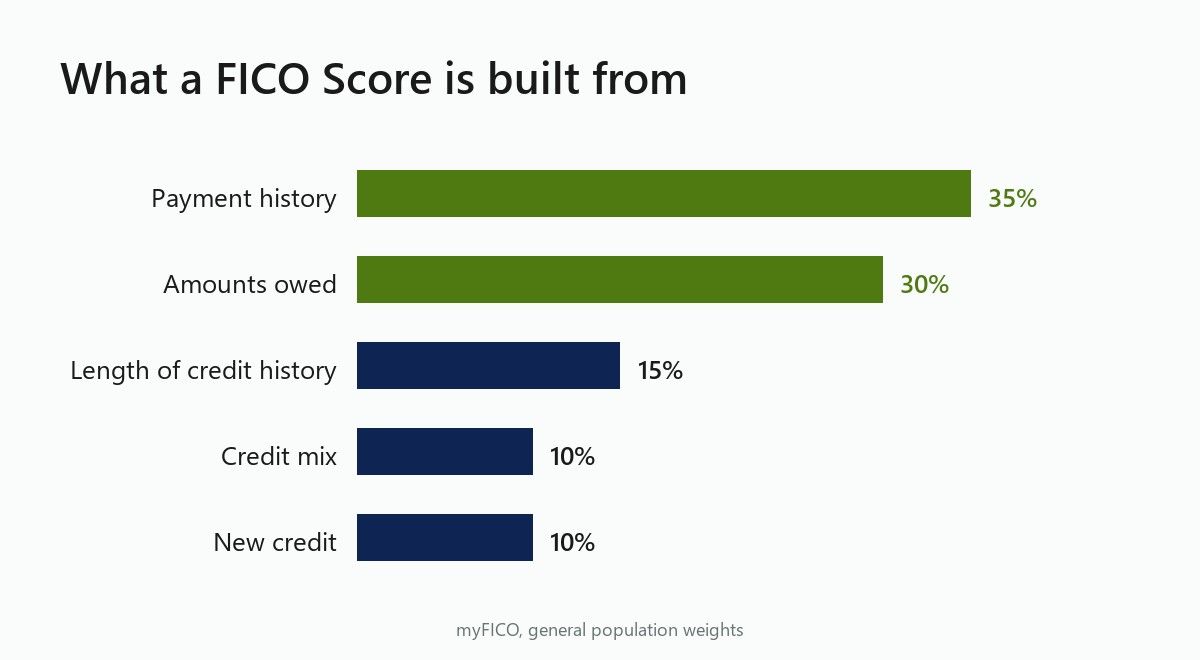
By now you should have enough history for a FICO Score to calculate, since that model generally needs six months of reporting to generate a number. Review your utilization (how much of your available credit you're using) and your payment history so far. Keeping utilization low and every payment on time matters more right now than almost anything else, since payment history alone makes up 35% of a FICO Score and amounts owed make up another 30% for the general population, per myFICO. myFICO notes that people with short credit histories are scored somewhat differently, so treat these percentages as a general guide rather than your exact math.
Month 6 is also a smart time to start a parallel savings habit. Pairing credit-building with an emergency cushion is what actually keeps you from ever needing a short-term loan later. Our piece on saving your first $1,000 lays out that side of the plan.
Month 12: Diversify and reassess
A year in, look at whether you're ready to add a second account. Credit mix (the variety of account types you hold) accounts for 10% of a FICO Score, so pairing a revolving account like a secured card with an installment account like a credit-builder loan can round out your file. Twelve months is also the point to reassess whether you now have enough independent income, or a strong enough file, to qualify for an unsecured card on your own without leaning on a cosigner.
Building this kind of history early also matters down the road. The credit union relationship you build now can matter if you ever need a low-cost option later. Our breakdown of credit union payday alternative loans explains how that option works.
What to Avoid in This Window
A few missteps show up again and again during this first year, and each one is easy to sidestep once you know it's coming.
- Co-signing for someone else. Your file is brand new and fragile. Taking on responsibility for another person's debt puts your still-forming credit at risk for a mistake you don't control.
- Maxing out your secured card. High utilization hurts your score, and amounts owed make up 30% of a FICO Score.
- Closing your first account too soon. Length of credit history makes up 15% of a FICO Score.
- Applying for too many accounts at once. New credit makes up 10% of a FICO Score. Space out applications over several months.
Where This Heads Next
This plan is built for someone starting with no credit file at all. If you already have some history but a low score, or if you're not sure whether you're "no file" or "thin file," that's a different problem with a different fix, since thin-file borrowers often have alternative data held by specialty bureaus that some lenders check. Our article on what to do when you're told you have "no credit score" covers that second file and how to use it.
Doing all this at 18 instead of drifting into your mid-20s with no credit history is about having real options if your car breaks down or a bill lands wrong someday: a low-rate credit union loan, a card with room on it, a co-signer relationship you've already proven you can honor. Building that safety net now is what keeps a payday loan from ever being the only door left open.
Frequently Asked Questions
Open a secured credit card or a credit-builder loan in your first month, and ask a relative with a card in good standing about authorized user status. Confirm reporting by month three, then add rent or utility reporting if you qualify. Credit-builder loans and authorized-user status skip the CARD Act's card rule; a secured card still has to clear it.
Not in a meaningful way on your own. In nearly all U.S. states, 18 is the age of majority, the age at which a person gains the legal capacity to sign a binding contract independently. Contracts signed by minors are generally voidable, so lenders have little incentive to extend credit before that threshold, regardless of the applicant's financial responsibility.
Start with a product designed for exactly this situation: a secured credit card or a credit-builder loan. Both report your payment activity to the credit bureaus without requiring an existing score to qualify. Add authorized user status and rent or utility reporting alongside them, and give the process at least six months before expecting a FICO Score to appear.
Under Regulation Z, § 1026.51(b), a card issuer cannot open a credit card account for anyone under 21 unless the applicant shows independent ability to make minimum payments, or a cosigner who is 21 or older signs on and shows they can cover the payments. Every issuer has to follow it.
Yes. A secured card typically requires a refundable deposit, often starting around $200, that becomes your credit limit, and it reports to the bureaus the same way an unsecured card does. The deposit isn't visible to a scoring model; only your payment history is, making it a direct path to a first credit file.