


Two offers sit on your kitchen table. Both are for $500, both from licensed lenders. One asks for a single check written today, cashed in two weeks. The other lays out nine monthly payments on a printed schedule.
You probably can't say why the paperwork looks so different until someone walks you through it. The real difference between installment loans and payday loans isn't the label, it's the repayment structure underneath it, and once you understand that structure, both the cost and the legality of each product start to make sense.
The Real Dividing Line: One Payment vs. Several
A payday loan is a balloon-payment product. You borrow a set amount, and the entire balance, principal plus fee, comes due in one lump sum on your next payday, typically about two weeks out. There's no partial schedule. You either pay the full amount on that date, or you don't.
An installment loan works on amortization. The lender calculates a fixed monthly payment that covers a slice of principal and a slice of interest, spread across a set number of months. For products like OppLoans' small-dollar installment loans, that term typically runs 9 to 18 months. You pay the same amount on a recurring date until the balance hits zero.
That mechanical split, one payment versus a scheduled series of them, is the actual line between these two products. Everything else about how each one feels to repay follows from it.
Are Payday Loans Installment or Revolving? Regulation Z Has a One-Word Answer
Here's what surprises a lot of borrowers: under federal law, a payday loan is not revolving credit. It's closed-end credit, the same broad category that covers installment loans.
The Consumer Financial Protection Bureau's implementing regulation for the Truth in Lending Act, Regulation Z, defines closed-end credit by exclusion. Under 12 CFR 1026.2(a)(10), closed-end credit is "consumer credit other than 'open-end credit' as defined in this section" (Consumer Financial Protection Bureau, Regulation Z). Open-end credit, defined at 12 CFR 1026.2(a)(20), requires three things: the creditor reasonably expects repeated transactions, a finance charge may be imposed periodically on an outstanding balance, and the credit line generally replenishes as you repay it. A credit card fits that test; so does a home equity line of credit.
A payday loan does not. Neither does a typical installment loan. Each is a single advance, disclosed up front, repaid on its own fixed schedule with no line that reloads afterward.
Both fail the open-end test, which puts both in the closed-end category by definition. So if you're asking whether a payday loan is installment or revolving credit, the legal answer is installment, or closed-end, even though the two closed-end products repay very differently.
This distinction matters beyond trivia. Knowing which category, open-end or closed-end, your offer falls into tells you which Reg Z disclosure rules actually apply to it.
The $500 Math, Side by Side
Numbers make the structural difference concrete. Here's what $500 actually costs under each repayment model, using a real government-published example for the payday side and a clearly labeled calculated illustration for the installment side.
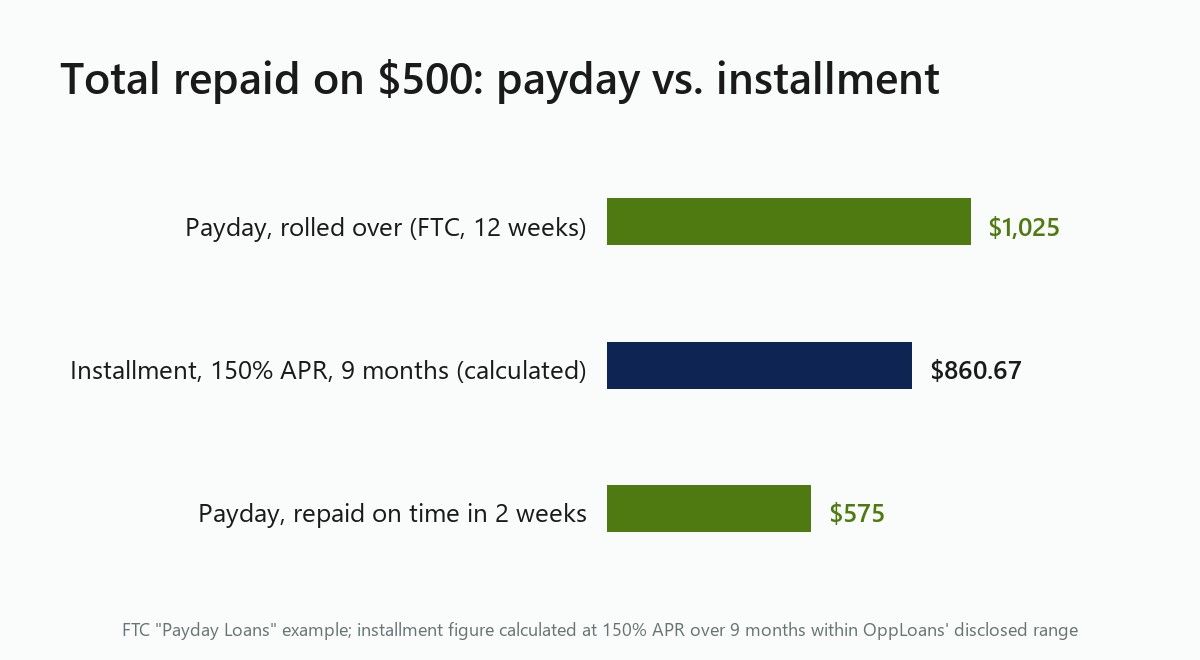
Payday loan, single balloon payment. The FTC's own consumer-education material walks through a borrower who needed $500 in cash. He wrote a check for $575, covering the $500 principal plus a $75 fee, postdated to his next payday. He couldn't cover it when it came due, so he rolled the loan over repeatedly.
By the time he cleared the debt twelve weeks (three months) later, he had paid $1,025 to borrow $500 (Federal Trade Commission, "Payday Loans"). That's the FTC's rolled-over example. The base case, no rollover, is $75 in fees on $500 for a two-week term.
The Consumer Financial Protection Bureau's 2013 payday lending data lines up with that structure: the average loan size was around $375, the typical fee ran $15 per $100 borrowed, and the full balance came due at the next payday (Consumer Financial Protection Bureau's 2013 "Payday Loans and Deposit Advance Products" report). The median borrower took out eight of these loans in a year: repeated single-payment borrowing, month after month.
Installment loan, amortized payments. OppLoans, a licensed small-dollar installment lender, publishes a loan amount range of $500 to $5,000, an APR range of 129% to 195%, and terms running 9 to 18 months (OppLoans). The company's own worked example is a $2,000 loan over 9 months at 160% APR, carrying payments of $394.58 a month.
OppLoans doesn't publish a $500-specific example, so here is a calculated illustration built from their disclosed range: scaling to a $500 loan at an APR within that range, 150%, over a 9-month term with standard amortization, the monthly payment comes out to $95.63, for a total repaid of $860.67 and a total finance cost of $360.67.
Line the totals up: $575 if the payday loan is paid on time in two weeks, $1,025 in the FTC example's total after repeated rollovers across twelve weeks, versus an illustrated $860.67 spread across nine months for the installment structure. The FTC example's total is higher than the installment illustration. The on-time payday total is lower. Which one actually costs you more depends entirely on whether you can pay the payday balance in full on the first due date, and that's the honest answer this comparison supports.
What stays constant is the structural fact: one cost lands in a single two-week lump sum, the other is broken into nine smaller pieces you can budget around month to month.
It's also worth knowing that installment loans don't all price this high. U.S. Bank's Simple Loan product runs around 35.65% APR, $6 for every $100 borrowed, with a $400 example working out to a $24 fee and three monthly payments of roughly $141.33 each (U.S. Bank).
That product is bank-account-gated and typically smaller, so it will not fit every borrower. Even so, it shows the amortized structure itself can carry a far lower rate than the payday example above, or than the high-cost online installment lenders sitting in that 129% to 195% range. The structure sets the payment shape; the lender sets the price, and those two things vary independently of each other.
Credit unions offer a version of this same amortized structure at a much lower ceiling, through a credit union Payday Alternative Loan built on the same scheduled-payment mechanics as any other installment loan. It's worth checking the current rate cap and eligibility rules for that option before accepting a triple-digit-APR offer.
When an "Installment Loan" Is a Payday Loan Wearing a Different Label
Some lenders market a product as an "installment loan" while structuring it to function almost exactly like a payday loan: a short overall term, only two to four payments, and each payment large enough that the borrower feels the same lump-sum pressure a balloon payment creates. These hybrid products blur the line you'd normally rely on to tell the two apart, so the label on the offer letter alone won't tell you what you're actually signing up for.
Check the payment schedule on the offer itself. A genuine amortized installment loan gives you a fixed monthly payment, roughly equal in size, across enough months that no single date carries the full weight of the debt. If the "installment loan" in front of you has two or three payments crammed into a matter of weeks, each one sized like a payday balloon payment, you're looking at a payday loan wearing an installment loan's paperwork. Before signing, compare the payment count and spacing against a direct lender that discloses installment terms plainly for bad-credit borrowers.
Where You Live Changes Which Product Is Even Legal
Structure determines cost mechanics. Geography determines whether a given product is legal at all, and the two loan types don't always travel together on that question.
Georgia is the clearest case study on the books. Payday lending there goes well beyond a low rate cap: it's a criminal offense. O.C.G.A. § 16-17-2 prohibits loans under $3,000 structured as payday or deferred-presentment transactions, and violating it is a misdemeanor of a high and aggravated nature, punishable by up to a year in prison or a $5,000 fine.
A person with three prior convictions under the statute faces felony charges (O.C.G.A. § 16-17-2). Those penalties make clear the statute carries real criminal exposure for payday and deferred-presentment lending specifically.
At the same time, the same state affirmatively licenses installment lenders under a completely separate law, the Georgia Installment Loan Act, O.C.G.A. §§ 7-3-1 through 7-3-52, formerly known as the Georgia Industrial Loan Act before it was renamed effective June 30, 2020 (Justia, Georgia Code Title 7, Chapter 3). One statute makes payday and deferred-presentment loans under $3,000 a crime. A separate statute regulates and licenses the amortized version as a legitimate business.
That pairing reflects two distinct legal frameworks applied to two structurally different products. If you're weighing options in a state with restrictions like Georgia's, it's worth checking what's specifically permitted for Georgia borrowers before assuming every short-term product is off the table.
The practical takeaway: don't assume that because payday loans are illegal where you live, every short-term lending option is off the table. Check what's actually legal in payday-restrictive states and which statute governs the specific product in front of you before ruling it out.
Closed-End Credit Beyond Payday and Installment Loans
Once you can spot closed-end credit, you'll notice it well beyond small-dollar lending. Common closed-end credit examples include:
- Auto loans. You borrow a fixed amount to buy a specific vehicle, repay it in scheduled installments over a set term, and the loan is done once the balance hits zero. No refill.
- Mortgages. A fixed amount borrowed against a specific property, amortized over a set term. The line doesn't reopen once you pay it down.
- Personal loans. A single lump-sum disbursement repaid on a fixed monthly schedule over a defined term, structurally identical to the installment loan example above, typically issued through a bank or credit union.
What all three share with both payday and installment loans is the absence of a replenishing balance. Compare that to a credit card, where paying down the balance frees up room to borrow again under the same account. That replenishing feature is what makes a credit card open-end credit, and its absence is what makes every product on this list, payday loans included, closed-end.
Why This Structural Read Matters for the Offers in Front of You
APR headlines tend to dominate the conversation around short-term borrowing, and for good reason: they're the fastest way to compare cost. But APR alone won't tell you whether your entire obligation lands on one date or gets spread across a schedule you can actually plan a paycheck around. That's as much a cash-flow question as a cost question, and it's the one the balloon-versus-amortized distinction answers directly. The same structural read explains the Georgia example above: a criminal ban on the balloon-payment product sits next to a licensing law for the amortized one, reflecting how differently the two structures are treated by regulators, independent of which one costs more in a given case.
Before you sign either offer on that kitchen table, trace the payment schedule line by line: how many payments there are, how far apart they fall, and what happens if you can't make one on time. Those three details tell you more about what the loan will actually feel like to repay than the APR printed at the top of the page.
Frequently Asked Questions
Legally, a payday loan is installment: it falls under closed-end credit. Regulation Z defines revolving (open-end) credit as a replenishing line with repeated, reasonably anticipated transactions, like a credit card. A payday loan is a single advance repaid on its own schedule, closed-end under 12 CFR 1026.2(a)(10), the same category installment loans occupy (Consumer Financial Protection Bureau, Regulation Z).
Closed-end credit is any consumer credit that isn't open-end credit, per 12 CFR 1026.2(a)(10). In practice, that means a fixed amount borrowed once, repaid on a defined schedule, with no line that reopens as you pay it down. Mortgages, auto loans, personal loans, payday loans, and installment loans all qualify; credit cards and HELOCs do not.
In Georgia, yes: payday lending is banned as a crime under O.C.G.A. § 16-17-2, while a separate law, the Georgia Installment Loan Act, licenses installment lenders in that same state. Check your own state's statutes before assuming a payday ban rules out every short-term product.
No. Paid on time in two weeks, a payday loan can cost less in total dollars ($575 on $500) than the installment illustration spread over nine months ($860.67). But a payday loan rolled over repeatedly, as in the FTC's example reaching $1,025, can cost far more. Total cost tracks the specific APR and term you're offered.