

A payday loan comes due whole, in one lump sum, on your next payday. An installment loan spreads that same debt across a fixed number of scheduled payments made over several months, so the balance shrinks a little with every check instead of landing all at once. That structural difference is why so many borrowers who got burned once on a payday balloon payment start searching for installment loans direct lenders for bad credit.
They want the monthly-payment structure, but they also want the company approving them to be the actual funder, with no middleman reselling the application to the highest bidder. The mechanics matter. So does the vetting. Here is how both actually work, and how to tell a licensed direct lender apart from everything else wearing that label.
How a Bad Credit Installment Loan Actually Works
A bad credit personal installment loan works on amortization, the same principle behind an auto loan or a mortgage. You borrow a set amount, agree to a fixed number of payments (at least two, and usually many more), and each payment covers both interest and a slice of the principal. Early payments lean more heavily toward interest.
Later payments chip away more at what you actually borrowed. By the final installment, the balance hits zero on schedule, assuming nothing gets missed along the way.
That is the opposite of how a payday loan is built. A payday loan charges a flat fee against the full balance and expects everything back in a single lump sum, with no partial-payment path built into the product at all, which is exactly why so many payday borrowers end up rolling the loan over. An installment loan builds that partial-payment path in from day one.
Underwriting works differently too. A thin or damaged credit file does not tell a lender much on its own, so direct lenders often weigh the alternative credit file many bad-credit approvals actually run on, judging whether the payment schedule is realistic separate from whatever happened on an old account somewhere else.
What "Direct Lender" Really Means (and What It Doesn't)
The phrase "direct lender" gets used loosely across the bad-credit lending market, and the CFPB's February 2024 circular on digital intermediaries is useful for sorting out what it should mean. The circular describes two roles that are not the lender itself. One is a comparison-shopping tool that displays multiple lenders' offers side by side.
The other is a lead generator that collects an application and sells it to lenders, sometimes without ever contacting the consumer directly. Neither one funds your loan.
In practice, a direct lender is the company that originates and funds the loan itself, underwrites your application under its own criteria, and appears as the actual creditor on your loan agreement.
When you search for direct lender loans online for bad credit, the comparison tool, the lead generator, and the lender itself all show up mixed together in the results, which is exactly why the label needs translating before you apply. The CFPB circular also warns that intermediaries can steer applicants toward the highest-paying lender, and that misrepresenting their own role as the lender when they are not can violate the ban on abusive practices in the Consumer Financial Protection Act (CFPA). If a site collects your information and then several unfamiliar companies start calling, you were never talking to a direct lender in the first place.
A third structure complicates the picture further: bank partnerships. A non-bank company markets and services the loan, while a chartered bank actually originates and funds it behind the scenes. This structure is sometimes called a rent-a-bank arrangement, because it can let a company offer terms that would not be allowed under its own state license.
The lead generator, the comparison broker, and the bank-partnership servicer each play a legitimate role in the market. None of the three is a direct lender, and knowing which one is holding your paper changes who you can actually hold accountable if something goes wrong.
Realistic APR Ranges: Why 18% and Well Over 100% Can Both Be Legal
APR on a bad credit installment loan swings harder than almost any other consumer credit product, largely because it depends on where you live and which of the three lender types above actually holds your loan. The Texas Office of Consumer Credit Commissioner's 2025 study of licensed consumer loan products found that standard signature installment loans (Chapter 342-E) run roughly 18% to 30% APR on typical terms, climbing to about 44% APR on smaller, shorter loans. Installment loans structured under the credit access business (CAB) broker-fee model (Chapter 342-F) run roughly 80% to 113% APR, all inside that same state's regulated market. One study, one state, and a nearly 100-point APR gap depending on which statute the lender operates under.
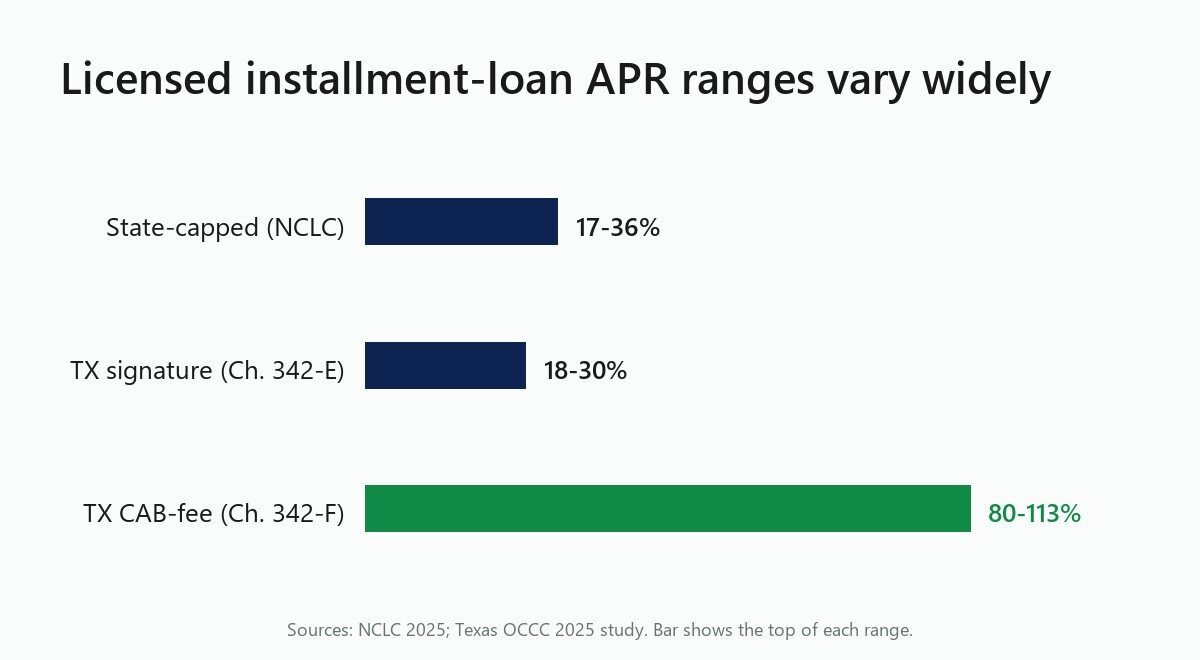
Nationally, the pattern holds: the National Consumer Law Center's 2025 review found statutory caps of roughly 17% to 36% across 19 states and DC. Federal credit unions offer an even tighter version of that same capped world: Payday Alternative Loans, capped by the National Credit Union Administration (NCUA), are a 28%-capped alternative worth checking first if you already belong to a credit union. They sit near the bottom of the entire bad-credit lending market.
States without a binding rate cap on installment lending are a different story. There, licensed lenders can charge well over 100% APR and still be operating entirely within the law, because no ceiling stops them.
A triple-digit APR is not automatically predatory, and an 18% offer is not automatically safe just because the number looks smaller. Term length and loan size explain why a high APR doesn't always mean a high dollar cost: a short loan at a high rate can cost less in total dollars than a long loan at a lower one. Read the total-of-payments line on the disclosure box, not just the headline rate, before comparing two offers.
Red Flag: Origination-Fee and Add-On Stacking
The first red flag shows up before you even sign: fees and optional add-on products packed into the loan without a clear, separate yes or no. The CFPB ordered OneMain Financial, a direct installment lender, to pay $20 million in 2023, split between $10 million in consumer refunds and a $10 million penalty. The CFPB found that OneMain pre-packed optional add-on products, including credit insurance, into loan paperwork, never verbally told borrowers the products were included or optional, made the products hard to remove once bundled in, and then kept interest that had already accrued on the add-ons even during the loan's own advertised refund-cancellation window.
A federal enforcement order against a licensed, openly operating direct lender says something specific: a license does not stop a company from packing extras into your paperwork. You have to check the bundle yourself, every time. The CFPB's own consumer guidance on installment loan fees lists what to look for: origination fees, documentation fees, optional credit or disability insurance, non-filing insurance on secured loans, and late fees, and it directs borrowers to check the required loan disclosures and loan documents before agreeing to anything. Learn how to read the fee disclosures before you sign, then go through them line by line and ask the lender to name, out loud, every optional product bundled into the total you are financing.
Red Flag: Prepayment Penalties
The second red flag is a fee for paying your loan off early. Most consumer loans can be prepaid without penalty, but that protection is not universal, and it depends on both your state and your specific loan type. The CFPB's guidance on the subject tells borrowers to check their loan agreement and ask the lender directly rather than assume early payoff is free. Some states restrict or ban prepayment penalties specifically on small consumer installment loans, separate from the rules governing mortgages, but coverage varies enough by state that you cannot assume protection just because prepayment penalties are broadly uncommon.
Your loan's required disclosure box, mandated under the Truth in Lending Act and Regulation Z, is where this question gets answered in writing. It lists the APR, the finance charge, the amount financed, the payment schedule, and the total of payments, and any prepayment terms should sit alongside them. If a lender hesitates to answer a direct question about early payoff before you sign, that hesitation is itself useful information.
Red Flag: Loan Flipping and Forced Refinancing
The third red flag is a lender that keeps pushing you to refinance a loan you have not finished paying off, generating a new set of fees with every renewal. The CFPB alleges this happened at scale inside Heights Finance and its affiliated brands, Southern Management Corp, Covington Credit, Southern Finance, and Quick Credit, all part of CURO Group Holdings. The CFPB sued the company on August 22, 2023, in federal court in Greenville, South Carolina, alleging that it identified borrowers who could not realistically repay their loans and aggressively pushed them into repeated refinancing that piled on new fees without reducing what they owed.
Per the CFPB's complaint, nearly 10,000 consumers were held in continuous, uninterrupted debt between 2013 and 2020, and borrowers who refinanced a dozen or more times made up just under 10% of the total borrower population while generating 40% of the company's net revenue. That is a filed lawsuit, not a settled judgment, and a federal court has not yet ruled on the allegations.
Watch for the pattern the CFPB describes regardless of how that case resolves. A lender contacting you unprompted about refinancing, especially soon after the original loan closed, deserves suspicion. Read a refinance offer as carefully as you read the original agreement: check whether new fees are being added, whether the term is resetting the clock on interest already paid down, and whether the new loan actually leaves you better off or just further from paying off the debt.
How to Vet a Licensed Direct Lender Before You Sign
Vetting a lender takes a few minutes, and it should happen before you fill out an application that triggers a credit pull.

- Search the lender's name or NMLS ID at nmlsconsumeraccess.org, the free national registry that tracks which companies are authorized to do business in which states, and confirm your state shows "Yes" under Authorized to Conduct Business. Coverage is strongest for mortgage licensees and increasingly covers consumer-lending licensees, but it does not catch every state-licensed installment lender, so treat a clean result as a strong signal rather than the final word.
- Check your own state's banking or financial-regulation department license lookup as a backup. Some consumer-finance-company and installment-loan licenses are tracked only at the state level and never appear on NMLS at all.
- Ask directly who originates the loan and who services it. If the answer involves a bank partner you have never heard of, you are likely looking at a bank-partnership arrangement, and it is worth knowing whose name is actually on the note.
- Be skeptical of lenders that claim state law doesn't apply to them. That claim shows up most often from operations citing tribal sovereign immunity, a structure worth understanding before you borrow.
- Read the TILA disclosure box in full before signing anything: APR, finance charge, amount financed, payment schedule, and total of payments. If any of those figures look different from what you were quoted verbally or in an ad, stop and ask why, in writing.
Each of these five steps is a short, specific check, nothing that requires more than a couple of open browser tabs. Together, they are the difference between borrowing from a company you can identify and hold accountable, and borrowing from whichever name happened to show up first in your search results.
Frequently Asked Questions
A direct lender originates and funds your loan itself, rather than selling your application to other companies. Lead generators and comparison sites collect your information and route it to third-party lenders, a practice the CFPB has flagged for steering borrowers toward the highest-paying lender. Ask directly who is lending the money.
Search the lender's name or NMLS ID at nmlsconsumeraccess.org, a free national registry, and confirm your state shows "Yes" under Authorized to Conduct Business. Since not every consumer-finance license appears there, also check your own state's banking or financial-regulation department license lookup as a second, independent confirmation.
It depends heavily on your state's rate cap. Texas's state credit regulator found licensed signature installment loans running roughly 18% to 30% APR, up to about 44% on smaller loans, while installment loans structured under the credit-access-business model ran 80% to 113% APR. In states without a binding cap, licensed lenders can legally charge well over 100% APR.
Sometimes, depending on your state and loan type. Prepayment penalties are not banned universally on installment loans the way they often are on mortgages. The CFPB advises checking your loan's required disclosure documents and asking the lender directly before signing, rather than assuming early payoff will always be free.
Loan flipping, also called churning, is when a lender repeatedly pushes you to refinance an existing loan, generating new fees each time. The CFPB has sued installment lenders over this practice. Treat any unsolicited refinance offer as a red flag and read new terms as carefully as the original.