


Direct Lender Loans Online for Bad Credit: The Real Difference
Of the loan applications the Federal Trade Commission examined in its 2017 case against Blue Global Media, only about 2 percent ever reached an actual lender. The rest went to buyers who held no lending license and, in some cases, had no legitimate use for a Social Security number or a bank routing number. That case is the reason "direct lender loans online bad credit" is worth searching carefully rather than clicking the first result that loads. Typing that phrase into Google puts you in front of three fundamentally different businesses: a direct lender who will actually fund you, a broker who legally arranges credit with someone else, or a marketplace that may route, or sell, your application to whoever bids the highest.
None of the three models is wrong by default for a bad credit borrower. Approval odds matter more than brand loyalty when your file is thin or your credit is damaged, and a marketplace exists precisely because a wider net catches offers a single lender's underwriting model would reject outright. The business model becomes a problem only when a site conceals which one it is running, and the enforcement record shows exactly what that concealment has already cost real borrowers.
What a Direct Lender Actually Is
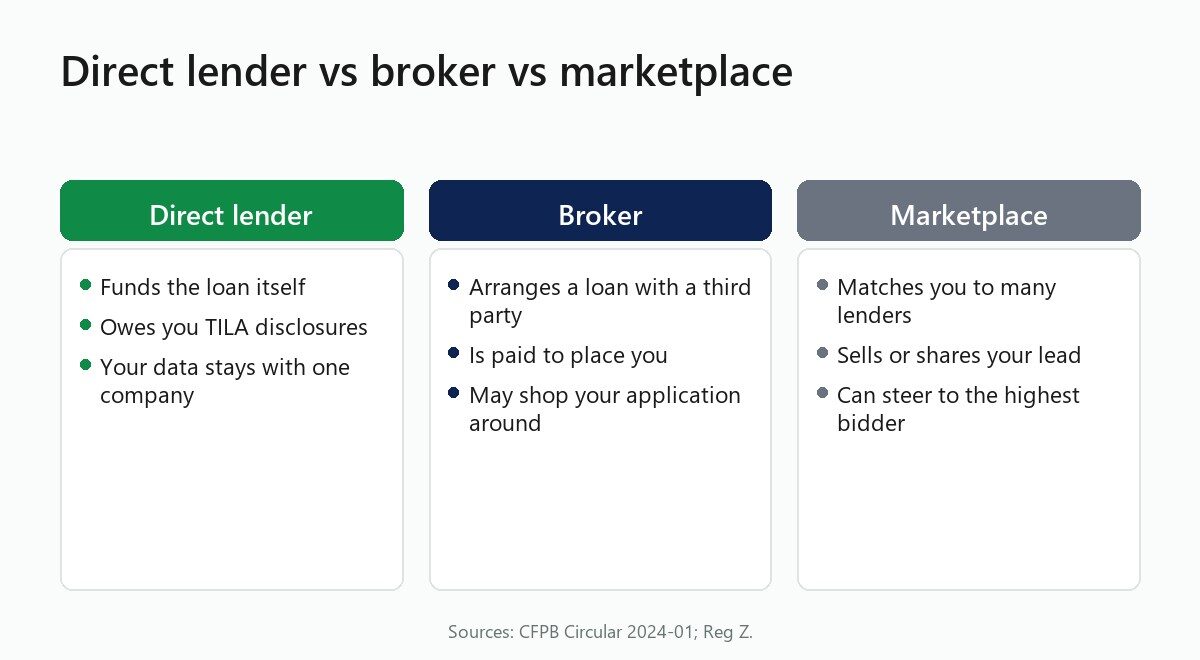
A direct lender online is the company that reviews your application, makes the credit decision, and puts the money in your account. There is no middle step. When you search for direct lender loans online for bad credit, this is the arrangement you are actually looking for: one company, one underwriting call, one contract signed with the party that is extending you the money.
The trade-off is real. A direct lender can only approve you against its own criteria, so if your file does not fit that one lender's model, you get a denial and have to start over somewhere else. Credit unions offer a version of this worth knowing about: a Payday Alternative Loan is a capped-rate direct lender alternative, funded by the credit union itself with a hard rate ceiling the National Credit Union Administration sets, rather than left to a lender's discretion.
Because a direct lender funds you itself, it also carries the direct disclosure obligation: annual percentage rate, payment schedule, and total repayment amount, spelled out under the Truth in Lending Act before you sign. A broker or a marketplace is not always required to hand you that same paperwork directly.
What a Loan Broker Actually Is
A loan broker does not fund your loan itself. It arranges credit on your behalf with a lender who does, collecting your application, shopping it to one or more lending partners, and connecting you with whichever one agrees to fund you. Under Regulation Z, the rule implementing the Truth in Lending Act, a "creditor" is defined as a party who regularly extends credit subject to a finance charge or repayable in more than four installments, and to whom the debt is initially payable (12 CFR 1026.2(a)(17), via Cornell Law School's Legal Information Institute). A broker who merely refers or arranges credit, without the debt ever being payable to the broker itself, does not meet that definition.
That legal distinction is the seam separating a broker from a direct lender, and it explains something that surprises a lot of borrowers: a broker's paperwork looks different because the broker is generally not the party Regulation Z requires to hand you the full disclosure box. The obligation instead sits with whichever lender the debt is actually payable to. A legitimate broker still answers to state licensing requirements, prohibitions on unfair or deceptive practices, and the Fair Credit Reporting Act's limits on how it can use your credit file, so falling outside Regulation Z's creditor definition does not mean a broker operates free of oversight.
Both a broker and a marketplace may also pull alternative credit data, the file lenders pull when your credit score won't cut it, and share that same file with more than one potential funder. Knowing that in advance changes how you should read the next section.
What a Marketplace or Matching Service Actually Is
A marketplace, sometimes called a matching service or a comparison site, collects your application once and then routes it, or as the FTC's own enforcement cases put it, sells it, to lenders willing to bid on it. In a well-run version of this model, every "partner" you get routed to is a state-licensed lender, and the site discloses upfront that it earns money when a partner funds you. In the worst version, documented repeatedly by federal regulators, the application does not stop at licensed lenders. It continues into a secondary market of data buyers with no intention of ever making you a loan.
The Consumer Financial Protection Bureau's Circular 2024-01, published February 29, 2024, put digital comparison tools and lead generators on formal notice that steering a consumer toward whichever lender pays the operator the most, rather than whatever fits the consumer's interest, can violate the Consumer Financial Protection Act's ban on abusive acts and practices (CFPB Circular 2024-01). The circular names specific red flags: a lead generator that promises a lender a set volume of leads and divides consumers to hit that quota regardless of fit, a site that claims to find you the "best interest rate" but actually routes your application to whichever lender bid highest, and a comparison page that labels paid placements "featured" without disclosing that money changed hands.
Federal privacy law also governs this transaction. Under the Gramm-Leach-Bliley Act and Regulation P, the rule implementing GLBA's privacy provisions, a financial institution generally cannot hand your nonpublic personal information to a company it is not affiliated with unless it has given you the required privacy notice and you have not exercised your right to opt out, with narrow exceptions for service providers and certain joint-marketing arrangements (FTC business guidance on GLBA/Regulation P). A real privacy notice and a working opt-out are what separate a compliant marketplace from the pattern regulators have already caught.
Quick5k operates in this category: it is a marketplace that collects your application and routes it to state-licensed lending partners rather than funding loans itself. Naming that plainly is what "honest reading, no selling" is meant to commit to: telling you which business model you are dealing with and keeping your application inside licensed partners rather than the kind of secondary data market the enforcement cases below describe. That commitment does not exempt this site, or any marketplace, from real scrutiny, since every site asking for a Social Security number and a bank routing number earns that scrutiny.
The common complaint pattern documented in the FTC's own case narratives looks like this: a borrower applies once on what appears to be a single loan offer, then gets contacted by phone, text, and email from multiple companies within hours, several of which never appeared on the site's stated partner list. This pattern matches the resale documented in the Blue Global Media and ITMedia cases, and it is why knowing what to do if a lead buyer keeps calling you is worth reading before you apply. Many borrowers do not realize a "matching" or "comparison" site is not itself a lender until they are already mid-application.
Direct Lender, Broker, or Marketplace: The Side-by-Side Comparison
Once you know which of the three models a site is running, comparing installment loans from direct lenders for bad credit against broker or marketplace offers comes down to five questions: who actually funds you, who sees your application, how transparent the fee and rate structure is, what disclosure paperwork you should expect, and which borrower each model fits best.
Direct lender
- Who funds you: The lender itself, in a single underwriting decision.
- Who sees your application: Just that one company.
- Fee and rate transparency: Full Truth in Lending Act disclosures come directly from the party extending the credit.
- Disclosure paperwork: The complete Regulation Z disclosure box, since the lender meets the "creditor" definition under 12 CFR 1026.2(a)(17).
- Best fit: A borrower whose profile is likely to clear one specific lender's underwriting model, such as an existing credit union member applying for a Payday Alternative Loan.
Loan broker
- Who funds you: A lending partner the broker arranges the credit with, never the broker itself.
- Who sees your application: The broker and whichever lending partner or partners it shops your file to.
- Fee and rate transparency: Varies. A broker may add its own arrangement fee on top of the lender's rate, so ask directly whether one applies.
- Disclosure paperwork: Generally not the full Regulation Z creditor disclosure box; that obligation belongs to the lender the debt is payable to.
- Best fit: A borrower who wants one company to shop multiple lenders without filing several separate applications.
Marketplace
- Who funds you: Whichever partner lender ultimately bids on or accepts your routed application.
- Who sees your application: Potentially several bidding lenders, and in the worst documented cases, non-lender data buyers as well.
- Fee and rate transparency: Should be disclosed upfront per CFPB Circular 2024-01's expectations; a site that hides how it is paid is the red flag the circular names.
- Disclosure paperwork: Generally a privacy notice and opt-out right under the Gramm-Leach-Bliley Act and Regulation P, plus disclosure from whichever partner lender ultimately funds you.
- Best fit: A borrower with a thin file or lower approval odds who wants the widest net, provided the site names its licensed partners plainly.
After you have narrowed the field to a single direct-lender offer, the next step is learning how to read the real cost before you compare offers, since two loans with similar advertised rates can carry very different total repayment amounts.
How to Tell a Legitimate Matching Service From a Lead-Selling Trap
The enforcement cases below share one thing in common: every warning sign was visible before the borrower submitted a Social Security number, not after. Run any site through this checklist before you apply.

- Does it name its actual lending partners, including their state licensing, rather than describing them only as a "network" or "trusted partners"?
- Does it post a real privacy notice with a working opt-out, the disclosure the Gramm-Leach-Bliley Act and Regulation P require before your data goes to a nonaffiliated company?
- Does it disclose that it may be paid per lead or per funded application, rather than presenting itself as a neutral comparison tool?
- Does the contact volume you receive after applying match what you actually agreed to, rather than calls from companies that never appeared on the partner list?
- Does it explain what happens to your data before it runs a credit pull, including what happens if no partner extends you an offer?
Any one of these gaps is reason enough to close the tab before you type in a Social Security number.
What Regulators Have Already Caught Bad Actors Doing
FTC v Blue Global Media, 2017
The company operated roughly three dozen loan-application websites, telling consumers their information would go to a network of "trusted lending partners" and would be stored securely. In fact, the FTC found, only about 2 percent of applications were ever sold to an actual lender; the rest went to non-lender buyers, including some the agency said had no legitimate use for a Social Security number or bank routing number. The FTC's judgment against the company totaled $104,470,817, though most of that amount was suspended based on the company's inability to pay, a common outcome in FTC settlements of this size (FTC press release).
FTC v ITMedia Solutions, settled January 7, 2022
ITMedia told applicants their information would go to a "trusted network of lenders," then fed the applications into a live marketplace where buyers bid on the data instead. The FTC also found the company pulled applicants' credit reports and used that data to screen and price leads for sale, a use federal credit-reporting law does not permit. ITMedia paid a $1.5 million civil penalty to resolve the case (FTC press release).
CFPB v T3 Leads, settled 2018
T3 Leads sat between the lead generators who collected applications and the payday and installment lenders, plus non-lender buyers, who purchased them. The Consumer Financial Protection Bureau found the company failed to vet or monitor how the generators feeding it obtained or handled consumer data. The settlement required T3 Leads to pay roughly $4 million and permanently barred the company from lead generation, lead aggregation, or data brokering for high-interest consumer loans going forward (CFPB newsroom).
None of these three cases involved a hidden fringe operator. Each one ran a functioning, high-traffic website that looked like any other loan-comparison page. That is exactly why the checklist above matters more than gut instinct: a professional-looking site tells you nothing about which of the three models it is actually running.
Frequently Asked Questions
A marketplace can be a safe way to compare offers if it names its licensed lending partners, posts a real privacy notice with an opt-out under the Gramm-Leach-Bliley Act, and discloses how it gets paid. The FTC's cases against Blue Global Media and ITMedia Solutions show what happens when a site skips those disclosures instead.
Sometimes. A broker may add its own arrangement fee on top of whatever the funding lender charges, while a direct lender's price is just its own rate and fees. Since Regulation Z's disclosure requirements fall on the lender rather than the broker, get the total cost in writing before you sign anything.
It should not, and doing so can violate federal law. The Gramm-Leach-Bliley Act generally requires a privacy notice and opt-out before sharing your data with an unrelated company. ITMedia Solutions paid a $1.5 million penalty in 2022 after the FTC found it claimed a trusted lender network would receive applicants' data, then auctioned it instead.
Check the loan agreement itself: it names the actual creditor, the party your payments legally go to, which can differ from the brand on the website you applied through. If that name does not match any lender you recognize, ask the site directly which company is funding you before you sign.