You don't need a lecture on budgeting right now. You need a $100 loan, and you need to know what it's going to cost you before you commit to anything. That's fair. So let's skip the sales pitch and put real numbers on the table for the ways people actually get $100 fast: cash advance apps, bank small-dollar loans, credit card cash advances, and payday storefronts, plus one option worth knowing about even though it doesn't come in a $100 size.
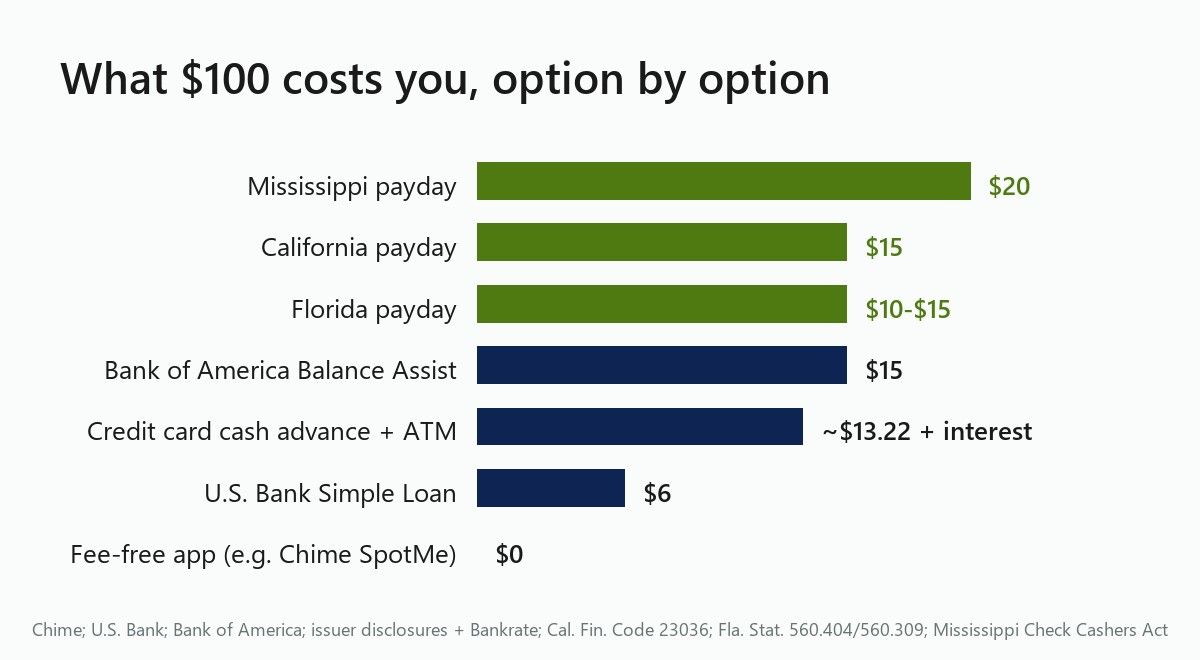
Here's the ranking, cheapest to most expensive, based on what a real $100 request costs in fees:
- Fee-free cash advance apps: $0 in mandatory fees
- U.S. Bank Simple Loan: $6 flat fee
- Florida payday loan: $10 to $15 (a 10% fee plus up to $5 in verification charges)
- Credit card cash advance: roughly $10 in upfront fees, plus interest starting day one
- California payday loan and Bank of America Balance Assist: tied at a $15 fee
- Mississippi payday loan: $20 fee
Florida's floor beats the other two payday states, but not the apps or bank options above it, and its ceiling ties California and Bank of America at $15. More on that in the state-by-state breakdown below.
A credit union Payday Alternative Loan (PAL) sits outside this ranking because it doesn't come in a $100 size. Now let's walk through each option and where the real cost hides.
Fee-Free Cash Advance Apps: Your Cheapest $100 Option
Two apps stand out for a $100 cash advance with no mandatory fee attached. MoneyLion's Instacash product advertises no interest and no credit check, with tips entirely optional and no effect on your advance eligibility or limit. Standard delivery, which lands in one to two business days on a MoneyLion Spend account or two to five days to an outside account, is free.
Instant delivery carries a variable fee, so if speed matters to you, read that screen carefully before you tap confirm. Per-transaction advances cap at $100, which lines up neatly with what you're likely trying to pull right now, according to MoneyLion's Instacash terms.
Chime's SpotMe is the cleanest fee-free option in this whole category. It covers $20 to $200 with zero fee, not even an optional instant-transfer charge, as long as you've received a qualifying direct deposit of $200 or more within the last 34 days, per the Chime SpotMe help page. If you already bank with Chime and meet that deposit threshold, this is likely the least expensive $100 you'll find anywhere on this list.
Worth flagging: not every app in this space is actually free. Cash App Borrow charges 1.25% weekly non-compounding interest on any balance you carry, plus a $5 fee if you pick a repayment schedule the app doesn't recommend, with a $20 minimum advance, per Cash App Borrow's loan agreement terms. EarnIn runs on tips rather than mandatory fees but caps daily access at $150 and requires a recurring deposit of $320 or more, and its instant-transfer tiers run $3.99 to $5.99, per EarnIn's Cashout terms.
Read the fee screen on any app before you accept an advance. "No credit check" and "no fee" are two different promises, and apps love blurring the line between them.
If you're weighing an app advance against an overdraft on your checking account, quick5k breaks down that tradeoff in its guide to cash advance apps vs. overdraft fees.
Bank Small-Dollar Loans: The Cheapest Loan Product You Can Point To
If a fee-free app isn't available to you, U.S. Bank's small-dollar loan is the next cheapest thing on this list. It's a real installment loan, not a revolving advance.
Bank of America's Balance Assist lets existing checking customers borrow up to $500 for a flat $15 fee, no matter the amount borrowed. Repayment splits into four equal monthly payments, and borrowing $100 means you owe $115 total, paid back in four installments of $28.75 each. On a $100 loan the flat $15 fee works out to roughly 70% APR. BofA's published 14.32% to 23.77% range applies to larger loans ($300 to $500), where the same flat fee is a smaller share of the amount borrowed, per Bank of America's own Balance Assist terms.
One catch: this program is only open to existing BofA checking customers, and BofA has required at least one year of account history (2.5 years if you don't have a credit score) to qualify.
U.S. Bank's Simple Loan works similarly, and it's the cheaper of the two bank options. You can borrow $100 to $1,000, and the flat fee runs $6 per $100 borrowed versus BofA's $15. On a $100 loan, that's $6, for a $106 total owed, repaid in three equal monthly installments.
Annualized, that $6 flat fee works out to roughly 35.65% APR. Stated as a percentage that sounds steep, but it's a fraction of what a payday storefront charges for the same $100, per U.S. Bank's Simple Loan fee structure.
If you already have a checking account with either bank, call before you go to a card or a storefront. U.S. Bank's $6 fee undercuts every other paid option in the ranking above.
Credit Union PAL: Worth Knowing About, Even If $100 Is Too Small
If $100 doesn't cover the full gap you're facing, a credit union Payday Alternative Loan (PAL) covers $200 to $1,000 at a federal 28% APR cap, with a $20 maximum application fee (NCUA's Payday Alternative Loan rule, 12 CFR 701.21). It won't help with a standalone $100 request since PAL I's floor sits at $200, but if you're going to need more than $100 before this is over, it beats every payday and credit-card option on this page over a multi-month repayment.
See quick5k's guide to credit union Payday Alternative Loans for how PAL loans work, who qualifies, and how to apply.
Credit Card Cash Advance: More Expensive Than It Looks
Pulling $100 in cash from your credit card feels simple, but it's usually more expensive than the sticker suggests. Card issuers typically charge a cash advance fee of 3% to 5% of the amount, or a flat minimum, whichever is greater (issuer disclosures, e.g. Chase and Capital One). On a $100 advance under a typical 5%/$10-minimum structure, expect around $10 in fees before interest even enters the picture.
And interest starts immediately. Cash advances don't get the grace period your regular purchases get, so interest accrues from the day you pull the cash, usually at a cash-advance APR that runs several points above your card's purchase APR (issuer disclosures, e.g. Chase and Capital One).
Federal rules on how issuers apply your payments make it worse. Under Regulation Z's payment-allocation rule, any payment above your minimum goes toward the balance with the highest APR first, under 12 CFR 1026.53. That means your cash-advance balance often gets paid down last, even while you're actively paying the card. It can sit there accruing interest for months.
Pull the cash from an out-of-network ATM and you can add an average operator surcharge of about $3.22 on top of everything else, per Bankrate's checking account survey. Add it up on a $100 advance and you could be looking at $10 in issuer fees, roughly $3.22 in ATM charges, and interest accruing before you've even made your first purchase this billing cycle.
For a fuller breakdown of how these true costs stack up against payday products, quick5k's guide to the true cost and APR of short-term loans walks through the math.
Payday Loans by State: California, Florida, and Mississippi
Payday storefronts sit at the top of this cost list, and the fee varies significantly depending on which state you're standing in. Here's what a $100 payday loan actually costs in three states, ranked cheapest to priciest.
Florida: $10 to $15, depending on the verification fee
Florida caps the fee on a deferred presentment (payday) transaction at 10% of the amount advanced, so a $100 loan costs a $10 base fee, under Florida Statute 560.404. Florida law also authorizes lenders to charge a separate verification fee, capped at $5, under a different section of the same statute, Florida Statute 560.309(8).
Add the two together and a $100 Florida payday loan can run $10 to $15 total, depending on whether your lender charges the full verification fee. Max loan size in Florida is $500.
California: $15 fee, $115 total due
California law caps the fee on a deferred deposit transaction at 15% of the check's face amount. Borrow $100 and you owe $115 back on your next payday, under California Financial Code Section 23036. California caps the loan itself at $300, so a $100 request sits well within the legal limit.
Mississippi: $20 fee, the priciest of the three
Mississippi's Check Cashers Act allows a $20 fee per $100 borrowed on loans up to $250. A $100 loan means $120 owed back. Run that fee through the standard APR formula, fee divided by principal, times 365 divided by loan term, times 100, and a 30-day loan lands at roughly 243% APR.
Shorten the term to 14 days, which is common for payday products, and the same $20 fee works out to roughly 521% APR. Same $20. Wildly different annualized cost depending on how many days you have to pay it back.
Ranked by dollar cost for exactly $100: Florida runs $10 to $15 depending on the verification fee, California's flat $15 can tie Florida's ceiling, and Mississippi's $20 tops the list among these three states. Florida's floor is the cheapest of the three payday states, but at the top end it's no longer the clear winner.
Which Option Should You Actually Pick?
The math above points toward a clear order of operations. Check a fee-free app first. If you bank with Chime and meet the deposit requirement, or if MoneyLion's terms fit your situation, that's your cheapest $100. No fee beats a small fee every time.
If apps don't work for you or aren't available, call your bank next. Ask specifically whether you have access to Balance Assist, Simple Loan, or an equivalent small-dollar program. A $6 to $15 flat fee on $100 is still far cheaper than what a storefront will charge you for the identical amount.
If you're a credit union member and you need more than $100, look at a PAL before you look at anything else on this page. The 28% APR cap puts it well below any payday or credit-card option for anyone who qualifies and needs more than $100, even though it can't help with a standalone $100 ask.
Reach for a credit card cash advance only if you've ruled out everything above and you genuinely have no better option. That $100 sitting in your wallet already comes with roughly $10 in issuer fees, interest accruing with no grace period, and roughly $3.22 in ATM charges if you pull the cash from an out-of-network machine. Reg Z's payment-allocation rule means that balance can linger even as you keep paying the card down.
Save a payday storefront for last. Mississippi's $20 costs more than every bank or app option here, California's $15 ties Bank of America's fee, and Florida's $10 floor undercuts only Bank of America's $15.
Even at the low end, the annualized cost on a short repayment term still runs into the hundreds of percent. If a storefront is genuinely your only option today, know the exact fee for your state going in, and have a plan to repay the full amount on your very next payday. Rolling it over is where the real damage happens: it adds another full fee each cycle, on top of the one you already owe.
One more thing worth saying plainly: the cheapest option on this list isn't always the fastest one to access. An app you've already got installed and linked to your bank beats a program you'd need to apply for cold, even if the fee comparison points the other direction on paper. Weigh speed against cost with your actual deadline in mind.
Frequently Asked Questions
A fee-free cash advance app is typically cheapest. Chime SpotMe charges no fee at all for a qualifying user, and MoneyLion Instacash charges no mandatory fee for standard delivery. Both beat every bank, card, and payday option on actual dollar cost.
It depends entirely on your state. Florida runs $10 to $15 on a $100 loan (10% plus up to $5 in verification charges), California caps it at a flat $15, and Mississippi allows $20 per $100 borrowed. Florida's floor is cheapest, but its ceiling can tie California.
Often, yes, upfront. A typical $100 cash advance runs around $10 in fees. But interest accrues immediately with no grace period, and payment-allocation rules can keep that balance lingering, so the total cost can climb well past the initial fee over time.
Not as a standalone product in most cases. Federal Payday Alternative Loans (PAL) have a $200 floor, well above a $100 ask, though they cap fees far below payday rates. If your need grows past $100, a PAL is worth checking with your credit union.
You need to already be a BofA checking customer. BofA requires at least one year of account history to qualify, or 2.5 years if you don't have a credit score. It's not available to new customers or anyone without an existing checking relationship with the bank.