

You got turned down. Maybe a bank, maybe an online lender, maybe both in the same week. Now your search bar is full of ads promising "second chance loans online," guaranteed approval, no judgment, funds by tomorrow.
Here's what you need to know before you click one of those ads: "second chance loan" is not a loan type. It's a marketing label. Nothing regulates it, defines it, or requires it to mean anything specific. It's a phrase a lender pastes over whatever product it happens to be selling that week, the same way "no credit check" describes a marketing pitch.
That label gets stamped on a high-APR installment loan, a tribal loan, a payday loan, a low-rate secured loan, and an advance-fee scam that will vanish with your money before you ever see a dollar. Same phrase, five completely different outcomes, the same pattern behind what "no credit check" actually means. Your job is to figure out which one is hiding behind the ad in front of you, and this article walks you through exactly how to do that.
What Is a Second Chance Loan, Really?
Ask ten lenders "what is a second chance loan" and you'll get ten different answers. The phrase describes an audience: people who've already been denied elsewhere. No regulator defines it beyond that.
Underneath that label, you'll typically find one of four things: a high-APR subprime installment loan, a tribal loan, a payday loan, or a secured or credit-builder product designed to rebuild your credit through a track record of payments. The first three exist to extract as much interest as your state's law and your patience will allow. The fourth exists to get you a clean payment history you can actually use later. Knowing which bucket you're looking at changes everything about whether that ad deserves your click.
Subprime installment loans
This is the product most "second chance loan" ads are actually selling. It's a fixed-payment loan aimed squarely at borrowers with damaged credit; one lender's first-time loans in this category run $500 to $4,000. The pricing varies wildly by lender and state.
One direct lender in this space discloses a range of roughly 75% to nearly 350% APR on first-time loans in that amount, according to a Yahoo Finance summary of that lender's disclosed range. Treat that as one lender's disclosed range, not an industry average. Other subprime installment lenders price differently, sometimes lower, sometimes not much better than a payday loan. "Second chance installment loan" tells you nothing about where on that spectrum you'll land until you read the actual offer.
Before you apply anywhere in this category, it helps to know your real approval odds with bad credit, so you're not burning hard pulls chasing offers you were never going to qualify for.
Tribal lending
A number of "second chance" ads route to lenders owned by or affiliated with a Native American tribe, which claim sovereign immunity from state interest-rate caps. Some of these are legitimate, licensed operations. Others are what's known in the industry as a "rent-a-tribe," a storefront that leases the tribal affiliation to dodge state lending law while the actual lending decisions and profits sit elsewhere.
Telling the two apart takes more than a quick glance at a website. This site has already published a full breakdown of exactly what to check, including the case law that's reshaped this space: how to tell a licensed tribal lender from a rent-a-tribe front. Read it before you sign anything from a "tribal-owned" second chance lender.
Payday loans
Plenty of ads promising a "second chance" are just payday loans wearing friendlier branding. Same structure: a small amount, due in full on your next payday, often north of 400% APR (CFPB figures, via Yahoo Finance) once you annualize the fee. If the loan is due in one lump sum in two weeks instead of installments over months, you're looking at a payday product, no matter what the landing page calls it.
Secured and credit-builder products
This is the bucket almost none of the loud "second chance loan" advertisers push, because it's less profitable for them and more useful for you. Secured personal loans, secured credit cards, and credit-builder loans trade collateral or a locked deposit for a dramatically lower rate and a track record you can use to qualify for better credit later. This article covers that bucket in detail below, because it's usually the honest answer to "how do I get a second chance" that the ad-funded sites skip.
Cost Comparison at a Glance
Here's the spread you're actually choosing from when an ad says "second chance loan," roughly ordered from cheapest to most expensive:
- DCU savings-secured loan: 3.50% APR, secured by your own savings balance.
- CUTX savings-secured loan: 7.25% APR, also secured by your savings balance.
- Credit union PAL: capped by federal rule at 28% APR, $200 to $2,000, a $20 maximum application fee.
- Unsecured subprime personal loan: averages 26.96% APR for borrowers under a 630 credit score.
- Subprime "second chance" installment loan: one direct lender's disclosed range runs roughly 75% to nearly 350% APR.
- Payday loan: commonly exceeds 400% APR when the fee is annualized (CFPB figures, via Yahoo Finance).
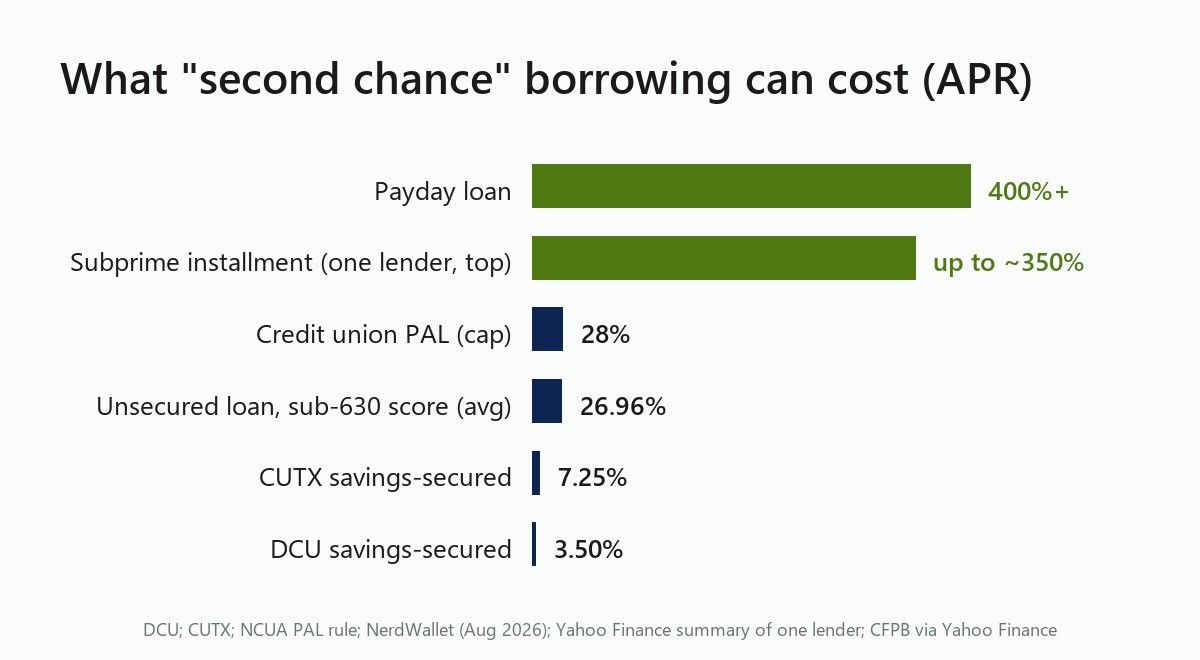
Digital Federal Credit Union (DCU) publishes its savings-secured loan rate at 3.50% APR. Credit Union of Texas (CUTX) publishes its own savings-secured rate at 7.25% APR. NerdWallet's August 2026 rate data puts the average unsecured personal loan APR at 26.96% for borrowers with sub-630 credit scores. This site's deeper breakdown of what a secured personal loan actually protects is worth reading before you decide which end of that spread you're willing to accept.
Second Chance Loan Scams: The Red Flags the FTC Wants You to Know
This is the part that matters most. The FTC's guidance on advance-fee loans describes the pattern: you're approved almost instantly, no credit check mentioned, and then you're told a fee is required before the money can be released.
The FTC puts it bluntly: "Any up-front fee that the lender wants to collect before granting the loan is a cue to walk away, especially if you're told it's for 'insurance,' 'processing,' or just 'paperwork'" (FTC). It's also illegal for telemarketers to promise you a loan and then ask for payment before the loan shows up.
A legitimate lender won't guarantee approval before it has reviewed your credit report. Guaranteed approval before a credit check is a red flag, plain and simple. This scam counts on you being too relieved by the "yes" to ask the obvious question: why didn't they need to see my credit history first?
Watch for this progression, a pattern common to this scam: a fast approval promise with no credit check mentioned, a fee framed as routine ("processing," "insurance," "administrative"), a demand that you pay it by wire transfer, gift card, or cryptocurrency, then silence once the money is sent. Scammers lean on exactly these three payment methods because they're close to impossible to recover once they're gone.
People searching for a second chance loan are in a tight spot by definition, and scammers know it. Bankrate's research on personal loan scams notes that these operators specifically target people who have trouble getting approved through conventional lenders and carry a high debt-to-income ratio (Bankrate). That's the targeting strategy behind nearly every version of this scam.
A quick legitimacy checklist
Before you give a "second chance" lender any information, run through this:
- Look the lender up on your state's licensing database. No license, no deal.
- No fee should ever be required before funding. None.
- A real lender checks your credit or at minimum verifies income and identity before approving anything.
- Legitimate lenders have a physical address and, for many product types, an NMLS ID you can search.
- The lender's name should turn up real complaints, real reviews, and a real regulatory history beyond a landing page.
If any single item on that list fails, stop the application. You lose nothing by walking away from an offer that can't clear a five-item checklist.
The Genuine Second-Chance Routes
Here's what almost never shows up in a "second chance loan" ad, because it doesn't pay affiliate commissions the way a high-APR installment loan does: the products actually built to earn you a better rate next time.
Credit-builder loans
A credit-builder loan flips the normal order of operations. You don't get the cash up front. The lender holds the loan amount in an account while you make fixed payments, then releases the funds once you've paid it off, with your payment history reported to the credit bureaus the entire time. You build a track record before you build debt.
The Consumer Financial Protection Bureau studied this product directly: borrowers who had no existing loan when they opened a credit-builder loan were 24% more likely to establish a credit score than non-participants, saw their scores rise roughly 60 points more on average, and ended up with an average $253 in savings by the end of the loan (CFPB). That same study found something you should sit with: about 40% of participants made at least one late payment. This product works only if you treat the payment like rent: something you pay first, every month, no excuses.
Secured credit cards
A secured card asks you to put down a refundable deposit, and that deposit becomes your credit line. Use it, pay it off every month, and the on-time history reports to the bureaus just like any unsecured card would. Many secured cards tie the deposit to your starting credit line, with terms that vary by issuer.
As one concrete example, the Capital One Platinum Secured Card requires a refundable minimum deposit of $49, $99, or $200 depending on your credit profile, though you can deposit more, up to $1,000, to start with a higher line, and it carries no annual fee (Capital One). Every issuer sets its own terms, so read the specific card's current disclosure page before you apply anywhere.
Credit union PALs
If you belong to a federal credit union, or can join one, a Payday Alternative Loan is the closest thing to a genuine second chance that actually deserves the name. PAL I loans are capped by federal rule at 28% APR with a maximum $20 application fee, for amounts between $200 and $1,000; PAL II raises the ceiling to $2,000, under the National Credit Union Administration's own PAL rule. This site has already broken these down in full: credit union PALs capped at 28% APR.
A PAL isn't the only thing a credit union has to offer. Many carry their own bad-credit personal loan programs and secured products worth comparing before you go anywhere near a subprime installment lender. See what a credit union offers beyond the PAL for the fuller list.
How to Read Any "Second Chance" Offer Before You Sign
Once you've narrowed down which bucket an offer actually falls into, three questions tell you almost everything you need to know. What's the APR, stated as an actual number you can find in under a minute? Is any payment required before funds arrive? Can you verify this lender's license in your state today, before you hand over a Social Security number?
An offer that answers all three cleanly deserves your consideration. An offer that dodges even one of them deserves your suspicion. It doesn't require you to become an expert overnight, just to check what's actually underneath the "second chance loan" label.
Skip straight to "how fast can I get the money" and you're the exact borrower a bad offer is designed for. Slow down before you submit an application. That's the whole cost of doing this right.
Frequently Asked Questions
It's a marketing label used to advertise to people already denied credit elsewhere. There's no regulated product category behind the phrase. Underneath it you'll find subprime installment loans, tribal loans, payday loans, or genuine credit-building products like secured cards and credit-builder loans.
Some are, some aren't. A legitimate lender checks your credit or income before approving you and never asks for a fee before funding. An ad promising guaranteed approval with no credit check that later asks for an upfront payment is running an advance-fee scam.
The FTC's pattern: fast approval with no credit check, followed by a fee labeled "processing," "insurance," or "paperwork," paid by wire transfer, gift card, or cryptocurrency. Once you pay, the funding never arrives. It's also illegal for a telemarketer to promise a loan and ask for payment before it shows up, exactly the sequence these scams follow.
Credit union PALs cap out at 28% APR. Savings-secured loans go even lower: DCU publishes 3.50% APR and CUTX publishes 7.25% APR on their savings-secured products. Both beat a subprime installment loan; one lender discloses a range of around 75% to nearly 350% APR.
CFPB research found borrowers with no existing loan who opened a credit-builder loan were 24% more likely to establish a credit score and saw scores rise roughly 60 points more than non-participants. About 40% made at least one late payment, so treat it like a bill you cannot skip.