


Speedy Cash interest rates in California can't legally top a $45 fee on a $300 payday loan, which works out to roughly 460% APR over two weeks. That cap applies to every licensed payday lender operating in the state; California's 2018 consent order lists Speedy Cash as holding a California deferred deposit license.
This piece sticks to what's independently verifiable: the California statutory structure, who owns Speedy Cash, one regulator action on record, and the questions worth asking before you sign anything. Speedy Cash publishes its own rates-and-terms page for each state; read yours before you apply. State law actually sets the ceiling on what any licensed lender can charge you, and that's the part you can check yourself, against the statute itself, before you ever walk into a storefront or open an application on your phone.
Who Actually Owns Speedy Cash
Speedy Cash operates under Community Choice Financial. That's according to the company's own Better Business Bureau listing, which files the two names together as "Speedy Cash - Community Choice Financial."
That corporate structure matters for a practical reason. When you're checking licensing records, reading a complaint response, or trying to figure out who actually holds the loan you signed, Community Choice Financial is the parent name you may see listed next to the Speedy Cash storefront brand.
California's 2018 consent order against the company also fills in a piece of the corporate picture: it identifies Speedy Cash as a Nevada corporation headquartered in Wichita, Kansas, operating in California under a deferred deposit license numbered CDDTL 100-0854. CDDTL stands for California Deferred Deposit Transaction Law, the statute that governs payday lending licensing in the state, and it's the same license type California borrowers should look for when checking any payday lender's paperwork.
If you want to confirm a lender's license yourself before you walk into a storefront or fill out an online application, your state's financial regulator keeps a public list. California borrowers can search DFPI's licensee lookup directly. It tells you whether the entity extending you credit is actually authorized to operate in your state under the name on your paperwork, and it takes only your lender's exact business name to search.
Speedy Cash Rates and Terms Under California's Payday Cap
California doesn't let payday lenders set their own terms. State law builds the entire structure from the ground up. Under California Financial Code Section 23035, a deferred deposit transaction (the legal term for a payday loan) tops out at a $300 face amount. The fee a lender can charge is capped at 15% of that face amount, or $45.
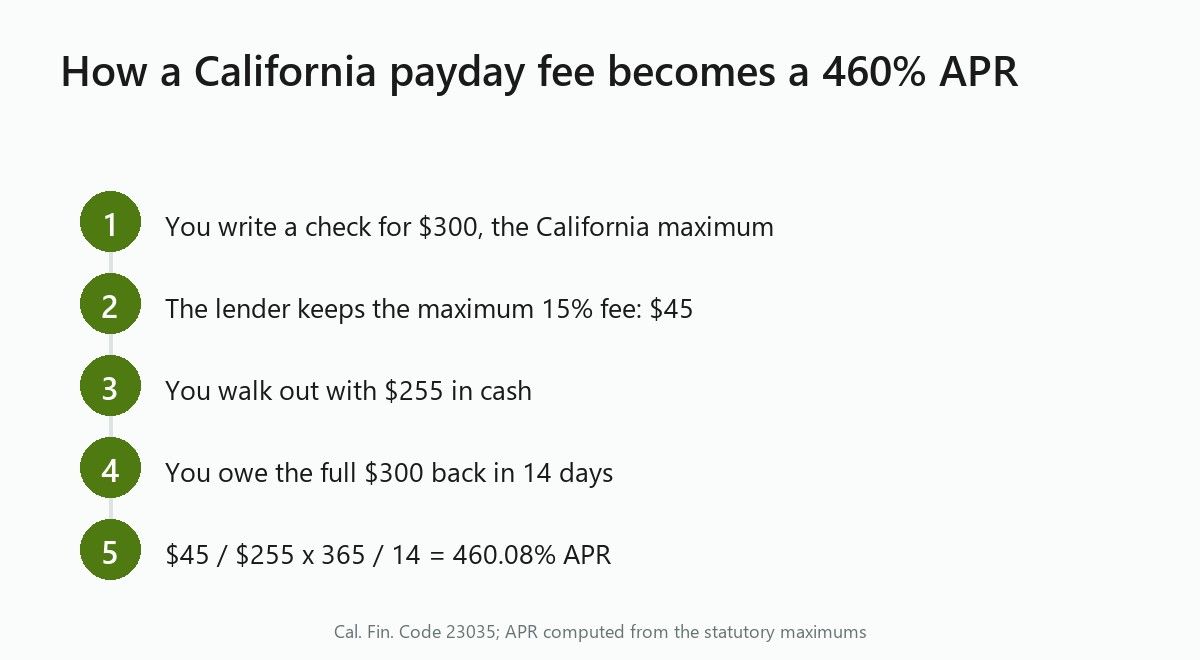
Subtract the fee from the face amount and $255 is what lands in your account. The loan term runs up to 31 days, and the statute ties that $45 ceiling to the face amount rather than to a daily rate, so the $45 ceiling stays the same whether you take the loan for a few days or the full term.
Every licensed payday lender in California operates inside this statutory frame, Speedy Cash included, since state law sets the same cap for every lender. A lender that charges more than that $45 ceiling on a $300 loan, or extends credit above the $300 face-amount limit under the payday label, is operating outside what Financial Code Section 23035 allows. Here's what that structure produces on a typical two-week loan, with all four numbers laid out:
- Face amount: $300
- Fee charged: $45
- Amount actually advanced to you: $255
- Loan term: 14 days
Run the standard APR formula: (fee divided by amount advanced) multiplied by (365 divided by term in days) multiplied by 100. That's (45 divided by 255) times (365 divided by 14) times 100. Work through it and you get 0.1765 times 26.07 times 100, which lands at approximately 460.1%, or roughly 460% APR.
The statute produces this math on its own maximum loan amount and maximum fee, every time you plug in the same three inputs: fee, amount advanced, and term.
Sit with that number for a second, because the dollar figure and the annualized figure tell two different stories. A $45 fee on $255 borrowed for two weeks is a 17.6% cost for that loan period. Stretch that same rate over a full year, which is exactly what APR calculations do, and it turns into 460%.
Both numbers describe the same loan; they just answer different questions. The dollar figure tells you what leaves your bank account on the due date. The annualized figure tells you how that cost compares, on a standardized basis, to every other kind of credit you could use instead, from a credit card to a personal loan to the PAL option covered further down in this piece.
That gap between the sticker fee and the annualized rate is the single most important thing to understand before comparing any short-term loan offer, Speedy Cash's or anyone else's. A lender can advertise "$45 to borrow $255" and it sounds almost manageable next to a late fee or an overdraft charge. Annualized, it's a different conversation entirely. Neither number is wrong; they're just measuring different things, and a lender's marketing tends to lean on whichever one looks smaller in context.
Our guide to how APR gets calculated on short-term loans walks through the formula in more detail and explains why a scary-looking APR can be misleading.
The One Regulator Action on Speedy Cash's Record
California's Department of Business Oversight (later renamed the Department of Financial Protection and Innovation) issued a consent order dated October 19, 2018 against Speedy Cash covering conduct from mid-2014 through late 2018. The order lays out two separate findings.
First, Speedy Cash violated Financial Code Section 23036, subsections (e) and (f), by charging $15 insufficient-funds fees without first presenting the ACH transaction for payment. That practice is documented in the order from June 2014 through February 2017. The distinction matters procedurally: the statute requires the lender to actually attempt the electronic transaction before charging a borrower for its failure.
Second, the order found that Speedy Cash accepted cash payments from borrowers while their ACH transactions were still processing, which resulted in overcollection from those borrowers. That conduct is documented from December 2015 through October 2018. Both findings involve the same underlying problem: money moving out of a borrower's account, or being collected twice, without the borrower having a clear view of what was actually being charged and when.
The resolution included a $90,000 administrative penalty, a desist-and-refrain order barring the practices going forward, and a requirement that Speedy Cash put corrective policies in place. A desist-and-refrain order is a regulator's instruction to stop a specific practice; it isn't a criminal conviction, and it doesn't shut down the business, but it becomes part of the public record other borrowers and reporters can check. Here's the context worth keeping in mind if you're deciding whether to borrow from Speedy Cash today: this order describes conduct from 2014 through 2018, resolved that same October.
It's a documented piece of the company's regulatory history rather than evidence of a current, ongoing violation, and this research turned up no more recent regulator action against Speedy Cash. DFPI's enforcement database is public and searchable; check it directly before you sign with any lender.
Questions to Ask Before You Sign
Speedy Cash publishes its own current rates-and-terms page for each state; read it carefully, the same way you'd read a contract. Rate structures vary substantially by state, and payday lending is illegal outright in some states; our breakdown of payday loan bans by state covers where this kind of lending is and isn't legal to offer.
An interest rate by itself doesn't tell you the full cost of a payday loan; it describes the shape of that cost, and you still need the dollar amount you'll actually owe. Before you sign anything with Speedy Cash, or any short-term lender, ask these four questions and get the answers in writing from whoever's at the counter or on the phone.
What's the total dollar cost? Ask for the exact fee in dollars on the exact amount you're borrowing, for the exact term you're agreeing to. APR is useful for comparing lenders, but the fee amount is what actually leaves your account.
Is this a direct loan, or does a separate credit access business structure apply? Ask the lender directly, since that structure can add its own fee on top of the loan's stated rate in states that allow it. The answer changes what you'll actually owe.
What happens if I can't repay on the due date? Get the renewal or rollover terms spelled out before you sign, including whether a rollover means paying the fee again without reducing the principal you owe. Ask specifically how many times a rollover is allowed and what the total cost looks like if you need one.
Is there a prepayment penalty? If money comes in early, you want to know whether paying the loan off ahead of schedule actually reduces your cost or whether the fee is locked in either way. A lender that structures its fee as a flat charge regardless of when you repay has less incentive to make early payoff easy.
A lender who hedges on any of these four questions, or won't put the answer in writing, is telling you something worth paying attention to. Take the paperwork home, read it away from the counter, and compare it line by line against what the lender told you out loud before you sign, including the fee amount, the term length, and the total repayment figure.
A Cheaper Option Worth Checking First
Before signing with Speedy Cash or any payday lender, check whether you qualify for a credit union Payday Alternative Loan. Our guide to credit union Payday Alternative Loans (PALs) covers the federal rate cap on these loans, eligibility requirements, and how to find a participating credit union near you.
None of this means a payday loan is never the right call. Sometimes the alternative costs more, like an overdraft fee that cascades into your next few transactions. What it means is that you should know the full cost before you compare it against those alternatives. Run the numbers on paper, both options, side by side, before you decide which one actually costs less in your specific situation.
If you've borrowed from a payday lender before and already know what a rollover cycle feels like, that's reason enough to make the PAL call first. A single phone call to a local credit union, asking whether you qualify and what the eligibility requirements are, costs you nothing and could change which of these two paths you end up on.
Frequently Asked Questions
California Financial Code Section 23035 caps a payday loan's face amount at $300 and the fee at $45, or 15% of the face amount, which advances $255 to you. On a 14-day term, that fee structure works out to approximately 460% APR. This is the statutory ceiling that applies to every licensed California payday lender, including Speedy Cash.
Speedy Cash operates under Community Choice Financial, according to the company's own Better Business Bureau listing, which lists the two names together as "Speedy Cash - Community Choice Financial." If you're checking licensing records or a complaint response, Community Choice Financial is the parent name you may see listed next to the Speedy Cash storefront brand.
Yes. California's Department of Business Oversight, later renamed the Department of Financial Protection and Innovation, issued a consent order dated October 19, 2018 covering conduct from 2014 through 2018: improperly charged insufficient-funds fees and overcollection from cash payments taken during ACH processing. Speedy Cash paid a $90,000 penalty and agreed to desist-and-refrain terms.
Under the statutory cap, the fee is $45, so you receive $255 and repay $300 total. Annualized over a 14-day term, that fee structure equals approximately 460% APR, even though the $45 dollar cost looks small next to the annualized percentage on its face. Both figures describe the same loan; only the time horizon changes.
Check whether you qualify for a credit union Payday Alternative Loan before you apply for a payday loan. Our PAL guide covers the federal rate cap that applies to these loans, eligibility requirements, and how to find a participating credit union near you.
In California, DFPI maintains a public license lookup tool, and other states' financial regulators typically offer something similar. Search the lender's exact business name before signing anything, and confirm the license covers the specific product you're applying for, since some lenders hold licenses for certain loan types but not others.