


If you searched "universal credit loan" hoping to find the UK's Universal Credit benefit, this isn't it. That program is a government welfare payment run by the UK's Department for Work and Pensions. This article covers a US personal loan brand for borrowers with fair to bad credit, owned and operated by the fintech company Upgrade, Inc.
That distinction matters more than it should. A borrower with fair to bad credit searching for financing options can land on the wrong page, the wrong country, and the wrong product before ever seeing a rate. Here's what the US lending brand actually charges, how its origination fee changes the money you receive, and whether it beats the alternatives available to you right now.
What Universal Credit Actually Is
Universal Credit is a lending platform owned and operated by Upgrade, Inc., a San Francisco-based fintech founded in 2017. The site's own footer states plainly that "Upgrade also does business as Universal Credit" (Universal Credit FAQ). Loans funded through the platform are originated by partner financial institutions under agreements with Upgrade, according to the lender's own FAQ page.
That structure carries a practical consequence for a borrower in this credit tier. State usury caps that limit what an in-state, direct lender can charge often don't apply the same way to a bank-originated marketplace loan. That's part of why fair and bad credit annual percentage rates here can legally run into the mid-30s.
Offers may also not be available in every state. The lender's site does not name which states are excluded, so confirm eligibility for your own address before you apply. That marketplace structure is also why this article treats Universal Credit as a lending platform first and a brand name second: the rate and terms you're quoted trace back to whichever partner bank actually funds your loan.
The loan amounts and terms scale together. Universal Credit's own site lists loan amounts up to $50,000 with repayment terms of 36 to 60 months, so a borrower requesting a smaller amount, closer to the $1,000 floor LendEDU reports, is likely looking at the shorter end of that term range, while a request closer to the $50,000 ceiling is more likely to stretch toward 60 months. Either way, the origination fee and the APR you're quoted apply to the full approved amount, including any portion beyond what you actually end up needing.
Rates, Fees, and Loan Terms
Universal Credit's own site lists an annual percentage rate range of 11.69% to 35.99%, with loan amounts up to $50,000 and repayment terms of 36 to 60 months (Universal Credit personal loans page). The upgrade.com help center corroborates the same APR band. LendEDU reports a $1,000 minimum; Universal Credit's own pages don't state one.
The number that decides whether this loan makes sense for you, though, is the origination fee: 5.25% to 9.99% of the loan amount, taken out of your proceeds before you ever see the money. Most competitor reviews stop at reporting that range. Few show what it does to an actual deposit, which is where borrowers get caught off guard. It's easy to skim past that deduction when the fee and the APR are both listed as percentages without a dollar example attached.
How Universal Credit's Rate Compares to a Credit Union PAL
Context matters here, because 35.99% sounds abstract until you set it next to a benchmark. Federal credit unions offering Payday Alternative Loans (PALs) are capped at 28% APR by the National Credit Union Administration (NCUA). PALs are structured as small, short-term loans, built for a smaller and more immediate borrowing need.
That structure matters for how you use this benchmark. A PAL works best for sizing up the rate gap on a smaller borrowing need; a $10,000 loan repaid over 36 to 60 months is a different size of borrowing entirely, and the two products are not really competing for the same application. If your need is smaller and you already belong to, or can join, a federal credit union, a PAL is typically the cheaper route to check first.
How Universal Credit's Origination Fee Works
Universal Credit deducts the fee directly from the loan proceeds before disbursement. You apply for $10,000, you owe $10,000 plus interest over the life of the loan, but the cash that lands in your account is smaller than $10,000 by the size of the fee.
That gap between the approved amount and the deposited amount is easy to lose track of. It's simple to anchor on the number you were approved for and forget that the fee comes off the top before the money ever reaches your account. If you request $10,000 to cover a $9,500 expense, a 9.99% fee alone could leave you short.
The fix here is simple arithmetic. Work backward from what you actually need in hand. If a repair or a debt payoff genuinely costs $9,000 and you expect a fee near the 9.99% ceiling, request closer to $10,000 so the fee doesn't eat into the money you actually need. Ask the lender to confirm your exact fee percentage and net deposit amount in writing before you sign, since the fee applied to your specific offer can land anywhere in that 5.25% to 9.99% range depending on your credit profile and the terms Universal Credit assigns you.
The Worked Example: $10,000 Requested vs. What You Actually Receive
Upgrade's own help center walks through a real example: a $10,000 loan at a 28.47% APR carries a 7% origination fee. That's $700 deducted at closing ($10,000 x 0.07 = $700), leaving a net deposit of $9,300 ($10,000 minus $700). You still owe the full $10,000 plus interest, amortized over the loan term.
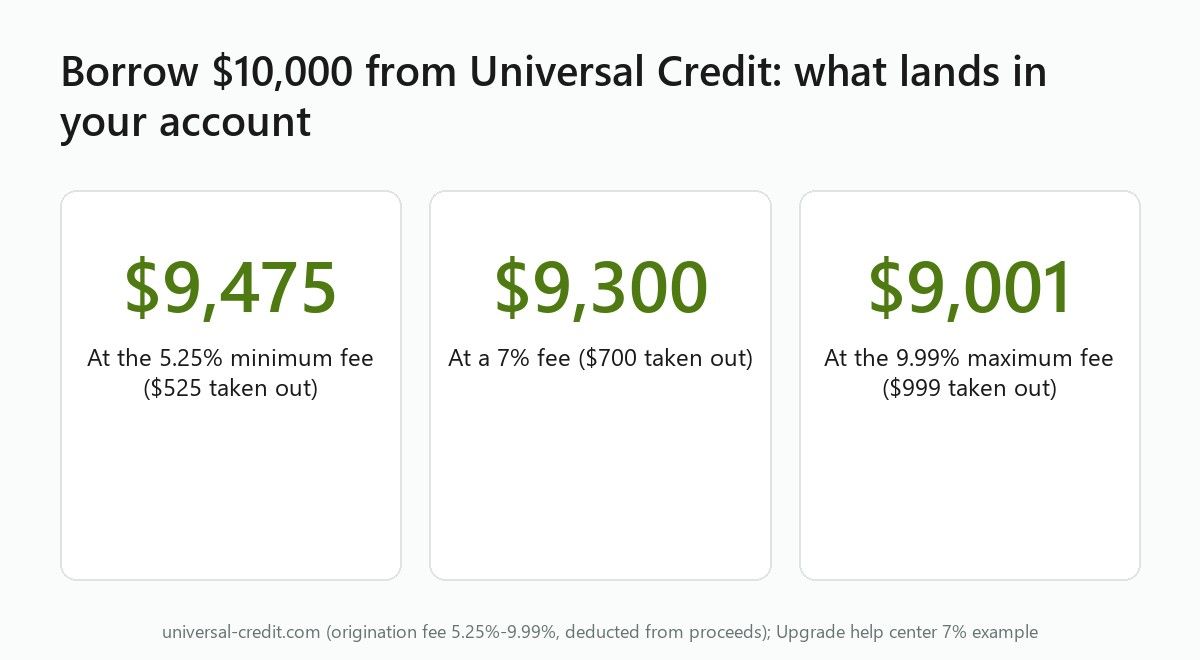
Applying the same arithmetic to Universal Credit's published fee range on that same $10,000 loan amount produces three scenarios:
- At the 5.25% floor: $10,000 x 0.0525 = $525 fee, leaving a net deposit of $9,475.
- At 7% (Upgrade's published example): $10,000 x 0.07 = $700 fee, leaving a net deposit of $9,300.
- At the 9.99% ceiling: $10,000 x 0.0999 = $999 fee, leaving a net deposit of $9,001.
The spread between the best and worst case on an identical $10,000 request is $474 in cash you either keep or lose before a single payment is due. Your repayment obligation stays fixed at the full $10,000 plus whatever interest your APR generates across the 36 to 60 month term, regardless of which end of the fee range you land on. If your loan needs to cover a fixed expense such as a $9,000 repair bill, ask for enough to cover both the bill and the fee.
Universal Credit Loan Requirements: Who This Fits
Credible, one marketplace that lists Universal Credit offers, sets its entry point for this credit tier around a 580 score. Universal Credit's own pages don't publish a minimum score; that figure reflects one marketplace's listing threshold, confirmed for Credible only, until you check your own eligibility directly. No major CFPB enforcement action against Universal Credit was found during this research, which is worth noting on a page about a lender's trustworthiness.
Within that context, Universal Credit fits a specific borrower well: someone with fair to bad credit who needs fixed monthly payments and a predictable payoff date, who has already been declined or priced poorly by a traditional bank, and who values funding speed over the lowest possible cost. Fixed-rate installment structure also means no surprise rate changes mid-term, which matters if you're budgeting around a tight monthly margin.
Run your own budget math before you sign. A 36 to 60 month term at the upper end of the 11.69% to 35.99% APR range produces a materially larger monthly payment than the same loan amount priced through a cheaper installment lender you already qualify for. On top of that, the origination fee shrinks your net deposit before a single payment is due, by as little as $525 or as much as $999 on a $10,000 request. If your monthly cash flow is already tight, a longer 60-month term lowers the payment but stretches the interest you pay over more months; match the term to how quickly you can realistically pay the loan off.
It fits poorly for anyone who can qualify for a lower-cost option elsewhere, since the origination fee and the APR ceiling can run higher than what a credit union or a strong direct lender might charge the same borrower. The Better Business Bureau lists Universal Credit with an A+ rating, BBB accredited since February 2021, and nine complaints closed over the prior three years (BBB profile). That track record points to a legitimate, BBB-accredited operation with a low complaint count. For a fair to bad credit borrower, cost is the bigger question here than reliability.
One caution worth naming: reviewers have flagged scammers impersonating recognizable lender names, including brands in this space, to run fraudulent loan offers. Verify you're on the lender's own domain before submitting any personal or banking information, and treat unsolicited offers that arrive by text or email with caution. A legitimate offer lets you review the full APR, fee, and repayment schedule before you provide sensitive account details.
Cheaper Alternatives Worth Checking First
Before you accept an origination fee on top of a rate that can reach 35.99%, run the numbers on these three options. Each one trades away something Universal Credit offers, usually speed or approval odds, in exchange for a meaningfully lower total cost. Which trade makes sense depends on how urgently you need the money and what you can realistically qualify for elsewhere. Remember the baseline you're comparing against: a $10,000 Universal Credit loan can net you as little as $9,001 before a single payment is due, on top of interest at up to 35.99% APR over as long as 60 months.
Credit union Payday Alternative Loans
As covered above, federal credit unions offering Payday Alternative Loans (PALs) are capped at a 28% APR. Quick5k has covered this program in depth, including eligibility rules, in The 28% Loan Most Payday Borrowers Have Never Heard Of. For a smaller borrowing need, and for a borrower who already belongs to, or can join, a federal credit union, this is usually the cheaper path to check first.
Direct lenders vs. marketplaces
Universal Credit operates as a lending platform connected to partner banks, distinct from a direct lender that funds and services its own loans. That distinction affects how your rate is set and who actually services your loan. Quick5k's breakdown of direct lenders versus brokers and marketplaces for bad credit borrowers walks through why that structural difference can change your total cost: direct lender vs. broker vs. marketplace.
A secured personal loan
If you own an asset you can put up as collateral, a secured personal loan can carry a lower rate and a lower or no origination fee, depending on the lender, in exchange for the lender's right to claim the asset on default. Quick5k compares the tradeoffs in secured vs. unsecured personal loans.
It also helps to understand what an advertised APR actually costs in dollar terms before comparing offers side by side. Quick5k's guide to converting APR into real cost walks through that math: what a short-term loan really costs. And if your credit sits closer to the lower end of this range, reviewing approval odds by credit tier can help you set expectations before you apply anywhere: bad credit loan approval odds.
Why This Matters for Your Application
The number on Universal Credit's offer letter and the number that lands in your account can differ by close to $1,000 on a $10,000 loan, depending on where your fee falls in the 5.25% to 9.99% range. That gap buys you approval speed and access at a fair to bad credit score, a trade worth pricing against the alternatives above: a credit union PAL for a smaller need, a direct lender, or a secured option.
Before you sign anything, check your rate at Universal Credit and at least one alternative, then compare the net deposit, the APR, and the total repayment on the same loan amount side by side. Those three numbers tell you more about whether this loan fits your budget than the headline rate ever will.
Frequently Asked Questions
No. The UK's Universal Credit is a government welfare benefit administered by the Department for Work and Pensions. The Universal Credit discussed here is a US personal loan brand owned by Upgrade, Inc., an unrelated fintech company. The names are identical, and the confusion is common enough to matter before you apply anywhere.
Published disclosures describe the origination fee as deducted directly from your loan proceeds at disbursement. The lender's own site does not describe a refund process for this fee, so treat it as a cost built into the loan itself, priced in before you ever accept the offer.
Yes, based on available third-party records. The Better Business Bureau lists Universal Credit with an A+ rating, BBB accredited since February 2021, with nine complaints closed over the prior three years (bbb.org). That's a low complaint count, and no major CFPB enforcement action against Universal Credit was found during this research.
Universal Credit's own published pages do not list a minimum score. Credible, one marketplace that lists Universal Credit offers, sets its own listing threshold around a 580 score, but that's a marketplace requirement, not a confirmed Universal Credit policy. Check your own rate directly to see where you stand.