
If you typed some version of "loan of 2000 bad credit" into a search bar tonight, you already know what you don't want: another article on rebuilding your score before anyone tells you the price. Here's the number that matters first.
The average APR on a personal loan for borrowers with credit scores below 630 was 26.96% in August 2026, according to NerdWallet's rate tracker, built from actual pre-qualification offers over the prior 30 days. Compare that to the 14.70% average for borrowers above 720, and the credit-score penalty on a $2,000 loan comes into focus fast. Whether the $2,000 is covering a car repair, a medical bill, or a gap between paychecks, the reason rarely changes what a lender sees on your application.
Three paths get you there realistically: a credit union Payday Alternative Loan, a bad-credit installment loan from a direct lender, or a savings-secured loan if you already have cash parked somewhere. Each prices the same $2,000 very differently, and the difference shows up in real dollars, not just percentage points. None of these paths require a strong credit history; they require credit union membership, a qualifying score at a direct lender, or existing savings instead, and knowing which one you actually have access to is most of the battle.
The Three Realistic Paths to a $2,000 Loan With Bad Credit
Set aside payday storefronts and title lenders for a moment. They dominate the search results for this amount, and neither one reliably delivers $2,000 (more on why later). The three paths worth comparing are:
- A credit union PAL II, capped at 28% APR under federal rule, sized specifically for loans this small.
- A bad-credit personal installment loan from a direct lender, averaging 26.96% APR and running as high as a 36% affordability ceiling for the weakest files.
- A savings-secured loan, priced closer to 7% APR, if you already hold roughly $2,000 in savings you're willing to pledge as collateral.
Only one of those is genuinely open to nearly everyone who searches this amount: the direct-lender installment loan. The other two carry a prerequisite most searchers don't have yet. That ordering, more than any marketing page, should drive your first call.
Underwriting mechanics differ from path to path too. A direct lender pulls your credit report, verifies income and employment, and often checks your bank statements for existing debt before pricing your rate within its advertised range. A credit union looks at similar inputs but caps what it can charge regardless of what your file shows. A savings-secured loan skips most of that scrutiny, since the collateral already sitting in your account is effectively doing the underwriting for you.
What a Bad Credit Personal Installment Loan Actually Costs
Credit tier is the single biggest lever on price at this loan size. NerdWallet's own data shows the gap in stark terms: 26.96% average APR for scores under 630, versus 14.70% for scores at 720 and above. That's nearly double the finance charge before you've missed a single payment.
For the weakest credit files, NerdWallet notes that some applicants won't qualify for anything below 36% APR. NerdWallet describes 36% as the affordability ceiling most consumer advocates use for small-dollar credit: the rate above which a loan tends to stop being repayable relative to what a typical borrower can actually afford. Be precise about what that number represents, because the phrase gets misused constantly online.
The 36% figure is not a nationwide legal cap. State usury and small-loan-rate laws vary widely, and most states allow bad-credit installment lenders to price well above 36% for civilian borrowers. The only place 36% functions as a binding legal ceiling is the Military Lending Act's Military Annual Percentage Rate (MAPR), which protects active-duty service members and their dependents. That's a separate rule from the advocacy benchmark discussed here, and the two shouldn't be confused when you're comparing offers.
Individual lender APRs and fees shift by state, credit profile, and origination structure, so a single lender's advertised range tells you less than the market average does. The more reliable comparison point is the sub-630 average NerdWallet has already confirmed: 26.96% for borrowers shopping direct lenders for a bad-credit installment loan, with 36% marking roughly where the math tends to stop working for the borrower.
Watch the disbursed amount as closely as the rate. It is common for bad-credit installment loans to carry an origination fee that gets deducted from the loan before the money reaches your account, so the cash you actually receive lands below the $2,000 you borrowed while interest still accrues on the full principal. Lenders making consumer loans must disclose the APR, finance charge, amount financed, and payment schedule in a standardized box before you sign, under the Truth in Lending Act's Regulation Z. Read that box before you read anything else in the loan agreement.
The Math: $2,000 Over 12 Months vs. 24 Months
Run the amortization on $2,000 at a representative bad-credit APR and the tradeoff between term length gets concrete fast.
At 26.96% APR, the NerdWallet average for sub-630 borrowers:
- 12-month term: $192 a month, $2,304 total paid, $304 in interest.
- 24-month term: $109 a month, $2,609 total paid, $609 in interest.
Stretching the loan from 12 to 24 months cuts the monthly payment by $83, more than 40 percent, but it roughly doubles the total interest owed. That's the entire tradeoff, in two numbers.
Now push the APR to the 36% affordability ceiling, representative of applicants who don't qualify at the market average:
- 12-month term: $201 a month, $2,411 total paid, $411 in interest.
- 24-month term: $118 a month, $2,834 total paid, $834 in interest.
At 36% APR over 24 months, you'd pay $834 in interest to borrow $2,000, more than 40 cents of interest for every dollar borrowed. That's roughly the point NerdWallet flags as where a small loan stops making financial sense for the person repaying it. The monthly payment gets easier to manage; the total interest owed does not.
In practice, choosing between the 12-month and 24-month term comes down to which number you can absorb: a monthly payment that fits your budget today, or a total repayment figure you can live with over the life of the loan. Few borrowers can optimize for both at a bad-credit APR.
Credit Union PAL II: A 28% Rate Cap Set by Federal Regulation
If you belong to a federal credit union, or can join one, credit union PALs, capped at 28% APR, are worth checking before you apply anywhere else. The National Credit Union Administration built PAL II for exactly this loan size: a maximum amount of $2,000, no required minimum, a maximum term of 12 months, and no minimum length of credit union membership before you can apply, unlike the original PAL I program, which required a waiting period. A federal credit union may charge an application fee only up to the actual cost of processing your loan, capped at $20.
Joining a federal credit union is often simpler than it sounds. Many credit unions extend membership through an employer, an affiliated association, or a small one-time donation.
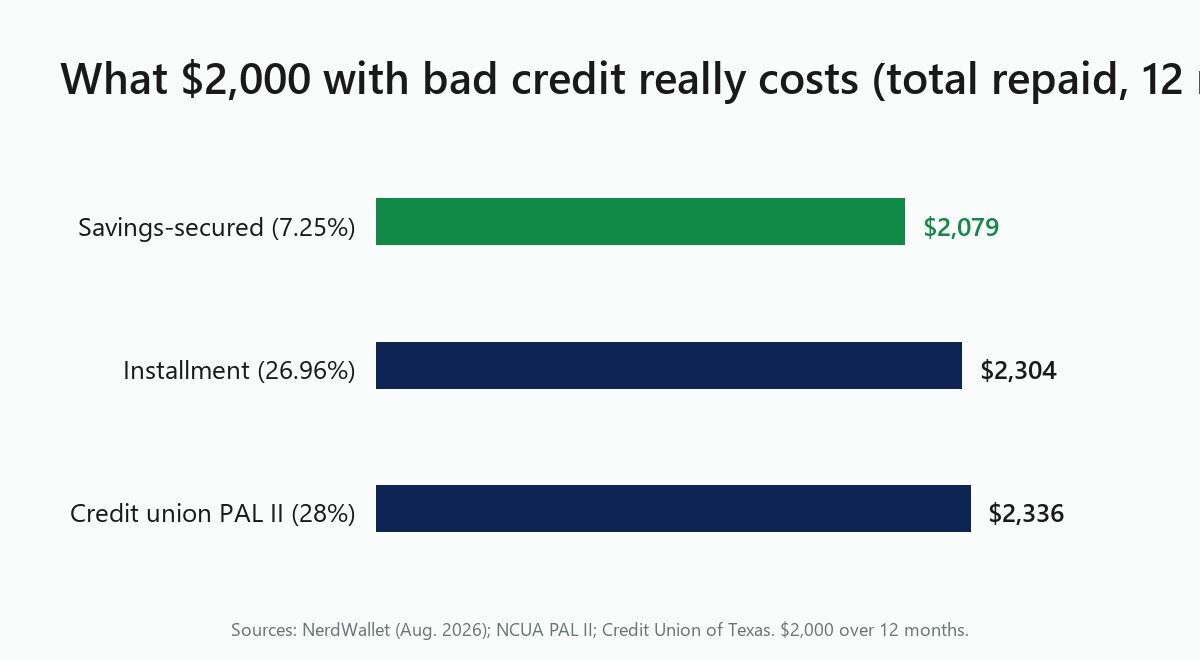
The math at the 28% cap over the maximum 12-month term looks like this: $193 a month, $2,316 in principal and interest, plus the $20 application fee, for an all-in total of $2,336. That sits below the $2,411 you'd pay over 12 months at the 36% ceiling the weakest-credit applicants can't get below, though it lands slightly above the 12-month total at the 26.96% national average. The real advantage of PAL II is regulatory certainty: a hard 28% ceiling written into federal rule, so you know your maximum rate before you apply rather than after underwriting decides for you.
Credit unions price 36-month unsecured personal loans below banks. Federally chartered credit unions averaged 10.64% APR versus 12.00% at banks on that product in the fourth quarter of 2025, according to NCUA's credit union and bank rate data. That figure describes the general unsecured-lending population; it doesn't isolate bad-credit borrowers specifically. Still, the structural gap it shows helps explain why checking your local credit union is worth the extra step before turning to a national online lender.
Savings-Secured Loans: Cheaper If You Already Have the Cash
The third path is the cheapest and least available: a savings-secured loan. It won't fit most people searching for a $2,000 loan with bad credit, but it's worth naming honestly. Credit Union of Texas offers one at 7.25% APR for members who want access to cash without waiting for a certificate of deposit to mature. Because the loan is backed by money you already have on deposit, the credit union's risk is minimal, and the rate reflects that.

Amortizing the same $2,000 loan at 7.25% APR over 12 months produces $173 a month, $2,079 total paid, $79 in interest. That $79 cost of borrowing compares to $304 in interest on the sub-630 average installment loan, or $336 in interest and fees on a PAL II ($316 interest plus the $20 application fee). A savings-secured loan costs a fraction of either option's true borrowing cost.
The catch is built into the structure. You need roughly $2,000 already sitting in a savings account or share certificate to pledge as collateral. If you're searching for a way to borrow $2,000 specifically because you don't have $2,000 on hand, this option probably doesn't apply to you yet. It's worth knowing the option exists, though, for the specific reader whose cash is tied up somewhere illiquid, such as a CD that hasn't matured or an emergency fund they don't want to fully drain, and who wants a bridge loan cheaper than any unsecured product on this list.
Options to Avoid When You Need $2,000
Three categories of lender show up in nearly every search for this amount, and none of them serves someone who actually needs $2,000.
Title loans
Auto title loans rarely even offer $2,000. The Consumer Financial Protection Bureau's most recent title-loan analysis, published in 2016 on 2010-2013 lending data and covering single-payment auto title loans specifically, found a typical loan amount of about $700, well under half of what this article covers, alongside a typical APR near 300% and roughly 1 in 5 borrowers losing their vehicle to repossession after failing to repay. If a title lender does offer to structure $2,000 against your car, treat the size itself as a warning sign. For the full breakdown of why this product performs so poorly for borrowers, see why we don't recommend title loans.
Payday storefronts
Payday loans are built around a few hundred dollars repaid in about two weeks, not a $2,000 principal. A storefront advertising a $2,000 loan online is often setting up an upsell: a title loan instead, a rolling installment product with its own fee structure, or a suggestion to split the amount across multiple payday advances, which stacks fees on fees. To see how APR translates to real dollars on a payday-sized loan, quick5k's breakdown of short-term loan costs walks through that math directly.
Unlicensed and rent-a-tribe lenders
The riskiest category doesn't advertise itself honestly. Watch for three signals: no state lending license disclosed anywhere on the site, a refusal to state an APR before you apply, and a demand for fees paid by gift card or cryptocurrency. Some online lenders structure themselves around tribal sovereign immunity specifically to sidestep state rate caps.
Quick5k's guide on how to spot a rent-a-tribe lender walks through how that structure works and why it puts you outside normal consumer protections. Spotting these red flags mostly takes patience: slow down long enough to read the offer before you accept it.
Cost is only half of this decision. If you're also unsure whether a lender will approve you at $2,000 given your specific score, quick5k's breakdown of your realistic approval odds separates what you'll likely qualify for from what you'll actually pay once you do.
Frequently Asked Questions
Yes, through a bad-credit direct-lender installment loan, a credit union PAL II, or a savings-secured loan if you have collateral to pledge. Approval odds and pricing vary a lot by path, but a sub-600 score does not rule out borrowing $2,000 outright, it just narrows which lender is realistic for you.
NerdWallet's tracker put the average APR for borrowers with scores below 630 at 26.96% as of its August 2026 update, versus 14.70% for borrowers above 720. On a $2,000 loan repaid over 12 months, that gap between credit tiers works out to roughly $140 in extra interest over a single year.
Not always in raw dollars. PAL II's 28% cap produces a slightly higher 12-month total than the sub-630 national average for direct-lender loans, but it guarantees that maximum rate in advance under federal rule, something the average cannot promise any individual applicant before they apply.
Rarely. Payday loans are typically a few hundred dollars, repaid within about two weeks, and were never built to fund $2,000 in a single advance. A storefront advertising that amount online may be steering applicants toward a title loan, a rolling installment product, or splitting the request across several payday advances instead.
Credit Union of Texas prices its savings-secured loan around the collateral you pledge, which is why its 7.25% APR stays far below unsecured bad-credit pricing. The real requirement is having roughly $2,000 already parked in savings or a share certificate to pledge, regardless of what your credit report shows.
No. NerdWallet describes 36% as the affordability ceiling most consumer advocates use for small-dollar credit. State usury and small-loan-rate laws set the actual legal limits, and those vary widely. The Military Lending Act's Military Annual Percentage Rate (MAPR) is the one place 36% functions as a binding legal ceiling, applying solely to active-duty service members and their dependents.