

Borrow $300 for two weeks and call it a "cash advance," and you could end up paying anywhere from zero dollars to roughly $45, depending entirely on which product answers to that name. That spread, from free to 15% of the amount borrowed in under a month, is the whole story of why "payday loan vs cash advance" is a confusing search in the first place. The word "cash advance" gets applied to three legally distinct products: a transaction on your existing credit card, an app-based advance on wages you've already earned, and a storefront shop that lends against a post-dated check or bank authorization. Only one of those three is legally a payday loan, and all three put a few hundred dollars in your hands within days.
A "payday loan" and a "cash advance app" are only two of the three products people mean when they search this term. The third sits inside your own wallet: the cash advance option on the credit card you already carry. Here's how all three stack up when you need $300 today and can pay it back in roughly two weeks, along with who regulates each one and whether it lands on your credit file.
The Three "Cash Advances" at a Glance
Every figure below assumes a $300 advance repaid in about 14 days.
- Credit card cash advance: regulated by the CFPB and bank regulators under the Truth in Lending Act; costs roughly $18 for $300 over two weeks; shows up on your credit report as part of your existing card account.
- Storefront "cash advance" shop (legally a payday loan): regulated by your state's small-dollar lending statute; costs roughly $45 for $300 over two weeks in a representative state example; on-time payments are not reported to Equifax, Experian, or TransUnion.
- App-based paycheck advance: increasingly regulated by state earned wage access (EWA) statutes; costs $0 to roughly $6 for $300 over two weeks with EarnIn, about $15 or more with Dave; also not typically reported to the three bureaus.
The cheapest option on paper isn't automatically the right one for you, and the numbers below show why.
Credit Card Cash Advance: The One That Already Lives in Your Wallet
If you have a credit card, you already have access to this option, though it doesn't advertise itself as a loan product. Pull cash from an ATM using your credit card, or request a cash-equivalent transaction like a money order, and the issuer treats it as a cash advance, which is priced differently than a purchase. The CFPB oversees the disclosure rules at the federal level, while the OCC, the FDIC, and the Federal Reserve each supervise different issuing banks depending on how that bank is chartered, which is one reason two cardholder agreements can price the same $300 advance a little differently without either one breaking the law.
Two things make this different from swiping the same card at a register. First, there's typically no grace period: interest starts accruing the day of the transaction, according to the Consumer Financial Protection Bureau's explanation of credit card grace periods. Regulation Z requires issuers to disclose when that grace period doesn't apply, but the disclosure sits in the fine print of the cardholder agreement. A regular purchase typically earns an interest-free window if you pay the statement balance in full; a cash advance skips that window entirely, so the interest meter starts the moment the cash leaves the ATM.
Second, issuers charge an upfront cash advance fee on top of the interest, usually 3% to 5% of the amount advanced or a flat minimum of $5 to $10, whichever is greater, as Capital One's cash advance explainer lays out. That fee posts the moment the transaction clears, separate from and in addition to whatever interest accrues afterward.
Run the numbers on $300. At a 5% fee, you're charged $15 upfront. Cash advance APRs on current cardholder agreements, such as Capital One's Quicksilver card, commonly run in the high-20s; your own card's agreement governs your account. Fourteen days of interest on $300 at a representative 29% APR works out to roughly $3.34.
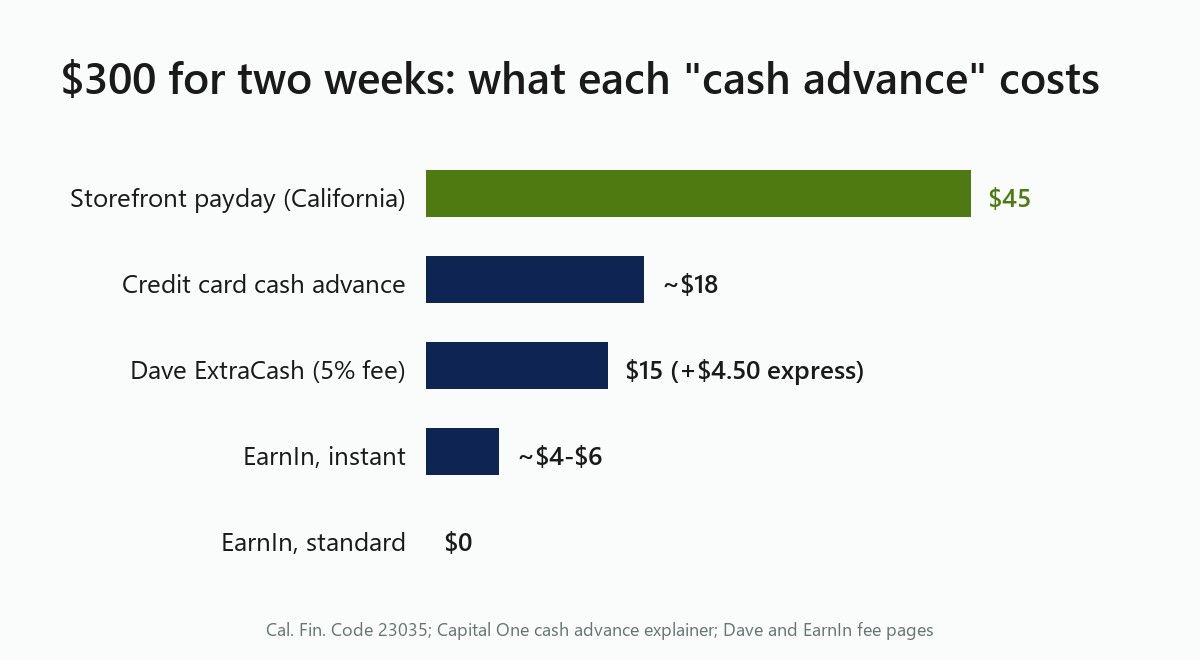
Add the fee and you land at a total cost of about $18.34, call it $18, for borrowing $300 for two weeks. That's the cheapest of the three products compared in this article. It doesn't feel cheap while you're doing it (a same-day interest clock and a fee both hitting your statement at once is unpleasant), but the arithmetic holds.
Storefront "Cash Advance" Shop: A Payday Loan Wearing a Different Sign
Walk into a shop advertising "cash advance" that lends against a post-dated check or an ACH debit authorization, and you're looking at a payday loan, regardless of what the storefront sign says. The name on the door doesn't change the legal category a lender falls into; state law does. It matters because the word "advance" sounds gentler than "loan," when in practice the storefront product is the most expensive of the three by a wide margin.
California's Deferred Deposit Transaction Law provides a concrete, worked example. Under California Financial Code Section 23035, a payday transaction is capped at a $300 face-value check with a maximum fee of 15%. A borrower who writes that $300 check receives $255 in cash and owes $300 in about two weeks, meaning the $45 fee reflects what it actually costs to borrow the $255 you receive.
The two-week cost lands at $45 for a $300-scale advance, and the annualized rate on the California example works out to roughly 460%.
Regulation here is state-by-state. Each state's small-dollar lending or deferred-deposit statute sets its own fee cap, loan limit, and licensing requirement (California's Department of Financial Protection and Innovation oversees the example above); there's no single national fee cap.
Federally, the Truth in Lending Act and Regulation Z require the standard APR and finance-charge disclosure box on the loan agreement, so you'll see the true annualized cost in writing before you sign. That federal layer requires disclosure. The price cap itself comes from state law.
App-Based Paycheck Advance: Cheapest, but Newly and Unevenly Regulated
The third product is the app-based earned wage access advance: think EarnIn, Dave, or similar services that front you money against wages you've already worked for but haven't been paid yet.
The regulatory picture here shifted meaningfully at the end of 2025. The CFPB's December 2025 advisory opinion concluded that a "covered" earned wage access product, one with no recourse against nonpayment, no credit reporting, no debt collection, and a no-cost or low-cost option, isn't "credit" under Regulation Z. That means qualifying EWA products aren't subject to the TILA APR and finance-charge disclosure box the way a credit card cash advance or a payday loan is, according to the CFPB's advisory opinion on earned wage access, effective December 23, 2025.
With the federal government treating qualifying EWA products as non-credit, oversight has shifted toward the states: a growing number of states now license or regulate earned wage access providers directly, with rules focused on fee and tip disclosure.
What does that mean for your $300? EarnIn charges a flat, tiered instant-transfer fee, historically in the $3.99 to $5.99 range regardless of advance size, per the EarnIn Cashout fee page. Dave's ExtraCash charges an overdraft fee of 5% of each advance ($5 minimum), which is $15 on $300, plus an optional 1.5% fee (about $4.50) to push the money to an external debit card, according to Dave's ExtraCash fee schedule.
Choose EarnIn's free, slower delivery and your two-week cost on $300 can land at $0. Choose its instant delivery and you're looking at roughly $4 to $6, an order of magnitude below the storefront example and cheaper than the credit card cash advance. Dave's fee structure lands closer to the card: $15 on $300, or about $19.50 with express delivery.
Does Any of This Show Up on Your Credit Report?
If you're worried about your Equifax, Experian, or TransUnion file, the answer varies by which of the three products you're actually looking at.
On-time payments on storefront payday loans are not reported to the three nationwide bureaus, as Experian's payday loan versus cash advance app comparison states directly. Miss a payment, though, and the debt can still land in collections, which the bureaus do report. App-based EWA advances follow the same pattern according to the same Experian source: not reported in the ordinary course, and consistent with the CFPB's December 2025 opinion describing qualifying EWA providers as not performing the credit-risk assessment or debt collection that a traditional creditor does.
The credit card cash advance is the odd one out, and the reason comes down to how card accounts already report. A cash advance is simply a transaction against an account you already have. Your card's balance, payment history, and utilization, all affected by pulling a $300 advance, are reported to all three bureaus as part of normal card reporting, because the underlying account is already a mainstream credit file entry. The advance appears only as a change to that account's balance and utilization, folded into a tradeline that already exists.
That's worth understanding before you assume the option that shows up on your credit report is automatically the riskier one to your score. If a lender checks your eligibility for any of these products with a soft credit check first, that check alone does not affect your score the way applying for new credit can.
Which One Fits a Real $300, Two-Week Need
Line the three up and the storefront payday loan is the most expensive by a wide margin, roughly $45 on $300 over two weeks, against roughly $18 for a credit card cash advance and $0 to $6 for an EarnIn advance ($15 or more with Dave). On price alone, that leaves the storefront option little room to compete if you have any real alternative.
But cost isn't the only variable. A credit card cash advance requires you to already have available credit on a card, and pulling one increases your utilization, which can nudge a credit score even though the advance itself isn't separately reported to Equifax, Experian, or TransUnion. An app-based advance requires a qualifying income pattern the app can verify, and the cheapest, free-delivery option is often the slowest, which doesn't help when the need is genuinely today.
If your income and banking situation don't fit either of those, a credit union payday alternative loan capped at 28% APR is worth checking first, under NCUA rules. Before signing anything with a triple-digit disclosed rate, it also helps to understand why a scary-looking APR number on a short-term loan can be misleading without the dollar math to go with it.
If the real alternative you're weighing is a bank overdraft, that's a separate comparison with its own numbers; cash advance apps versus overdrafting your bank account covers that specific matchup. And if your actual goal is avoiding a fee altogether, it's often worth one phone call before you borrow anything: asking your bank to waive the fee instead costs nothing to try.
Frequently Asked Questions
Sometimes, but not always. A storefront shop advertising "cash advance" that lends against a post-dated check or ACH authorization is legally a payday loan under state law. A credit card cash advance and an app-based earned wage access advance are both called "cash advance" colloquially but are regulated and priced completely differently from a payday loan.
It depends on the product. A credit card cash advance runs roughly $18 (a 5% fee plus about 14 days of interest at a high-20s APR). A storefront payday loan runs roughly $45, the fee on a $300 check under California's example. An EarnIn advance runs $0 for free, standard delivery up to roughly $4 to $6 for instant delivery; Dave charges $15 on $300, plus about $4.50 for express delivery.
A credit card cash advance affects your existing card's reported balance and utilization, so it indirectly appears on your credit file through the account you already have. Storefront payday loans and app-based advances are generally not reported to Equifax, Experian, or TransUnion when paid on time, though missed payday loan payments can reach collections.
The CFPB's December 2025 advisory opinion found that qualifying earned wage access products aren't "credit" under Regulation Z, so they fall outside the Truth in Lending Act's disclosure requirements. Oversight has shifted toward the states, where a growing number now license or regulate EWA providers directly.
A payday loan's fee is a flat percentage of a very short-term loan, often two weeks, which annualizes to a triple-digit APR. A credit card cash advance charges a smaller upfront fee plus daily interest, and even at a high-20s APR over just 14 days, that total stays far below what a two-week payday fee annualizes to.