
You pull up your Chase statement, and there it is: a cash advance interest charge sitting right under the withdrawal you made from an ATM a few weeks back. Maybe you already paid that balance down. Maybe you thought you paid it off completely. Either way, you're staring at a number that shouldn't exist, and you're wondering what you missed.
You didn't miss anything. This is how Chase cash advances are built to work. Once you see the mechanics, the charge becomes something you can manage.
Why This Happened: There's No Grace Period on a Cash Advance
With a regular purchase on your Chase card, you get a buffer. Pay your statement balance in full by the due date, and you owe no interest on that purchase at all. That buffer is called a grace period, and it's the reason a lot of people carry a credit card without ever paying a cent of interest.
Think of it like a tab you open at a coffee shop. The barista doesn't charge you the second you order; you settle up before you leave, and nothing extra gets added as long as you pay in full. A cash advance skips that arrangement entirely. It's closer to a loan that starts collecting interest the moment the cash lands in your hand, on top of whatever you already owe on the rest of your card.
Chase says it plainly on its own education page explaining cash advance APR: cash advance APRs "usually do not have a grace period," and once the transaction is complete, you begin accruing interest. A second Chase page backs this up in nearly the same words: interest "begins accruing as soon as you withdraw money," while purchases "allow a grace period before interest begins to accrue" (Chase's guide to how cash advances work).
So the clock starts the second the ATM hands you your cash. That happens well before your statement date, and well before your due date. If you paid the balance off a week later, interest had already been accruing for that entire week. That's why you can pay a cash advance back in full and still see a leftover interest line on your next statement.
The charge itself, plus the first stretch of daily interest, often posts to your account before your billing cycle even closes, so a small amount of interest gets locked in before your payment has a chance to catch up, no matter how quickly you paid it back.
What You're Actually Being Charged: Chase's Cash Advance Fee and APR
A cash advance costs you in two separate ways, and it helps to see them as two different line items on your statement.
The upfront fee. On the Chase Amazon Prime Rewards Visa Signature Card, the disclosed cash advance fee is "either $5 or 4% of the amount of each transaction, whichever is greater," according to that card's own Chase pricing and terms disclosure. Chase's general education page describes the typical fee across its cards as around 5% of the amount you withdraw.
Both numbers are real, they just belong to different cards. Your card's Rates and Fees table, usually reachable from your online account or your cardmember agreement, is the only place that tells you which one applies to you.
The ongoing APR. That same Amazon Prime Rewards card discloses a 28.49% variable cash advance APR, tied to the Prime Rate. This is one real, current, verifiable example, not a universal Chase number. Cash advance APRs vary by card and shift with the Prime Rate over time, and they're almost always the higher of the two APRs on a given card.
If you want your exact figure, pull up your own card's Pricing & Terms page or cardmember agreement and look for the cash advance APR specifically. It's typically higher than your purchase APR, and it's worth knowing the gap between the two.
The $300 Example: Watching the Math Add Up
Numbers are easier to trust when you can walk through them yourself, so let's use a $300 cash advance on a card with the disclosed 28.49% APR and the 4%-or-$5 fee structure above.
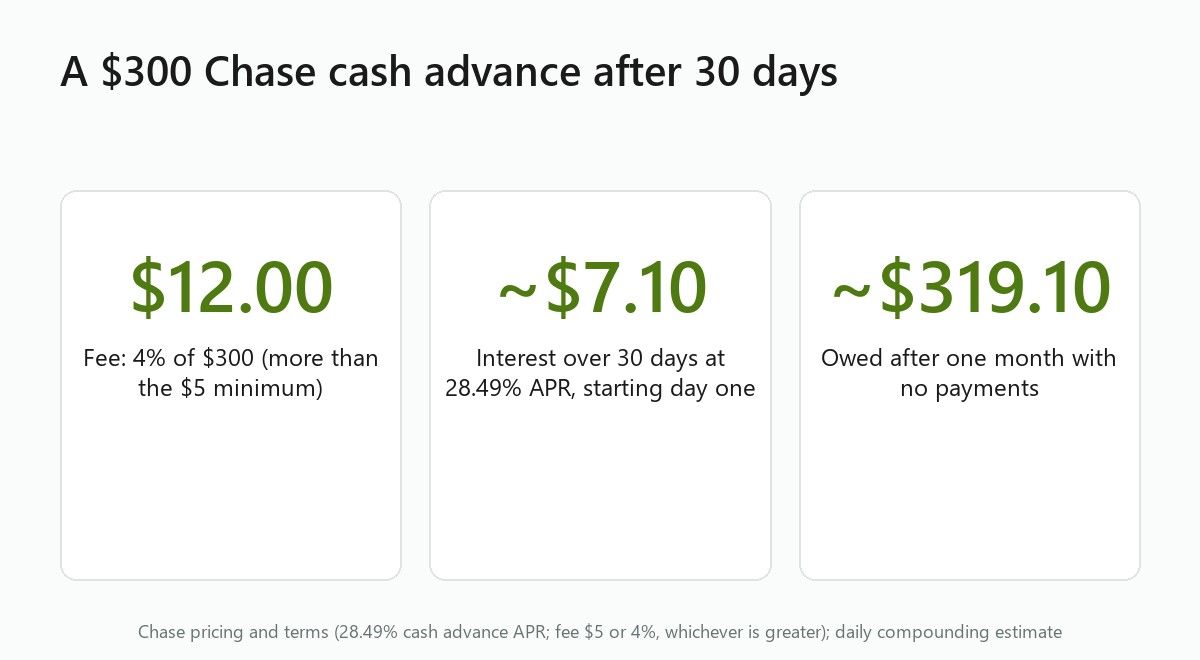
Step 1: The fee posts immediately. Four percent of $300 is $12.00. Compare that to the $5 floor: $12 is greater, so $12.00 is the fee, and it gets added to your balance the moment the transaction clears.
Chase converts your APR into a daily periodic rate to figure interest, and that's step 2: find the daily rate. Divide 28.49% by 365, and you get roughly 0.0780548% per day, or 0.000780548 as a decimal.
From there, step 3 is calculating 30 days of interest, and there are two ways to do it. The simple version, where you apply the daily rate to the flat $300 each day, gets you $300 multiplied by 0.000780548, which comes to about $0.2342 a day. Over 30 days, that's roughly $7.02.
Credit card issuers, Chase included, typically compound daily instead: each day's interest gets added to the balance, and the next day's interest is calculated on that slightly larger number. Run that version and $300 grows to about $300 multiplied by 1.000780548 raised to the 30th power, which lands near $307.10. That's about $7.10 in interest over 30 days, a hair more than the simple estimate because of the daily compounding.
Step 4: Add it up. $300 (the advance) plus $12.00 (the fee) plus roughly $7.10 (30 days of compounded interest) comes out to about $319.10 owed after a month, if you hadn't paid any of it down. And that's before accounting for the fact that fees typically start accruing interest too, since there's no grace period on this balance either, so treat the $319.10 as a close estimate.
Run this same four-step process with your own card's disclosed APR and fee, and you'll get a number that matches your actual statement far more closely than any generic estimate could. It's the same logic behind how a scary-looking APR translates into real dollars on other short-term borrowing products, so it's worth understanding once.
Why Your Last Payment Didn't Make It Disappear
Here's the part that trips up people who've already made a payment: you sent money in, and the interest charge showed up anyway. The interest itself comes from the no-grace-period accrual you just read about. What decides where your payment actually lands, though, is a separate federal rule, and that part works in your favor once you understand it.
Chase explains it directly on its page on how payments are applied: "any excess payments you make (amounts higher than your minimum payment) should be credited towards the balance with the highest APR," then the next-highest, and so on. The rule behind that sentence comes from the Credit Card Accountability Responsibility and Disclosure (CARD) Act, written into federal regulation at 12 CFR § 1026.53. The Consumer Financial Protection Bureau's text of the rule requires that when you pay more than your minimum, the issuer "must allocate the excess amount first to the balance with the highest annual percentage rate and any remaining portion to the other balances in descending order based on the applicable annual percentage rate."
Since cash advance APRs almost always run higher than purchase APRs on the same card, any amount you pay above your minimum is required to go toward the cash advance balance first.
The catch is the minimum payment itself. Your minimum is applied by whatever method your issuer's terms describe, and it isn't guaranteed to hit the cash advance balance specifically.
If you're carrying both a purchase balance and a cash advance balance and you only ever send in the minimum, you may be servicing both at once at whatever split your issuer's terms use, without necessarily clearing the higher-rate one first. That's why the balance can seem to linger no matter how consistent you are, and it's a pattern worth checking for on your own statement.
There are two narrow exceptions tied to deferred-interest promotions and consumer-directed payment requests. For most people staring at a cash advance charge, though, the core rule is what matters: pay more than the minimum, and the extra goes to your highest-APR balance automatically.
How to Stop the Charge From Growing
Once you know the mechanics, you have real levers to pull. Here's how to work through them in order.
- Pay more than your minimum. Because of the CARD Act rule above, anything above your minimum payment is required to go toward your highest-APR balance first, which on most cards means the cash advance gets attacked before your regular purchases do.
- Pay the cash advance balance down as fast as your budget allows. Interest is compounding daily, the same way it did in the $300 example above, so every day you shave off the payoff timeline is a day of interest you don't accrue. There's no reward for stretching this out.
- Hold off on additional cash advances on the same card. Each new advance triggers your card's cash advance fee all over again and starts its own no-grace-period interest clock the moment it posts. Stacking advances compounds the cost fast, since each one runs the same fee-plus-daily-interest math independently.
- Check whether a lower-cost option exists for your next need. If you're weighing a cash advance against a cash advance app for a future gap, it helps to compare cash advance apps vs. overdraft fees before you decide, since the cost structures aren't the same.
- Ask about the fee, even if you don't expect a yes. It won't always work, but there's no downside to asking, and getting a fee waived by asking is a low-effort step worth trying once your balance is under control.
- If you have multiple balances, get clear on the order to attack them. A cash advance is rarely your only debt, and knowing which balance to pay off first keeps you from chasing the wrong one.
None of these steps require a perfect financial situation to start. Even one extra payment above your minimum this month, aimed at the cash advance balance, changes the math in your favor starting the next day. Since interest compounds daily on this kind of balance, every dollar you send early is a dollar that stops generating its own interest sooner, which is a bigger deal on a cash advance than it is on most other charges on your card.
Go back to the $300 example from earlier: a single cash advance turned into roughly $319.10 owed after just one month of sitting untouched, once the $12 fee and the compounded interest were counted in. Stack a second cash advance on top, or let the first one ride for several months instead of one, and that same fee-plus-daily-interest structure keeps adding up in the same predictable way. Cash advances are built this way on purpose, and the same pattern will repeat on any card with similar terms. Now that you've walked through the fee, the daily rate, and the payment rule together, the next line item on your statement won't catch you off guard the same way.
Frequently Asked Questions
Does paying off a cash advance the same day stop the interest?
No. Because cash advances have no grace period, interest starts accruing the moment the transaction clears, well before your statement date. Even a same-day payoff can leave a small interest charge, since accrual starts the moment the advance is granted.
Is a cash advance the same as a balance transfer?
No. A cash advance gives you cash, usually through an ATM, and it starts accruing interest immediately with no grace period. A balance transfer moves debt from one card to another. They show up as different transaction types on your statement, so don't assume the terms match.
Can Chase waive cash advance interest?
You can ask, but don't plan around a yes. The lever you control is paying more than the minimum: under the CARD Act payment-allocation rule, that extra amount goes to your highest-APR balance first, which on most cards is the cash advance. That's a more reliable way to bring the interest down than hoping for a waiver.
Why is my cash advance APR higher than my purchase APR on the same card?
Cash advance APRs are typically higher than purchase APRs, and they also come with no grace period, so interest starts immediately instead of after a billing cycle. Your card's Pricing & Terms page will list both APRs side by side so you can see the gap for your specific card.
Where do I find my exact cash advance APR and fee?
Log into your Chase account and look for your card's Pricing & Terms disclosure, or check the physical cardmember agreement you received when you opened the account. These figures vary by card product and can change with the Prime Rate, so the numbers on your card may not match another Chase cardholder's numbers exactly.