


Is a Short-Term Loan From Your 401(k) Actually a Smart Fix?
You're at the kitchen table with two browser tabs open. One shows your 401(k) balance, sitting there like it's been waiting for you. The other is a payday lender's application, asking for your bank routing number and your next paycheck date.
You need $2,000 by Friday, and both tabs are staring back at you like they have an answer. Taking a short term loan from your 401(k) feels like the responsible choice, since you'd be borrowing from yourself instead of a lender charging triple-digit interest. But "responsible" and "risk-free" are not the same thing, and the fine print on a 401(k) loan carries consequences most articles gloss over.
How a Short Term 401k Loan Actually Works
A 401(k) loan lets you borrow against your own vested balance and pay yourself back over time, with interest that goes into your own account instead of a bank's pocket. Federal rules cap what a plan may offer, but plans can set stricter terms on top of that floor.
The maximum you can typically borrow is 50% of your vested account balance or $50,000, whichever is less, according to the IRS's rules on retirement plan loans. The IRS walks through this with a plain example in its retirement plan loan FAQ: someone with a $40,000 vested balance can borrow up to $20,000, since that's 50% of the account. There's also a floor built into the rule: if 50% of your balance would come out to less than $10,000, you can still borrow up to $10,000, even though that's technically more than half your balance (per the same IRS retirement-plans FAQ page). Small accounts aren't shut out of the option entirely.
Repayment follows a set structure, too. You generally have five years to pay the loan back, in substantially equal payments of principal and interest, made at least quarterly, per the same IRS retirement-topics-loans page. There's one exception worth knowing about: if you're using the loan to buy your main home, your plan may allow a longer repayment period than five years.
The IRS doesn't attach a specific number of years to that exception. Your plan sets the actual term, so don't take any "up to X years" figure at face value unless it comes straight from your plan document.
Federal rules also govern the interest rate itself. Under Department of Labor rules, a plan loan has to carry a "reasonable rate of interest," meaning a rate comparable to what commercial lenders would charge for a similar loan under similar circumstances, under the Department of Labor's reasonable-rate regulation. In practice, most plans handle this by tying the rate to a common lending benchmark plus a small margin, fixed for the life of the loan.
Every payment you make, principal and interest, lands back in your own account. That's the appeal in one sentence: you're not paying a stranger to use your own money.
Miss the quarterly-payment schedule or fall outside the five-year window and the plan can treat the unpaid balance as a "deemed distribution." That means the outstanding amount becomes taxable income immediately, and if you're under 59 and a half, it can also trigger a 10% early distribution penalty on top of ordinary income tax (per the IRS retirement-topics-loans page).
One more plan-specific detail worth checking before you borrow: some plans pause your ability to keep contributing while a loan is outstanding and some don't, so check your plan's Summary Plan Description.
What Happens If You Lose Your Job With a Loan Outstanding
This is the part most explainers either skip or get wrong. If you leave your job, quit, get laid off, or your employer's plan terminates while you still owe money on a 401(k) loan, the plan typically "offsets" your account balance by the amount you still owe. Your loan balance disappears, but so does that much of your retirement savings, converted into a taxable event called a "qualified plan loan offset."
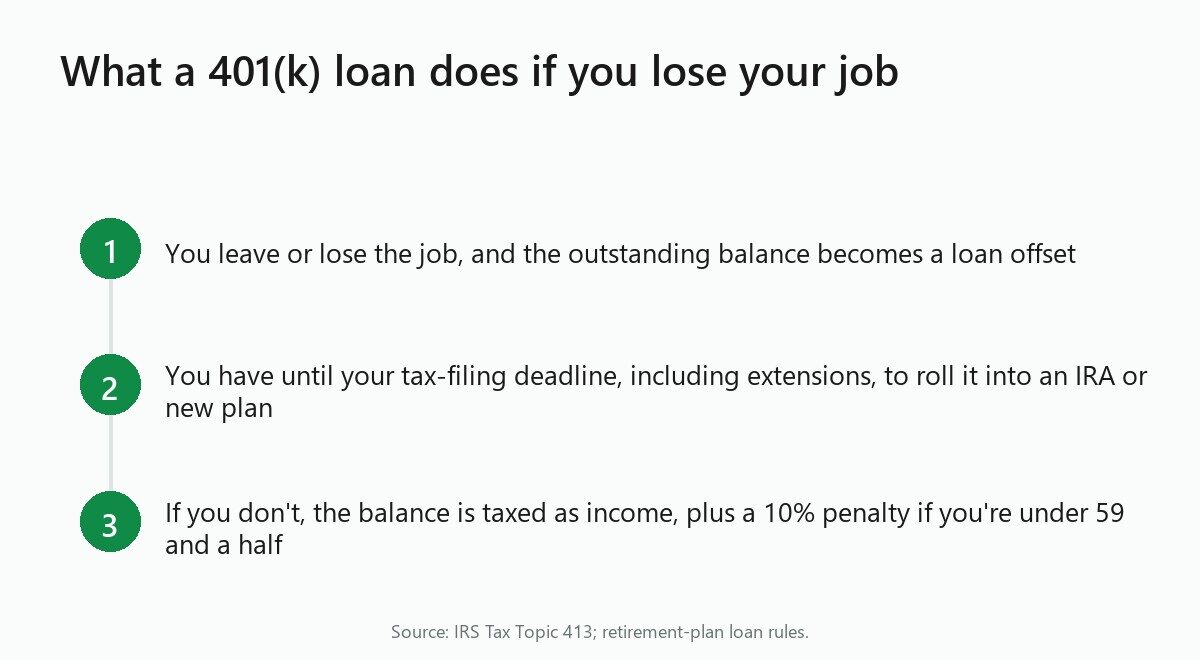
An outdated piece of financial advice still floats around the internet: the old rule gave you just 60 days to come up with the money and roll it into an IRA or a new employer's plan to avoid taxes. That rule changed. Under the Tax Cuts and Jobs Act, if your loan is offset because you left your job or your plan ended, you now have until the due date, including extensions, for your tax return for the year the offset happens, per the IRS's guidance on qualified plan loan offsets.
In plain terms: if you leave your job in the middle of the year with $8,000 still owed on your 401(k) loan, you generally have until the following April, or October if you file for an extension, to come up with $8,000 in outside cash and roll it into an IRA. Miss that window and the $8,000 becomes taxable income for that year, plus a 10% penalty if you're under 59 and a half (per IRS Tax Topic 413).
That extended deadline is a real cushion, but don't let it blur into a different, much less forgiving situation. A qualified plan loan offset only applies when your job separation or plan termination triggers the offset. If you're still employed and you simply fall behind on payments, the missed-payment consequence is a deemed distribution instead, and that one is immediate: it's taxed the year you miss the payment schedule, with no rollover window at all, extended or otherwise. Two different triggers, two very different outcomes, and it's easy to mix them up.
The practical takeaway: a short term 401k loan is only as safe as your job security. If layoffs are a live possibility in your industry, or you're already job hunting, that changes the math on borrowing against your retirement account in a way a payday loan's fixed repayment schedule simply doesn't.
Is a 401(k) Loan Really Taxed Twice?
You've probably heard the claim that a 401(k) loan gets "double taxed," and like most financial rules of thumb, it's half right. Sorting out which half matters, because it changes how you should weigh the real cost.
Start with the part that's true. Your loan payments, including the interest, come out of your paycheck as after-tax dollars. That's just how loan repayment works in general.
So the interest you pay yourself does get taxed twice in a narrow, real sense: once when you earn the income that funds the payment, and again years later when you withdraw that same interest from a traditional 401(k) in retirement, same as every other dollar in the account. It's a genuine quirk of borrowing from a pretax account with after-tax payments.
The other half of the claim is overstated. Your loan principal, the actual amount you borrowed, is not double taxed. It's taxed exactly once, at withdrawal, whether you ever took out a loan against it or not. Borrowing from your own balance doesn't create a second layer of tax on the money you borrowed.
That double-tax effect only touches the interest portion, and that portion is usually a modest amount relative to the loan itself, often just a few hundred dollars of interest on a $10,000 loan spread across the repayment period. It's a real cost. It's not the retirement-wrecking penalty the "double taxation" headline implies.
The Other Cost: Money Out of the Market
Taxes get most of the attention, but they aren't the whole picture. While your loan balance is out of your account and sitting in your bank instead, that money isn't invested. It's not earning whatever return the market delivers during your repayment period, and your interest payments to yourself may not cover what that money would have earned.

This is the cost nobody can hand you a precise number for in advance, because nobody knows what the market will do over your specific repayment window. What you can say for certain is that it's a real tradeoff: every dollar that leaves your account to cover an emergency is a dollar that stops compounding until you pay it back. A short payoff horizon limits how much growth you actually give up.
A five-year loan on a large balance gives up a lot more than a fast six-month payback on a small one. Think of it less as a fixed price tag and more as a dial you control through how quickly you repay.
401(k) Loan vs. Payday Loan: When Each One Wins
Neither option is automatically the right call. The honest answer depends on three things: how stable your job is, how fast you can pay the loan off, and what the alternative actually costs you in dollars.
Start with what a payday loan actually costs, since that's the number most people underestimate. The average storefront payday loan runs around $375, with a typical fee of $15 per $100 borrowed. On a standard two-week loan, that fee structure works out to roughly 391% APR, and the median borrower takes out about eight of these loans in a year, according to a CFPB payday loan factsheet. If you want the full breakdown of how a scary-looking APR translates into real dollars, that math is worth running before you sign anything.
A 401(k) loan wins when your job feels secure, your payoff window is short, and the interest rate you'd pay yourself genuinely beats what a payday or installment lender would charge. Under those conditions, you're trading a small, self-contained cost (some lost market growth, a bit of double-taxed interest) for a much larger one (391% APR compounding against you every two weeks). That's not a close call.
A 401(k) loan is the wrong move when your job feels shaky, when you're actively job hunting, or when your account balance is small enough that losing a chunk of it to an offset would set your retirement back years instead of months. In those cases, the job-separation risk from earlier in this article stops being a footnote and becomes the deciding factor. A credit union Payday Alternative Loan capped at 28% APR is worth checking first if you have access to one. So is asking your own employer whether it offers a hardship program or paycheck advance before you touch retirement money at all.
One more thing worth sitting with: if you're weighing this decision under real pressure, it's usually because you don't have much of a cash cushion to fall back on. Building even a small cash buffer, so you're not choosing between these two options the next time an emergency hits, does more for your long-term stability than picking the "better" loan this one time. And if you're already juggling other short-term loans alongside this decision, figuring out which one to pay down first matters just as much as which one to take out next.
A Quick Framework Before You Decide
Walk through these questions in order before you touch either option.
- How secure is your job over the next twelve months? If you have any real reason to expect a layoff or a departure, that alone should push you toward not touching your 401(k).
- Can you repay the full amount within a few months, not the full five years? Shorter payoff windows shrink both the opportunity cost and the job-loss risk.
- Have you already priced out the alternative? Run the actual APR on the payday or installment loan you're considering, in dollars, not just as a percentage.
- Have you checked whether your employer or credit union offers something cheaper first, like a hardship program, paycheck advance, or a capped-rate Payday Alternative Loan?
- Is your account balance large enough that losing part of it to a job-separation offset wouldn't meaningfully derail your retirement timeline?
If you answered confidently on most of these, a short term 401k loan is a reasonable, even smart, tool for the situation in front of you. If you hesitated on more than one or two, that hesitation is information. It usually means the payday or installment loan, expensive as it is, is the more contained risk of the two.
Frequently Asked Questions
Your outstanding balance is generally treated as a qualified plan loan offset against your account. Under current IRS rules, you have until your tax return's due date, including extensions, for that year to roll the offset amount into an IRA or a new employer's plan and avoid it becoming taxable income, per IRS Tax Topic 413 on plan loan offsets.
No. A 401(k) loan is money you borrow and repay with interest, and it stays in the plan as a receivable. A hardship withdrawal is money you take out and don't repay, and it's taxed as income in the year you take it. They're governed by different rules and used for different situations.
Only on the interest portion, in a narrow sense, since you pay it with after-tax paycheck dollars and then it's taxed again at withdrawal. The principal you borrowed is taxed exactly once, at withdrawal, the same as it would be if you'd never taken the loan at all.
Typically 50% of your vested account balance or $50,000, whichever is less. There is also a floor: if 50% of your balance comes out to less than $10,000, you can still typically borrow up to $10,000. Your plan can set a lower limit, or not offer loans at all, so check your plan document.
It depends on your job stability and payoff timeline more than anything else. With a secure job and a short repayment window, a 401(k) loan usually costs far less than a payday loan's roughly 391% APR. With an unstable job or a small balance, the job-separation risk can outweigh that savings.