


Somebody handed you a term you'd never heard before: flex loan. Maybe a lender's ad called it fast cash with no fixed payoff date. Maybe you're already three months into one and just noticed your balance barely moved. Either way, you want a straight answer about what a flex loan is, and you deserve one before you sign anything else.
Here's the short version, and then I'll walk you through the math so you can check it yourself. In Tennessee, a flex loan is a licensed, state-regulated open-end credit line. It's built under a specific law, and it carries a specific fee structure. That structure changes how your payments behave, in ways that surprise a lot of borrowers.
The products that confuse people most are the ones marketed as friendlier than they actually are. This is one of those.
What a Flex Loan Legally Is
In Tennessee, a flex loan is a product created by the Flexible Credit Act, Tennessee Code Title 45, Chapter 12, in force since January 1, 2015. The statute defines a "flex loan plan" as a written agreement establishing an open-end credit plan under which the lender expects repeated, noncommercial loans for personal, family, or household use (Tennessee Code § 45-12-102).
It may be unsecured or secured by personal property. It may carry no fixed maturity date, and you can prepay any part of it at any time without penalty.
Sit with that phrase for a second: "no fixed maturity date." A conventional installment loan tells you the day it ends. A flex loan doesn't have to.
It's a credit line, similar in structure to a credit card, and it stays open until you close it or the lender does. That's the entire legal identity of the product. The "flex" comes from Tennessee's Flexible Credit Act, and the name refers to the open-end structure of the line itself.
Under Tennessee's statute, a licensee running a flex loan plan cannot let your outstanding principal balance climb above $4,000 at any time (Tenn. Code Ann. § 45-12-111). That's a ceiling on the line, not a promise about what you'll actually owe day to day.
How the Draw-and-Repay Cycle Actually Works
You get approved for a credit line, say $1,500. You draw against it, maybe $500 to start. Each billing cycle, you owe a minimum payment. The statute requires that payment be enough to reduce your outstanding principal by at least 3% per calendar month (§ 45-12-111).
Pay the minimum, and the account stays open. You can draw against the line again later, sometimes before you've paid off what you already borrowed. That redraw feature is where things get complicated for a lot of borrowers.
Every dollar you draw resets part of the balance the fees are calculated against. A loan that should be shrinking can plateau, or even grow, if new draws outpace what you're paying down. The agreement doesn't have to carry a single payoff date printed on it, the way it would with a payday loan or a traditional personal loan. The account simply continues, cycle after cycle, until you either stop drawing and pay it down or you don't.
The Real Cost: What the Statute Actually Allows
This is the part that matters most, and it's spelled out in plain statutory text. Under § 45-12-111, a licensee may charge a periodic interest rate of up to 24% per year. On top of that, the statute permits a separate "customary fee," which is not legally classified as interest, capped at seven-tenths of one percent (0.7%) per day of your average daily principal balance in a billing cycle.
Read that daily cap again. It's not 0.7% per month. It's up to 0.7% every single day. Multiplied across a year, that fee alone works out to roughly 255.5%.
Add the 24% annual interest, and you get a combined effective rate that journalists covering this product have calculated at approximately 279.5% a year, reported by ProPublica and by Nashville's NewsChannel5. That 279.5% figure is journalism's arithmetic layered onto the verified statutory inputs. It isn't a number printed in the law itself, but the underlying 24% interest and 0.7%/day fee cap are direct statutory text.
One more detail worth knowing: Section 45-12-114 exempts flex loan licensees from Tennessee's general interest-rate and fee-limiting statutes, including the state's ordinary usury cap under Tennessee Code § 47-14-104. That exemption is a carve-out the legislature built into the law on purpose, when it created this product category.
A $500 Balance, Walked Through Month by Month
Numbers convince better than warnings, so let's build one you can check with a calculator. This example is a model built independently from the verified statutory rates above. It is not copied from any lender's disclosure or billing statement.
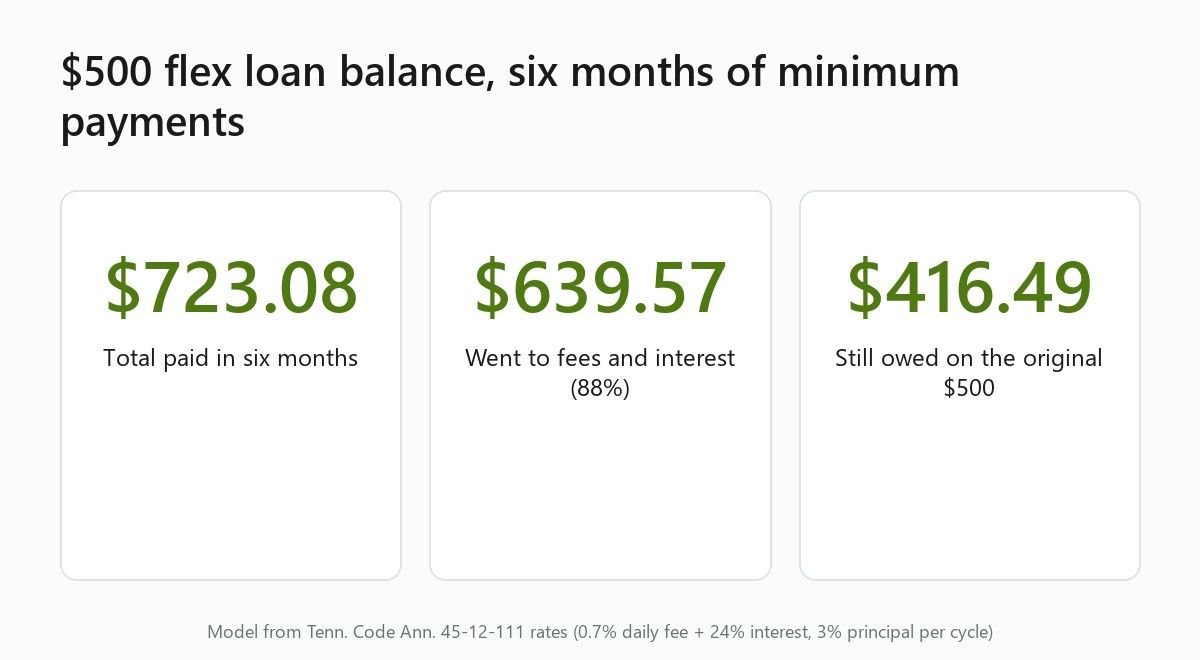
The model assumes 30-day billing cycles, no new draws, and that the lender charges the full finance charge (interest plus fee) each cycle on top of the required 3% principal reduction. Real billing will differ slightly on exact dates and rounding, but the order of magnitude holds.
Combine the daily fee (0.7%) with the daily interest (24% divided by 365, about 0.0658%) and you get a combined daily rate near 0.7658%. Over a 30-day cycle, that adds up to a finance charge of roughly 22.97% of the balance. Add the required 3% principal paydown, and here's what six months on a $500 balance looks like if you pay the minimum every time and never draw again.
Month one: you start at $500, the finance charge runs $114.87, and you pay 3% toward principal, or $15. Total minimum payment: $129.87. Your balance drops to $485.
The same pattern repeats every cycle after that. Month two takes the balance from $485 to $470.45, on a finance charge of $111.42. By month three, $470.45 drops to $456.34 on a finance charge of $108.08. Month four turns $456.34 into $442.65 on a $104.85 charge.
Month five takes the balance from $442.65 to $429.37, on a finance charge of $101.70. Month six brings it from $429.37 down to $416.49, on a final finance charge of $98.65 in this example.
Add it up. Over six months of on-time minimum payments, you paid $723.08 total. Of that, $639.57, which is 88%, went to interest and fees. Only $83.51 actually reduced your principal.
Your original $500 balance is still sitting at $416.49. At that pace, it would take well over two years of minimum payments alone to reach zero, and by then you'd have paid several times the original $500 in finance charges.
That trajectory lines up with what's already been documented in Tennessee. NewsChannel5 reported on borrower Malia Andrews, who described watching her payment get eaten alive: "Only like $20 of my payment was going to the principal and the rest was, like $300, was going towards the interest rate." She summed up her experience this way: "I just about had a complete meltdown in the car," and later added, "I will never do one again, never again."
Fort Campbell veteran Joshua Hause told the same outlet his existing balance was converted into a flex loan without any choice in the matter: "Everybody was moved into a flex loan account, there was no choice." He described the payments plainly: "If they're going to continue to get higher payments each month, I'll never get out of that hole."
ProPublica documented a larger, real case that tells the same story from a different angle. Borrower Rosita Hansen took a $2,050 flex loan, made on-time payments twice a month for ten months, paid over $6,600 total, and still owed nearly $3,000. The lender let her redraw principal as she paid it down, and each redraw reset the clock.
Different starting balance, same underlying mechanic. Under Tennessee's fee structure, most of each minimum payment goes to the daily fee and interest, and only the required 3% goes to the balance.
Flex Loan vs. Payday Loan: The Structural Difference
Advance Financial's CEO pitches "flex loan" as the friendlier cousin of "payday loan." The honest comparison comes down to how federal lending law classifies the two products.
Under Federal Regulation Z, the CFPB's Truth in Lending rule, open-end credit is defined as credit extended under a plan that contemplates repeated transactions on a revolving basis. Closed-end credit is everything that isn't that: a single advance, repaid in one shot or a fixed set of installments (12 CFR 1026.2). A flex loan is, by Tennessee statute, explicitly built as open-end credit. A traditional storefront or online payday loan is a single closed-end advance, due in full plus one flat fee on your next payday.
That distinction has real consequences. A payday loan has a built-in end date. You either pay it off or face the next fee.
A flex loan doesn't force that same reckoning. It just keeps billing, keeps accruing, and keeps offering you the chance to draw again, which is exactly what happened to Rosita Hansen: each redraw reset her clock before the balance could shrink.
If you want a deeper look at how APR math can mislead on a short-term loan, that comparison matters here too. A headline rate rarely captures what a revolving structure does to your total cost over time.
For context on scale, ProPublica noted that before the Flexible Credit Act existed, Tennessee payday lenders could lend at most $425, and a borrower could never be required to repay more than $500 on a single loan. Flex loans allow up to $4,000 outstanding, eight times the old $500 repayment cap.
Who's right about which product costs more? Advance Financial, Tennessee's dominant flex lender, has publicly defended its product through its CEO as "half the price of a payday loan." Diane Standaert of the Center for Responsible Lending calls flex loans "another name for a payday loan," both quoted by NewsChannel5.
I'm not going to referee that argument for you. Run the $500 example above against whatever payday terms you're comparing it to, and let the numbers tell you what they tell you.
What to Check Before You Sign
Before you put your name on a flex loan agreement, check three things straight off the disclosure. First, find the minimum payment amount and confirm how much of it goes to principal versus fees in the first cycle. Second, ask directly whether redrawing against the line resets your required principal reduction or extends your payoff timeline.
Third, confirm your state actually authorizes this exact product. This article covers Tennessee's Flexible Credit Act specifically. Other states may license similar open-end small-dollar products under different names and different rate caps, and none of that was verified here, so don't assume the numbers above travel across state lines.
If you have a thin credit file, it helps to know there is a second file lenders look at.
Get clear on what happens if a flex loan payment is missed before you sign anything. Advance Financial alone has filed more than 110,000 lawsuits against its own borrowers since introducing flex loans in 2015, according to ProPublica's reporting.
Where a Capped-Rate Alternative Might Fit
If what you actually need is $500 by Friday, a flex loan isn't your only door. If you belong to a credit union, or can join one, ask about a capped-rate alternative: credit union PALs, before you draw against an open-end line with a daily fee attached.
Buy-now-pay-later products get pitched as another way to bridge a short gap, and they're worth understanding on their own terms too, as another product structured differently than a traditional loan.
Before you sign anything that reopens itself every month, pull out that first billing cycle and check how much of your minimum payment actually reduces principal. If it looks anything like $15 on a $500 balance, you're looking at an open-ended line that expects to stay open.
Frequently Asked Questions
In Tennessee, a flex loan is an open-end, revolving credit line licensed under the state's Flexible Credit Act (Tenn. Code Ann. Title 45, Chapter 12). Unlike a traditional installment loan, it doesn't have to carry a fixed payoff date, and you can draw, repay, and redraw against it repeatedly.
Tennessee statute allows up to 24% annual interest plus a separate fee of up to 0.7% of your average daily balance, charged daily. Combined, journalists have calculated that this works out to roughly 279.5% a year, per statutory rates in Tenn. Code Ann. § 45-12-111.
No. Tennessee's statute builds a flex loan as open-end credit, which Regulation Z treats differently from a closed-end payday loan: a single advance due in full on your next payday. The structures differ even when the dollar amounts are similar.
Under Tennessee's statute, you draw against an approved credit line, make a required minimum payment each billing cycle large enough to reduce your outstanding principal by at least 3% per month, and can request additional draws later, as long as your outstanding balance does not exceed the statutory $4,000 cap.
No. The Flexible Credit Act is Tennessee-specific law. Other states may permit similar open-end small-dollar products under different names and different rate structures, but those weren't verified for this article, so don't assume the same terms apply where you live.