


Personify loans come with a number in front of you: a loan amount, a term, an APR that might be single digits or might be close to 180%. Before you click accept, read the offer the way you'd read a paycheck stub. Every line means something, and one of those lines determines whether you're paying this off in two years or still chasing it in five.
This walks through what Personify actually offers, where the company can legally lend to you, what a real offer costs over its full term, and what to check first if a cheaper door is still open.
What Personify Actually Offers
Personify Financial runs installment loans from $500 to $15,000, with two state-specific exceptions: Georgia borrowers see a range of $3,100 to $10,000, and Hawaii borrowers see $1,600 to $15,000, according to Personify's own rates, terms, and licensing information page. Terms run 12, 18, 24, 36, or 48 months, so you're choosing both a dollar amount and how long you stay attached to it. A shorter term on the same amount means a higher monthly payment but less total interest; a longer term stretches the payment down but keeps the balance, and the interest accruing on it, on the books longer.
The APR range is where it gets complicated, because Personify isn't one lender. It funds loans through two different channels, and each carries its own pricing tier. Loans made directly by Personify Financial or its bank partner, First Electronic Bank, run 36.00% to 179.50% APR. Loans made through what Personify calls "Participating Creditors," a separate referral tier, run 6.00% to 35.99% APR.
Put the two together and the company's published range spans 6.00% to 179.50%, per the same disclosure page. That gap between the low end and the high end is enormous, and which side of it you land on depends on your credit profile, your state, and which lending channel your application gets routed through. Two people borrowing the identical $3,000 for the identical 24 months can end up with monthly payments more than double each other, depending on where their offer lands in that range.
Personify also charges an origination fee of 5% to 5.99% of the loan amount, capped in Wisconsin at 5% of the financed amount or $175, whichever is lower. Personify's page doesn't specify whether that fee is deducted from what lands in your account or added to your balance, so it either shrinks what you receive or raises what you owe. Ask the lender directly which method applies to your offer before you sign anything.
Where Personify Lends
The company currently lends in 27 states: Alabama, Alaska, Arizona, Arkansas, Delaware, Florida, Georgia, Hawaii, Idaho, Indiana, Kansas, Kentucky, Louisiana, Michigan, Minnesota, Mississippi, Missouri, Montana, North Carolina, Ohio, Oklahoma, Rhode Island, Tennessee, Texas, Utah, Virginia, and Wisconsin, according to Personify's rate and licensing page cited above.
That list used to be longer. Personify's own page notes it no longer lends in New Mexico or South Carolina, but some older reviews and aggregator sites still list a 29-state footprint that includes both. If you're reading a comparison article that puts New Mexico or South Carolina on Personify's map, you're looking at outdated information.
Check the lender's own site before you trust any third-party summary, including this one, months or years from now. State lending rules shift, and companies pull out of markets when the math or the regulatory environment stops working for them. A state list is a snapshot, not a permanent fact, so verify it fresh each time you're actually reviewing an offer.
What Your Offer Actually Costs
Numbers on a screen don't feel real until you add them up. Here's a worked example using a $3,000 loan over a 24-month term, run at two points inside Personify's disclosed APR range. This is illustrative math, not a live quote. Your actual APR depends on your credit profile, your income, and your state, and it could land anywhere inside the ranges above.
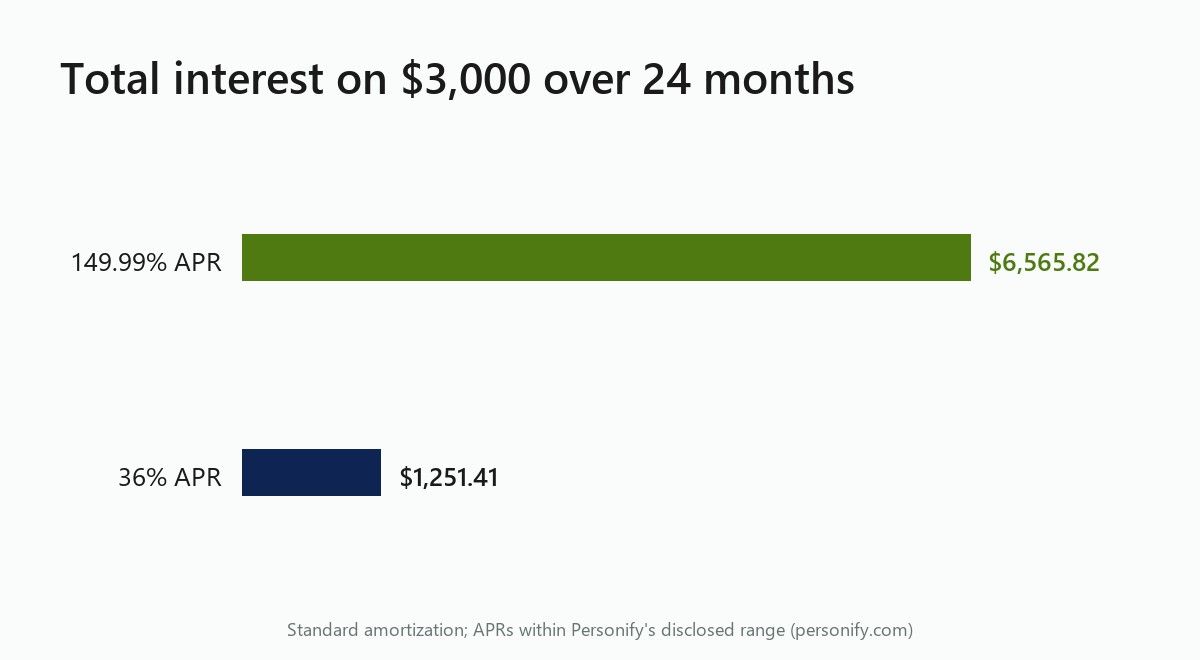
At 36% APR, roughly Personify's best available rate on its own direct-lending tier, a $3,000 loan over 24 months carries a monthly payment of $177.14. Over the full term you'd pay $4,251.41, meaning $1,251.41 of that is interest on top of the $3,000 you borrowed.
On the high end, at 149.99% APR, an illustrative point within Personify's disclosed 36% to 179.50% tier, the same $3,000 loan over the same 24 months carries a monthly payment of $398.58. Over the full term you'd pay $9,565.82, meaning $6,565.82 of that is interest, more than double the $3,000 you borrowed. Add principal and interest together and you'd repay more than three times the original loan amount.
These totals leave out the origination fee described above, since its treatment is unconfirmed; the true cost of your own offer will run higher than these numbers alone show.
Run this same math against your own offer. Take your principal, your term in months, and your quoted APR, and calculate the payment yourself, or ask the lender to show you the full amortization schedule in writing.
Why the Early Payments Barely Touch Principal
This is the part people miss until they're a year into the loan wondering why the balance hasn't moved. Installment loans amortize, which means every payment splits between interest and principal. At low APR, that split favors principal early and keeps favoring it. At an APR north of 100%, the math flips hard: in the first several months, most of your payment covers interest that's accruing on the full remaining balance, and only a small slice actually reduces what you owe.
Here's what that looks like on the numbers from the worked example above. At 149.99% APR, the monthly interest rate works out to about 12.5%. On a $3,000 balance, that's about $374.98 in interest due in month one alone. Your $398.58 payment covers that interest first, leaving only about $23.60 to knock down the principal.
Compare that to the 36% APR version of the same loan: month one interest is about $90.00 against a $177.14 payment, so roughly $87.14 goes to principal right away. That's nearly four times as much progress on the same starting balance, in the same first month, just because the rate was different. Carry that gap across a full 24-month term and it's the difference between roughly $1,251 in total interest and roughly $6,566, on the exact same $3,000 borrowed.
Online reviews for Personify frequently include a version of this complaint: borrowers who've paid thousands of dollars toward a loan and watched the principal drop by only a fraction of that. Treat this as reviewer sentiment, unverified as a specific case, but the pattern lines up exactly with how amortization behaves at a triple-digit APR. It's the structure working as designed, and it rewards the lender first for a long stretch of the term.
If you're staring at a high-APR offer and the payment feels manageable but the total feels wrong, trust the total. A payment that fits your budget this month can still leave you years away from actually owning less debt than you started with.
What Approval and Funding Actually Look Like
A recurring positive theme in borrower reviews is speed: a fully online application, a fast decision, and funding that can land as soon as the next business day. If your Personify offer came together in a single sitting online, that matches the pattern reviewers describe, and it's a real convenience if you're facing a hard deadline like a car repair bill or a rent due date.
Speed and cost are two separate questions, though, and answering the first one well doesn't answer the second. A loan that funds fast can still carry an APR that costs you thousands more than a slower option would. Before you let next-day funding decide the question for you, run your own numbers the way this article just did with the $3,000 example, and see which same-day loans actually fund that fast without the highest-APR markup, then weigh that total against the one-month PAL I membership wait covered below.
Cheaper Alternatives to Try First
Before you sign a Personify offer sitting anywhere near the high end of its range, check whether a cheaper door is still open. You may have more time than you think, and a few phone calls can save you thousands over the life of the loan.
Credit union payday alternative loans
Federal credit unions can offer a Payday Alternative Loan, known as a PAL. A PAL I runs $200 to $1,000, caps its APR at 28%, limits the application fee to $20, and requires you to have been a credit union member for at least one month, according to the federal credit union lending regulation that created the program. A PAL II raises the ceiling to $2,000 with the same 28% APR cap and a term of up to 12 months, under that same regulation.
Compare 28% against a Personify offer sitting at 100% or higher, and the gap explains itself. If you can join a credit union, spend the month building membership for a PAL I before you take a much more expensive loan. Read up on a credit union Payday Alternative Loan capped at 28% APR to see how the application process works and whether you qualify.
Beyond PALs, credit unions sometimes carry other small-dollar products for members with damaged credit. Our guide on what else a credit union can offer with bad credit covers what to ask for and how underwriting differs from an online lender's.
If a credit union isn't an option where you live, it still pays to shop your offer against other direct lenders before you commit. See how other direct-lender installment loans compare for a side-by-side look at terms and fees.
And if your Personify offer sits toward the lower end of its amount range, closer to $2,000 or $3,000, look at the real cost of a $2,000 bad-credit loan so you can compare your specific offer against a realistic field instead of accepting the first number you see.
How to Read Any Offer Before You Sign
Whatever lender you end up with, three numbers matter more than the marketing around them: the APR, the total you'll pay over the full term, and the origination fee. Ask for all three in writing. Any lender should be able to show you a full amortization schedule detailing how much of each payment goes to interest versus principal, month by month; if a lender hesitates to produce one, take that as a signal.
Your credit profile drives where you land inside any lender's published range. Paying down a card balance or correcting an error on your credit report before you apply can shift you into a lower tier. Bad credit doesn't lock you into the worst number on the page. It just means you have to work a bit harder to land somewhere better on it.
One more habit worth building before you accept any offer: get a second one. Apply with at least one credit union or another direct lender alongside Personify, using a soft-check prequalification where it's available, and set the two total costs side by side. A five-minute comparison against a real competing number does more for your wallet than any amount of reading about APR in the abstract, because it shows you exactly what this specific lender is charging you to skip the extra step. Even a partial offer, a preapproval range instead of a final number, is enough to tell you whether the Personify offer in front of you sits near the 28% credit union ceiling or up near Personify's own 179.50% high end.
Frequently Asked Questions
Personify's own rate and licensing page doesn't publish a minimum credit score. It prices loans across a wide APR range, so your specific offer depends on your credit profile, income, and state, not a single published cutoff.
Personify currently lends in 27 states, listed on its own rates and licensing page. It no longer lends in New Mexico or South Carolina, so check the company's current list directly rather than trusting an older review that may still include those two states.
The company's disclosure page confirms a 5% to 5.99% origination fee (capped in Wisconsin) but doesn't state whether it's deducted from your disbursement or added to your balance. Ask the lender directly which method applies before you sign, since it changes what you actually receive.
Ask directly before signing whether paying early reduces the total interest you owe or whether the loan carries a prepayment penalty, since that answer changes how much a shorter payoff timeline actually saves you. Personify's rates page doesn't address this.
For most borrowers, yes, on cost. A PAL caps APR at 28% versus Personify's range up to 179.50%. The tradeoff is smaller loan amounts ($200 to $2,000 across the two PAL types) and a membership requirement, so it depends on how much you need and whether you can join a credit union first.